
Reviewed · WALKING TOURS
Mostar Private Walking Tour – where East meets West
Mostar’s story comes into focus as you walk from the Old Bridge to the former front line, then onward through Ottoman lanes and Austro-Hungarian streets. This private tour connects the city’s famous views with the harder stories behind them, including the recent war and Mostar’s divided past.
I like the visit to the jumpers’ club, where you can learn about the old tradition of leaping from the bridge. I also like the way the walk includes both the romantic Crooked Bridge and the more sobering Spanish Square, giving you more than a postcard view of town.
The main drawback is its short length. Two hours is enough for an excellent introduction, but not enough for a slow museum visit or a thorough look inside every monument. Entrance fees to the mosque and bell tower are extra, and the tour requires at least two people.
Key points at a glance
- Old Bridge and jumpers’ club: Hear the story of Mostar’s best-known monument and visit the premises of the local jumping club.
- East meets West on foot: Move from Ottoman-era streets and bazaars to Austro-Hungarian buildings and modern wartime memorials.
- Private English-language guiding: Your group gets a guide’s attention rather than joining a large walking crowd.
- A clear look at the 1990s conflict: Spanish Square and the former front line add necessary context to the city.
- Best Old Bridge photo point: The minaret of Koski-Mehmed Pasha Mosque offers a high view, for an additional fee.
- Short, focused format: The two-hour route suits a first look at Mostar, especially if your time is limited.
Why this short walk explains Mostar so well
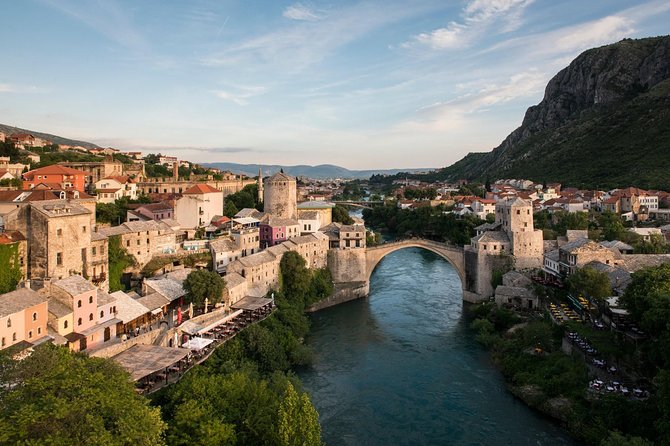
Mostar is not a city you understand from one bridge photograph. The Old Bridge is the grand symbol, but the city’s character comes from the meeting of several eras and faiths along a compact walking route.
You begin near the Franciscan Church, then move toward the Neretva River and the old Ottoman quarter. From there, the walk crosses into streets shaped by Austro-Hungarian rule and reaches places tied to the 1990s war. That change of setting is the real strength of the experience.
I like this arrangement because you do not spend two hours looking only at old stones. You see workshops, religious buildings, parks, bridges, and memorial spaces. The guide also gives you the local background needed to understand why Mostar feels both connected and divided.
The tour is private, so you can ask questions as they arise. That matters here. Mostar’s past includes religious, political, and military subjects that can be hard to grasp from a short guidebook paragraph. A local guide can put the places in front of you into a sensible order.
The pace is described as comfortable, with several brief stops. You should expect a walking introduction rather than a full-day study of the city. That makes it a good first activity after arrival, when you want to get your bearings fast without using half your day.
A few more Mostar trips to weigh up
- Mostar Private Walking Tour
★ 5.0 · 93 reviews - Charming Mostar: Private Mostar Walking Tour
★ 5.0 · 23 reviews - Best of Mostar – Private Walking Tour
★ 5.0 · 21 reviews
The Old Bridge and a centuries-old tradition
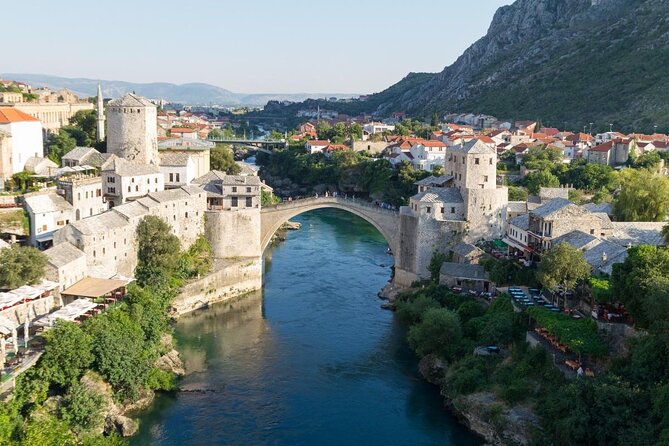
The Old Bridge is the main event, and the tour gives it proper attention. Your accredited guide explains the monument’s important facts and stories, then introduces you to the tradition of bridge jumping.
The special touch is a visit to the premises of the local jumpers’ club. This is more personal than simply standing at the riverbank and watching the bridge from below. You get a chance to learn about the people connected with the jumps and the long tradition of making the leap from this UNESCO-listed monument.
The stop lasts about 20 minutes and has no admission fee. That is enough time for an explanation, photographs, and a look at the bridge without turning the visit into a rushed photo stop.
Keep your expectations sensible. The tour does not promise that you will see a jump take place, and no jumping performance is included in the stated program. The value is in meeting the club connection and understanding why the bridge has such a strong place in local culture.
The bridge also gives you a first lesson in Mostar’s geography. The Neretva cuts through the old town, and the steep riverbanks help explain why bridges have always mattered here. From the bridge, you can look into the old quarter on one side and toward later city districts on the other.
Crooked Bridge and the Radobolja
The next stop is the Crooked Bridge, or Kriva Cuprija. It is a small, curved stone bridge over the Radobolja River, a tributary of the Neretva.
You have about five minutes here, mainly for photographs and a short story about the bridge, sometimes called the bridge of love. Its smaller scale gives you a pleasant contrast with the Old Bridge. The setting is quieter and more intimate, with the water adding a softer mood to the walk.
This is a quick stop, so do not expect a long historical talk or time to linger. Still, it earns its place because it shows another side of old Mostar. The city’s charm is not limited to its most famous monument.
Kujundziluk, Mostar’s oldest bazaar
From the bridges, you continue into Kujundziluk, the oldest bazaar in Herzegovina. This is where the tour shifts from monuments to daily craft traditions.
Your guide introduces you to old trades and to families who have made authentic handicrafts for generations. You can talk with local artisans and see how the bazaar remains tied to personal skill and family work rather than being only a row of souvenir shops.
I like this part because it gives you people to remember, not just buildings. The hospitality of the shopkeepers and makers is presented as an important part of the region’s character. You may find the pace here more relaxed than at the bridge, though the stop lasts about 20 minutes.
As with any historic bazaar, you should be ready for commercial attention. The tour gives you context for the crafts, but it does not include purchases. If you want to buy something, you will need to judge quality and price for yourself.
Same country, a completely different kind of day:
- Dubrovnik: Kravica Waterfalls, Mostar and Pocitelj Day Trip
★ 4.5 · 3,045 reviews - From Mostar: Blagaj, Počitelj & Kravice Waterfalls Day Tour
★ 5.0 · 1,310 reviews - From Mostar: Kravice Waterfalls, Blagaj, & Počitelj
★ 5.0 · 565 reviews - Herzegovina Day Tour from Mostar: Blagaj, Pocitej, Kravice falls (Join Us! :D)
★ 5.0 · 372 reviews
Koski-Mehmed Pasha Mosque and the best bridge view
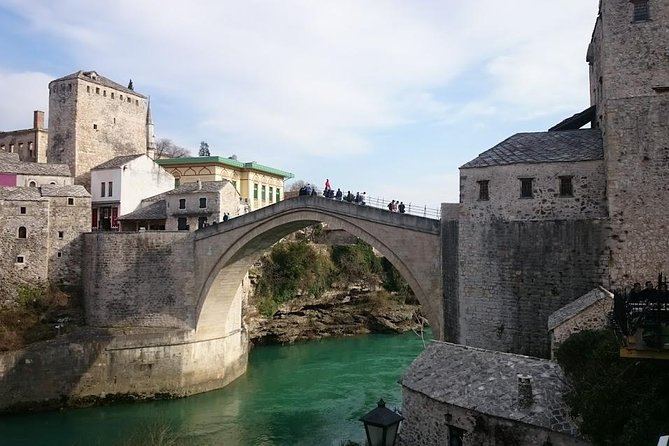
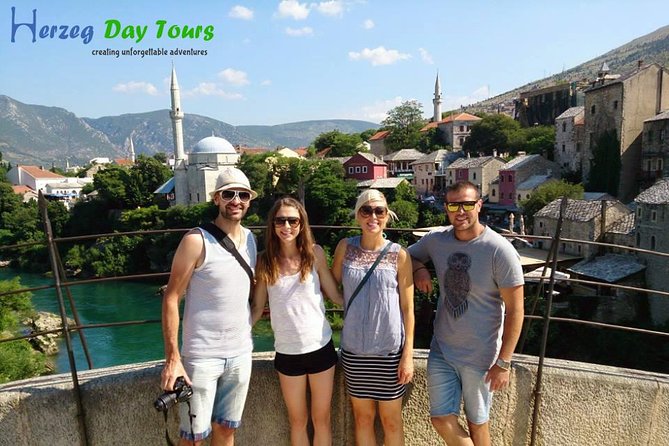
The Koski-Mehmed Pasha Mosque sits high above the Neretva and is one of the most memorable stops on the walk. The tour includes a visit to the mosque, with the option to climb its tall minaret for a famous view of the Old Bridge.
This is one of the few mosques in Bosnia and Herzegovina where tourists are allowed to enter and climb the minaret. From above, the bridge, river, and old town line up in a way that makes the city’s shape easy to understand.
The stop lasts around 15 minutes. Admission is not included, so you should plan for an additional entrance charge. The provided information does not state the current fee, so check the amount at booking or before arrival if your budget is tight.
Dress and behave respectfully in this religious setting. The information supplied does not give a specific dress code, but modest clothing is the sensible choice for any mosque visit. The climb may also matter if you dislike narrow or steep stairs, though no accessibility details are provided.
If you want one strong Old Bridge photograph, this is likely the place to focus your camera. You should also allow a little time to enjoy the view rather than taking only a quick snapshot.
Crossing from Ottoman Mostar to Austro-Hungarian Mostar
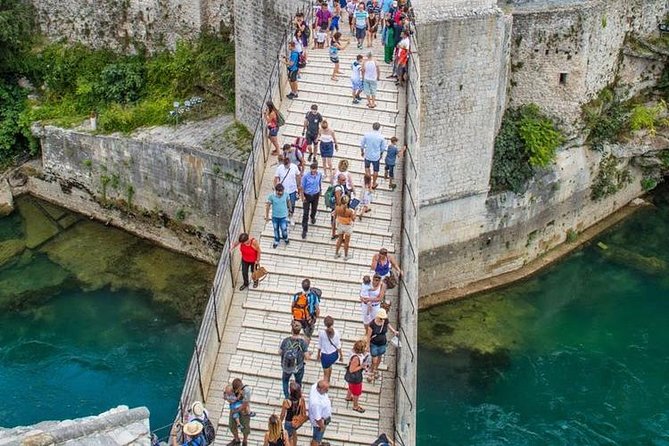
The walk then crosses one of Mostar’s attractive Austro-Hungarian-era bridges and heads toward a more romantic part of town, with parks and older buildings.
This transition is important. Mostar is often described as the place where East meets West, but that phrase works only when you can see the change in the streets. The Ottoman quarter has a different feel from the later European-style districts, and the tour lets you walk between them rather than treating them as separate attractions.
The route continues across Bulevar, a major road that served as the former front line during the last war. Here the tone changes. Mostar’s war is not a side note that you can politely skip. It shaped buildings, neighborhoods, families, and the city’s political life.
Your guide discusses this difficult period as part of the walk. One guide has been praised for giving a first-hand account of the conflict and for explaining the events that led to it. That personal connection can help make the subject more understandable, though the exact guide assigned to your booking is not named.
Spanish Square and the former front line
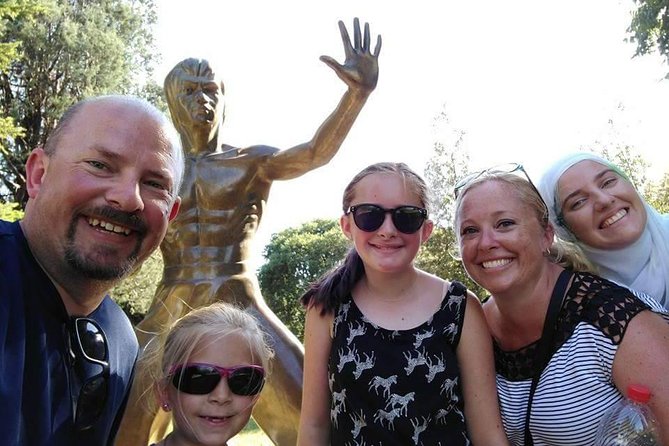
Spanish Square was opened by King Juan Carlos of Spain to honor Spanish soldiers who died while serving with United Nations peacekeeping forces. The stop lasts about five minutes and has no admission charge.
It is a brief visit, but the location carries weight. The square sits near the former front line, so the guide can connect the memorial to the wartime division of Mostar. You will not get a full military history in five minutes, but you will gain a clear reason to look beyond the preserved old town.
This is also where I would pay close attention to the guide’s explanation rather than rushing for photographs. The city’s recent past can be politically sensitive, and a calm local account is more useful than a simple list of dates.
The tour’s strength is that it does not pretend Mostar is only a pretty medieval town. You get beauty and discomfort in the same walk. That balance makes the visit more honest.
Park Zrinjevac and the Austro-Hungarian promenade
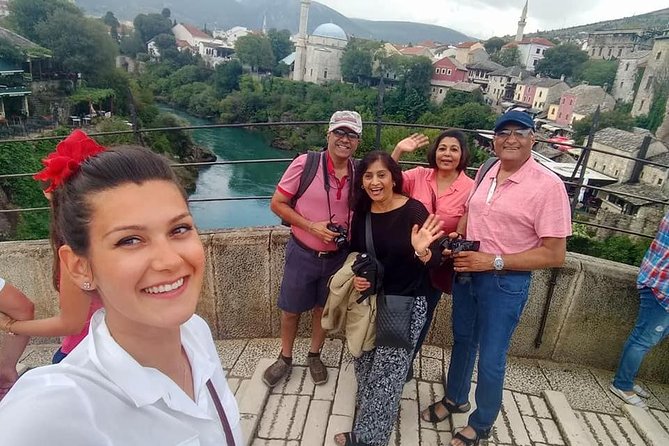
Next comes Park Zrinjevac, reached by way of Stefania’s promenade. The route passes some of Mostar’s finest Austro-Hungarian buildings and villas, including examples of pseudo-Moorish design.
This part gives you a break from the tight lanes of the old bazaar. The park is described as the largest and most beautiful in Mostar, and the walk explains how public parks were used as cemeteries during the war.
That detail is especially striking because it changes how you look at a pleasant green space. A park is not always just a place for shade and strolling. In a city marked by conflict, even an ordinary public area can carry a painful story.
You spend about 15 minutes here. The stop should appeal to anyone interested in architecture, urban design, or the way cities adapt during crisis. It also gives the walk some breathing room before the final stop.
The Peace Bell Tower and a multicultural ending
The Mostar Peace Bell Tower closes the route. The tower is presented as a fitting place to discuss the city’s multicultural character.
Admission is not included, and the stated information does not give the current entrance fee. The stop lasts about five minutes, so the emphasis is on the tower’s meaning and the surrounding city rather than a long interior visit.
Ending here works well. You have already seen religious sites, old bridges, craft streets, war memorials, and later European architecture. The bell tower brings those threads back to the question of how different communities share a city with such a complicated past.
The activity ends back at the starting meeting point near the Franciscan Church. That return is useful if you have left a bag at your hotel or want to continue exploring from the same central area.
What the two-hour format is really worth
No price is provided, so I cannot judge the exact cost in currency. The value depends on how much you want a private guide, not on the number of attractions alone.
For two or more people, a private tour can make sense because the guide’s attention stays with your group. You are not paying only for a route. You are paying for local explanation, questions answered on the spot, and access to the jumpers’ club premises.
The tour also saves you planning time. Mostar’s sights are close enough to walk, but their meaning is not always obvious. The guide links the Ottoman quarter, Austro-Hungarian district, religious buildings, and wartime sites into one story.
There are extra costs. Entrance fees for the mosque and Peace Bell Tower are not included, and museum or monument fees in general are excluded. Since the tour lasts about two hours, you may also want to budget for a separate visit to any site where you wish to stay longer.
The format suits a couple, family, or small group that values privacy and a focused introduction. It is less suitable if you want a long shopping session, several interior visits, or a full explanation of every museum in Mostar.
Practical details before you book
The tour is offered in English and includes an experienced local guide. Hotel pickup and drop-off are highlighted, but the detailed meeting information gives a start and end at the Franciscan Church in Mostar, Franjevačka 1. Confirm the pickup arrangement when you book so you know where to meet.
A mobile ticket is available. Confirmation is sent at the time of booking. The stated operating period runs from December 19, 2025, through December 18, 2026, daily from 9:00 a.m. to 6:00 p.m.
At least two people are required per booking. Children must be accompanied by an adult, and most people can take part. The information does not provide specific accessibility details, so ask before booking if stairs, the minaret, or walking on uneven old-town streets could be a concern.
The cancellation rule is strict. This experience is non-refundable and cannot be changed for any reason, so book only when your plans are firm.
Who should book this Mostar walk
I would choose this tour if you want Mostar to make sense quickly. It suits a first visit, a short stay, or a day when you want a local introduction before exploring alone.
It is especially useful for you if:
- You want the Old Bridge explained rather than simply photographed.
- You are interested in the Ottoman and Austro-Hungarian sides of the city.
- You want a direct explanation of the 1990s conflict.
- You prefer a private group and English-language guiding.
- You are comfortable paying extra for selected monument entrances.
- You can manage a walking route that includes a high minaret option.
I would look elsewhere if you want a slow, museum-heavy day or a tour with all admission fees included. The pace is focused, and some stops are only five minutes long.
Should you book the Mostar Private Walking Tour?
Book it if you want a compact, serious introduction to Mostar that balances the Old Bridge with local crafts, religious heritage, architecture, and wartime memory. The strongest parts are the jumpers’ club connection, the minaret view, and the guide’s ability to explain the conflict in local terms.
Skip it if your priority is free time, shopping, or long visits inside monuments. For most first-time visitors with two hours to spare, though, this is a useful way to see why Mostar is more than a beautiful bridge and a scenic river.
FAQ
How long does the Mostar Private Walking Tour last?
The tour lasts approximately two hours.
Where does the tour start?
It starts at the Franciscan Church in Mostar, at Franjevačka 1.
Where does the tour end?
The activity ends back at the meeting point.
Is the tour private?
Yes. Only your group participates in the private activity.
What language is the tour offered in?
The tour is offered in English.
Is hotel pickup and drop-off available?
Hotel pickup and drop-off are listed as features, while the detailed meeting information gives the Franciscan Church as the start and end point. Confirm the pickup arrangement when booking.
Is the Old Bridge visit included?
Yes. The guide explains the Old Bridge and its stories, and the tour includes a visit to the premises of the local jumpers’ club. No admission fee is listed for this stop.
Can you climb the minaret at Koski-Mehmed Pasha Mosque?
Tourists are allowed to enter the mosque and climb its high minaret. The admission fee is not included.
Are entrance fees included?
No. Fees for museums and monuments are not included. The mosque and Peace Bell Tower specifically show admission as not included.
Can children join the tour?
Yes, children can participate, but they must be accompanied by an adult. A minimum of two people is required for each booking.
Can the booking be cancelled or changed?
No. The experience is non-refundable and cannot be changed for any reason.
Just added around Mostar
- Mostar Old Town Walking Tour – Best Seller★ 5.0 · 4 reviews
- Stolac, the crossroads of civilisations, private walking tour.★ 5.0 · 9 reviews
- Neretva kayak canoe safari★ 5.0 · 12 reviews
- Private Transfer from Mostar to Split★ 5.0 · 3 reviews
- Mystical Sutjeska National Park★ 5.0 · 3 reviews
- Private Transfer Mostar–Dubrovnik English Speaking Local Driver★ 5.0 · 13 reviews
- Mostar gastro and historical treasures★ 5.0 · 6 reviews
- Mostar War Heritage Walking Tour★ 5.0 · 6 reviews
Walking Tours, compared.
Private Walking Tour, Food Tasting and Bosnian Coffee in Sarajevo
Read our review →
PROFESSIONAL SARAJEVO WALKING TOUR – With guide who guided STING!
Read our review →Browse the lists this tour appears in