
Reviewed · WALKING TOURS
Discover Sarajevo Walking Tour with Local Guide
Sarajevo’s story comes into focus as you walk from Ottoman lanes to Austro-Hungarian facades, passing mosques, churches, a synagogue, a covered bazaar, and the bridge tied to the start of World War I. The city’s famous Meeting of Cultures marker is not just a photo stop. It neatly sums up Sarajevo’s place between East and West.
I like the compact two-hour route, which gives you a useful first look without taking half a day. I also like the local guiding style described by visitors who joined Samira, Enes, Layla, and Senka. Enes is praised for humor and excellent English, while Samira is known around the Old Town and adds a personal sense of community.
The main consideration is that this is a fast overview. Most stops receive about 10 minutes, and several list admission as extra, so you should not expect a long museum visit or detailed interior tour at every landmark.
Key points before you book
- The route crosses several centuries: Ottoman mosques and bazaars meet Austro-Hungarian buildings, Orthodox and Catholic churches, and Jewish heritage sites.
- The Latin Bridge adds serious historical weight: You learn about the 1914 assassination of Archduke Franz Ferdinand and Sophie.
- Guides may include Samira, Enes, Layla, or Senka: Their strengths include local stories, humor, cultural context, and practical advice.
- The price is unusually low: At $12.07 per person, the tour offers a cheap way to get your bearings in central Sarajevo.
- Bottled water is included: A small perk, but useful during a two-hour walk.
- Entry fees are separate: Several sights are listed with admission not included, so budget extra if you plan to go inside.
Why this two-hour Sarajevo walk works
I see this experience as an orientation tour rather than a full historical study. In a short stretch, you move through Baščaršija, cross into the Austro-Hungarian part of the center, and return to the city’s central meeting point.
That change in architecture is the real star. Sarajevo is not a city where history sits in one fenced-off quarter. Ottoman buildings, Austro-Hungarian civic architecture, Islamic places of worship, Christian churches, Jewish heritage, and commercial streets share the same walkable center.
The route also gives your guide room to explain how these traditions live side by side. A good guide can turn a list of buildings into a clear picture of Sarajevo, and that is where the strongest feedback points. Enes is praised for combining historical detail with humor and a strong command of English. Samira is described as friendly, personal, and closely connected to the Old Town community.
The group can reach a maximum of 20 people. That is large enough to keep the price low, but small enough that the guide should be able to speak to the group without a microphone. The actual feel may vary with the day’s booking numbers.
A few more Sarajevo trips to weigh up
- Sarajevo: Grand Walking Tour Through Time and Cultures
★ 4.8 · 1,236 reviews - Sarajevo: 2 Hours Old Town Walking Tour With Local Guide
★ 5.0 · 505 reviews - Private Walking Tour, Food Tasting and Bosnian Coffee in Sarajevo
★ 5.0 · 255 reviews
Starting on Ferhadija and finding the meeting point
The walk begins at the Info Bosnia Tourist Information Center. The directions identify the starting spot as being on Ferhadija, Sarajevo’s main pedestrian street, beside the Sarajevo Meeting of Cultures marker. The formal meeting-point address is Velika avlija, Laure Papo Bahorete 2.
Because both a landmark and an address are provided, I would check the confirmation carefully before setting out. Look for the Info Bosnia Tourist Information Center and the Sarajevo Meeting of Cultures sign. The tour ends back at the meeting point, which makes it easy to continue exploring central Sarajevo afterward.
The activity is offered in English, and confirmation is provided when you book. You need a moderate level of fitness. This is a city walk, not a strenuous hike, but you should be ready to stay on your feet for about two hours.
Smart-casual dress is requested. That matters most because the route includes religious buildings. The tour supplies a bottle of water, while food and other drinks are not included.
Gazi Husrev-beg Mosque and the Ottoman heart
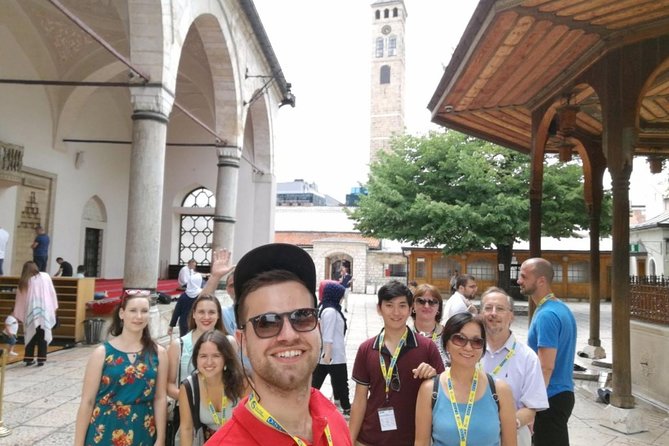
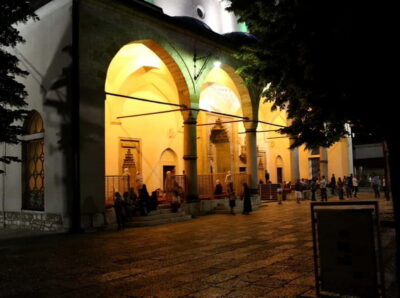
The first major stop is Gazi Husrev-beg Mosque, the central building of Gazi Husrev-beg’s charitable foundation, known as a waqf. Built in 1530 and 1531 in an Early Istanbul style, it is the largest historic mosque in Bosnia and Herzegovina.
Your guide can point out the scale of the building: the dome rises 23 meters and the minaret reaches 45 meters. The mosque also has an unusual place in Sarajevo’s modern history because it was the first mosque in the world to be lit by electricity.
The stop is scheduled for about 10 minutes. Admission is not included, so do not assume the walk automatically includes a full interior visit. Use this part of the tour to learn what the mosque meant as part of a wider charitable complex, not simply as a photogenic building.
If you want more time for the mosque, bazaar, and nearby streets, mark the location and return after the walk. Ten minutes is enough for an introduction, but not for a slow architectural study.
Morica Han and the old caravan route
Morica Han is Sarajevo’s only surviving caravanserai. It was first built in 1551 as part of Gazi Husrev-beg’s endowment, providing rooms for people and space for horses along the trading routes that passed through the city.
The original complex had 44 guest rooms, space for as many as 300 people, and room for 70 horses. It burned in 1957 and was restored between 1971 and 1974. That detail gives the courtyard extra meaning. You are not looking at an untouched medieval building, but at a place that was repaired so its role in Sarajevo’s commercial past would not disappear.
Admission is free, and the visit lasts about 10 minutes. This is one of the more useful stops for understanding how Sarajevo functioned. The city was not only a place of prayer and government. It was also a busy stop for merchants, animals, goods, and long-distance trade.
Same country, a completely different kind of day:
- Sarajevo: Mostar, Konjic, Blagaj Tekke, Pocitelj & Waterfall
★ 4.9 · 1,666 reviews - Fall of Yugoslavia, Sarajevo War Tour with Tunnel of Hope Museum and Frontlines
★ 5.0 · 1,314 reviews - Sarajevo: Mostar, Konjic, Sufi House, Pocitelj & Kravice Falls
★ 5.0 · 1,179 reviews - Sarajevo: Tunnel Museum Yugoslavia War Tour with War Veteran
★ 5.0 · 1,111 reviews
Sebilj Fountain and Baščaršija’s pigeon square
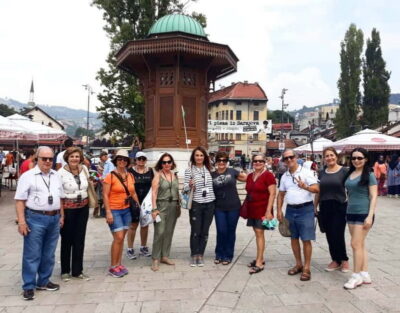
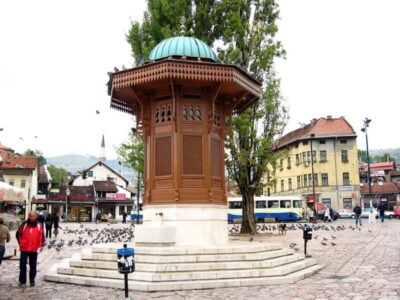
The Sebilj is the familiar Neo-Ottoman fountain at the center of Baščaršija. Its stone-and-wood form has become one of Sarajevo’s best-known city images, and the open area around it is often called the Square of Pigeons.
The first Sebilj was built by Mehmed Pasha Kukavica in 1753. The fountain you see today was relocated by Austrian architect Alexander Wittek in 1891. That combination of Ottoman design and later Austro-Hungarian intervention is typical of Sarajevo, where layers of power and style overlap in a small area.
The stop is free and lasts about 10 minutes. You will likely encounter plenty of activity around the fountain, so listen closely when the guide explains the details. This is a good place to pause for photographs, but the guide’s explanation gives the landmark more value than the picture alone.
Kazandžiluk, Sarajevo’s copper street
Kazandžiluk is Sarajevo’s famous coppersmith street. It offers a quick look at the city’s craft tradition and gives the walking tour a more human scale after the larger mosque and fountain.
The street is not presented as a formal museum stop. Its value comes from seeing how a traditional trade fits into the old commercial quarter. Your guide can help you notice the link between craft, bazaar life, and the wider Ottoman layout of Baščaršija.
The scheduled visit is about 10 minutes and admission is free. If you enjoy handmade goods, keep this street in mind for a return visit. The pace of a group walk may not allow much time to browse.
Sarajevo City Hall and Austro-Hungarian ambition
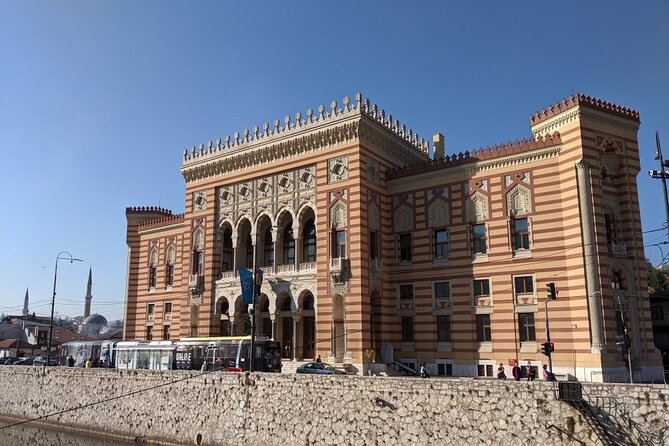
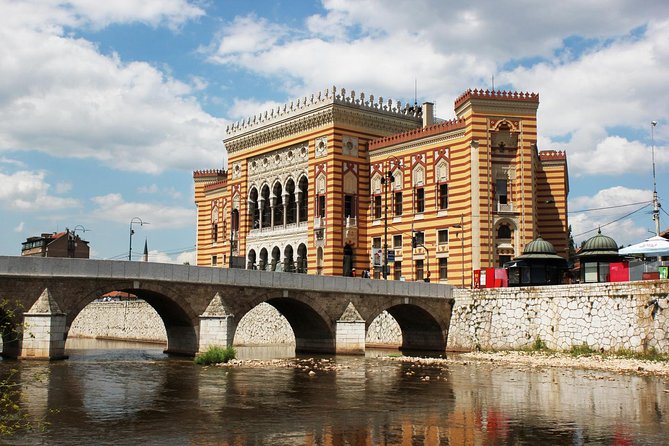
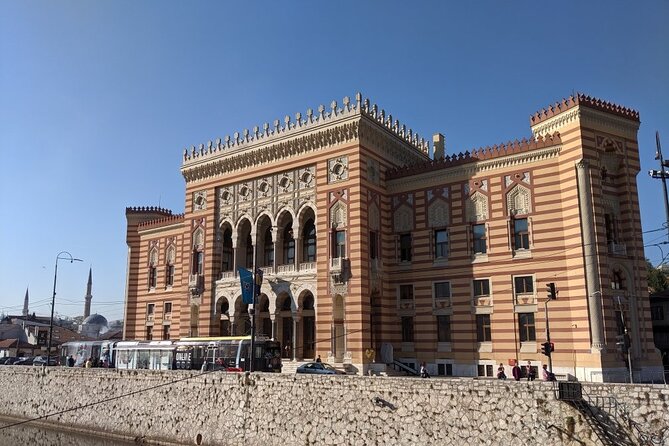
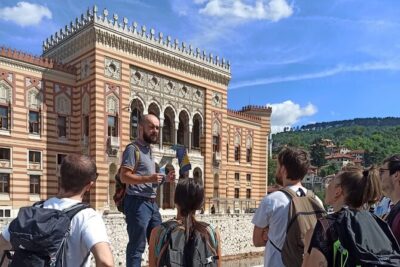
Sarajevo City Hall, completed in 1896, is the most representative building from the Austro-Hungarian period on this route. Its Neo-Moorish design draws on Islamic art from Spain and North Africa, making it a striking example of how imperial architecture borrowed visual ideas from other parts of the world.
This building is important because it complicates the simple idea that Ottoman and Austro-Hungarian Sarajevo are separate worlds. The city hall uses a European imperial project to present an architectural language associated with Islamic culture.
Admission is not included, and the stop lasts about 10 minutes. That likely means a concise explanation and exterior viewing unless you arrange entry separately. If the interior matters to you, treat this tour as a way to identify the building, then plan a separate visit with more time.
Emperor’s Mosque beside the river
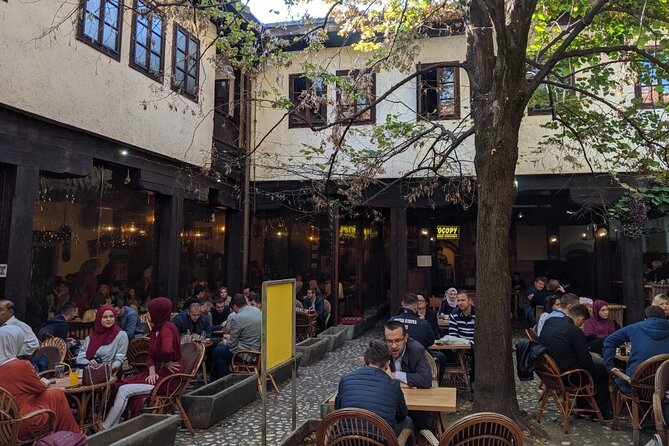
The Emperor’s Mosque was the first mosque built in Sarajevo by Isa-bey. It brings the walk back to the city’s Ottoman beginnings and provides a useful contrast with the grand civic style of City Hall.
The stop is free and lasts about 10 minutes. Its position helps show how Sarajevo’s religious and civic buildings sit close together rather than in isolated districts. That pattern is one of the clearest lessons of the walk.
This is also a point where a local guide can add context that a sign cannot. The tour’s strongest guides are praised for explaining not just dates, but the meaning of the city’s cultural mix.
Latin Bridge and the event that changed Europe
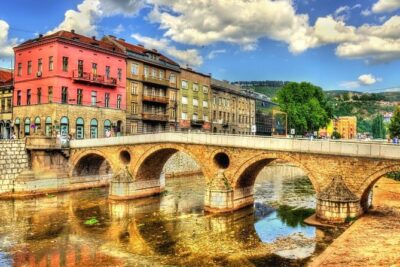
The Latin Bridge is the most historically charged stop. Beside it is the location associated with the assassination of Archduke Franz Ferdinand and Sophie in 1914, an event that helped set World War I in motion.
A short stop cannot explain every cause of the war, and it should not pretend to. What it can do is place the event in the city itself, where geography makes the story easier to grasp. You see the bridge, the nearby streets, and the compact setting in which a local incident gained international consequences.
Admission is not included, and the stop is scheduled for about 10 minutes. The value here is mainly the guide’s explanation and the chance to connect a major world event with a real location. If you have a strong interest in the assassination, plan extra time later for a more detailed museum visit.
Bezistan and the lost Tašlihan
Gazi-Husrev Beg’s Bezistan is a covered bazaar built during the same period as Tašlihan, a stone inn that was later destroyed during the Austro-Hungarian period. The Bezistan helps you picture Sarajevo as a trading center with enclosed markets, lodging, storage, and routes for merchants.
Admission is free, and the stop lasts around 10 minutes. The lost Tašlihan is especially useful to remember because it shows that city history includes absence as well as survival. Not every important building remains intact.
This part of the walk connects well with Morica Han and Kazandžiluk. Together, the three stops explain how commerce worked in old Sarajevo, from lodging and animal space to covered shopping and skilled metalwork.
Serbian Orthodox Cathedral and Sarajevo’s shared center
The Serbian Orthodox Cathedral, formally the Congregational Church of the Holy Mother, was built during the Ottoman period and is described as the largest Orthodox church in Sarajevo. Its presence is a direct reminder that the city’s religious story cannot be reduced to its mosques.
Admission is not included, with about 10 minutes allotted. The tour gives you a chance to understand the church as part of the city center, not as a remote outpost. The close sequence of religious buildings is one of the route’s strongest features.
You should keep your expectations realistic. The tour may not provide enough time for a full interior visit, and entry rules can vary. The main purpose here is to see the building and understand its place in Sarajevo’s shared urban fabric.
Cathedral of the Sacred Heart of Jesus
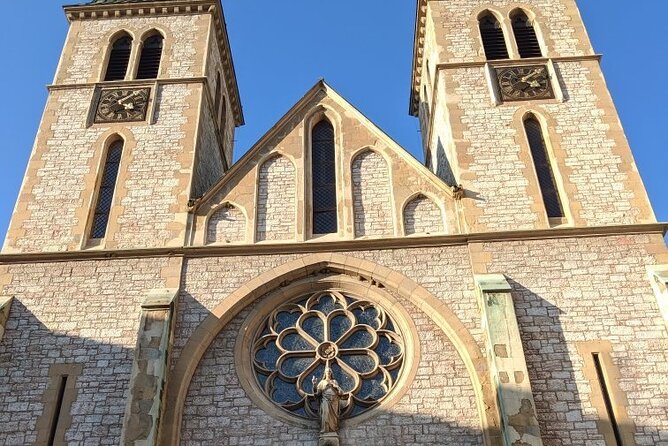
The Cathedral of the Sacred Heart of Jesus is one of the first major European-style buildings in Sarajevo. Its inclusion after the Orthodox cathedral creates a useful comparison between different Christian traditions and the broader architectural change brought by European influence.
The stop is listed as free and takes about 10 minutes. The cathedral also helps explain why the city center feels so varied. You are not simply moving from an old quarter to a new one. You are passing through a city where Ottoman, Austro-Hungarian, Catholic, Orthodox, and Jewish histories remain close together.
I would pay attention to the sequence rather than judging each building alone. The tour is strongest when you see how one short walk links several communities and political eras.
Jewish Museum and Sarajevo’s Sephardic story
The Jewish Museum of Bosnia and Herzegovina occupies the Old Jewish Temple, also known as the Sephardic Synagogue. It is described as the first and oldest synagogue built in Sarajevo.
Admission is not included, and the planned stop is about 10 minutes. That is enough to introduce the building and its place in Sarajevo, but not enough for a careful museum visit. If Jewish history is a priority for you, note the museum’s location and return when you can read and view the exhibits at your own pace.
This stop matters because it widens the story beyond the most visible Ottoman and Austro-Hungarian landmarks. The city’s identity was also shaped by Jewish communities, and the synagogue gives that history a physical place in the center.
Meeting of Cultures, the final idea
The walk returns to the Sarajevo Meeting of Cultures marker, where East meets West. The marker is a simple but effective way to understand the route you have just taken.
By this point, you have seen Ottoman religious and commercial buildings, Austro-Hungarian civic architecture, Orthodox and Catholic churches, and a Sephardic synagogue. The marker does not erase the differences between these traditions. It gives you a clear visual point from which to think about their closeness.
The final stop lasts about five minutes and is free. Since the tour ends at the original meeting point, you can use this location to continue into Ferhadija, return to Baščaršija, or head back to your accommodation.
Is $12.07 good value?
At $12.07 per person, this is an easy value choice if you want a local introduction to Sarajevo. The price includes a certified guide and bottled water, while food, drinks, and listed admission fees are extra.
The value depends on how you use the two hours. If you want a quick route through the center, a guide who can explain the connections, and a list of places to revisit, the cost is modest. If you expect extended interior access at every religious building, museum, and city landmark, the price and short schedule will not match that expectation.
The strongest added value comes from the guide. Samira is praised for knowing people along the Old Town streets and for giving the walk a local, community feel. Enes is praised for humor, clear English, and the ability to make difficult history easier to follow. Layla is described as offering strong insight into Sarajevo’s past, while Senka is noted for explaining the city, its history, cultural mixture, and practical advice.
You cannot choose a specific guide based on the information provided, so book for the route and general guiding service rather than for one individual. If a named guide is especially important to you, ask the operator before booking.
Who should book this Sarajevo tour?
I would recommend it for a first visit, a short stay, or the first morning of a longer Sarajevo trip. It gives you a mental map of the center and helps you decide which sites deserve a second visit.
It also suits anyone who wants history explained in plain English rather than read from plaques. The route covers sensitive and complicated subjects, including religious identity, imperial rule, and the assassination connected to World War I. A good guide can keep those subjects clear without turning the walk into a lecture.
You may want something else if you prefer slow photography, long museum visits, or a highly specialized tour. With roughly 10 minutes at most stops, the pace is designed for breadth. The group limit of 20 is reasonable, but a smaller private walk would offer more room for questions and personal interests.
Free cancellation is available if you cancel at least 24 hours before the start time. Changes made later are not accepted, and a minimum group size is required. If the operator cancels because that minimum is not met, you are offered another date or experience, or a full refund.
Should you book it?
Book this tour if you want an affordable, well-shaped introduction to Sarajevo’s central landmarks and cultural layers. The route is especially useful because it does not treat the Ottoman quarter, Austro-Hungarian center, and religious sites as separate attractions. It shows how they connect.
I would book it early in a Sarajevo stay, then return to the Gazi Husrev-beg Mosque, City Hall, Latin Bridge, or Jewish Museum if one catches your interest. The tour is short, direct, and best used as a foundation for exploring more deeply on your own.
FAQ
How long does the Discover Sarajevo Walking Tour last?
The tour lasts approximately two hours.
What is the price of the tour?
The listed price is $12.07 per person.
Where does the tour start?
The meeting point is the Info Bosnia Tourist Information Center at Velika avlija, Laure Papo Bahorete 2, Sarajevo. Directions also identify it as being on Ferhadija beside the Sarajevo Meeting of Cultures marker.
Where does the tour end?
The activity ends back at the meeting point.
Is the tour offered in English?
Yes. The tour is offered in English.
Is bottled water included?
Yes. A bottle of water is included with the tour.
Are meals and other drinks included?
No. Food and drinks are not included unless specifically stated.
Are admission fees included?
No. Admission is not included at several listed stops, including Gazi Husrev-beg Mosque, Sarajevo City Hall, Latin Bridge, the Serbian Orthodox Cathedral, and the Jewish Museum of Bosnia and Herzegovina. Other listed stops are free.
How many people can join the tour?
The maximum group size is 20 people. A moderate level of physical fitness is required, and smart-casual dress is requested.
Just added around Sarajevo
- Sarajevo Under Siege: A War History Tour★ 5.0 · 10 reviews
- WAR TUNNEL – Sarajevo’s only way of a communication during the WAR – Top secret★ 5.0 · 12 reviews
- Private Full Day Safari Tour★ 5.0 · 8 reviews
- Ultimate Gastro Experience★ 4.5 · 14 reviews
- Mysterious Visoko Pyramids Driving and Walking Tour★ 5.0 · 7 reviews
- Secret Tito’s Bunker/Konjic Tour★ 5.0 · 4 reviews
- The Secret Lifeline: Sarajevo’s War Tunnel Tour★ 5.0 · 6 reviews
- Crossroads of Cultures – Sarajevo Walking Tour★ 5.0 · 8 reviews
Walking Tours, compared.
Private Walking Tour, Food Tasting and Bosnian Coffee in Sarajevo
Read our review →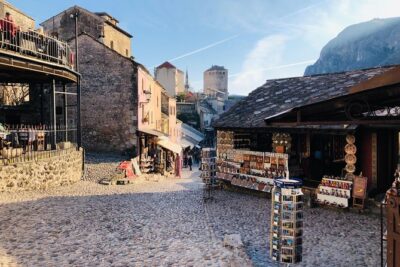
PROFESSIONAL SARAJEVO WALKING TOUR – With guide who guided STING!
Read our review →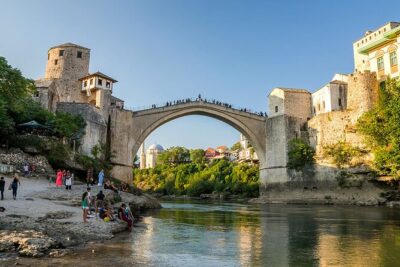
Browse the lists this tour appears in