
Reviewed · JAJCE AND PLIVA LAKES TOURS
Bosnian Kingdom Capitals: Travnik & Jajce Tour from Sarajevo
Travnik and Jajce give you two very different views of Bosnia in one long day. Travnik brings Ottoman streets, painted mosques, vizier tombs, and the birthplace of Nobel Prize winner Ivo Andrić. Jajce adds medieval walls, royal history, Roman remains, a roaring waterfall, and old wooden mills.
I like the private-tour format, especially since one booking became a personal trip with Muhmmnad arranging local guides in both towns. I also like that entrance fees, bottled water, snacks, WiFi, and transport are covered. The main drawback is the clock: with 14 stops and about five hours of driving, several visits are brief.
Key points to know before booking
- Two historic centers in one day: Explore Travnik’s Ottoman character and Jajce’s medieval royal sites from Sarajevo.
- A packed 10 to 12-hour schedule: Expect a full day, with roughly 2.5 hours on the return drive alone.
- Private group experience: Only your party participates, rather than joining a large coach group.
- Meals cost extra: Lunch is not included, and a 45-minute to one-hour dinner break in Jajce is also paid separately.
- Nature joins the history: Pliva Waterfall and the Pliva watermills provide a welcome change from museums and fortresses.
- Useful included extras: You receive bottled water, a chocolate bar or chips, WiFi, an air-conditioned vehicle, and entrance fees.
Why Travnik and Jajce make a strong day trip
Sarajevo has enough to fill several days, but Bosnia’s central towns reveal a different side of the country. Travnik was shaped by Ottoman rule and served as a seat of Ottoman viziers. Jajce was tied to the medieval Bosnian kingdom and later became an important site in 20th-century Yugoslav history.
This tour is built around that contrast. You move from mosques, mausoleums, and Ottoman architecture in Travnik to fortifications, catacombs, Roman religion, waterfalls, and wooden mills in Jajce. It is not a slow, village-by-village outing. It is a concentrated history day with some fine outdoor stops.
The private setup matters. You can ask for clarification, adjust the pace slightly, or spend more time at a place that catches your interest, though the number of scheduled stops limits how much flexibility you should expect. The supplied experience describes reliable drivers and local guides in Travnik and Jajce. One solo booking was operated as a private trip, with Muhmmnad organizing guides for both towns.
More jajce and pliva lakes tours in Sarajevo:
- From Sarajevo: Travnik, Jajce, Pliva Lakes & Watermills Trip
★ 4.9 · 519 reviews - From Sarajevo: Jajce, Travnik, Pliva Lake, & Watermills Tour
★ 4.8 · 317 reviews - Jajce, Travnik and Pliva watermills – Day Tour from Sarajevo
★ 5.0 · 295 reviews
Plava Voda starts the Travnik visit
The first stop is Plava Voda, a national monument beside water in Travnik. The site includes the Derventa cemetery, Lutvina Kahva café, and the tomb of Mufti Mehmed Efendi and his wife Ajiša.
You have about 20 minutes here, so think of it as an introduction rather than a long café break. The setting connects everyday Ottoman-era social life with religious and memorial sites. It is a pleasant place to get your bearings before the more formal historical stops.
Admission is free. If you want a drink at Lutvina Kahva, ask whether that purchase is separate, since personal expenses are not included.
Travnik Fortress brings the best views
Travnik’s Old Town fortress is one of the day’s strongest stops. Built on a hill, it gives you a clear sense of why the town developed around this defensive position. You can walk along preserved walls and towers, inspect the stone structure, and look across Travnik and the surrounding countryside.
The visit lasts about 35 minutes, with admission included. Wear shoes suitable for uneven stone and slopes. The fortress is more rewarding if you pause for the views instead of treating it as another quick photo stop.
This is also the place where the phrase old capital becomes easiest to understand. Travnik’s importance came from its role under Ottoman administration, and the fortress helps connect the town’s political past with its physical setting.
Šarena Džamija shows Ottoman design in color
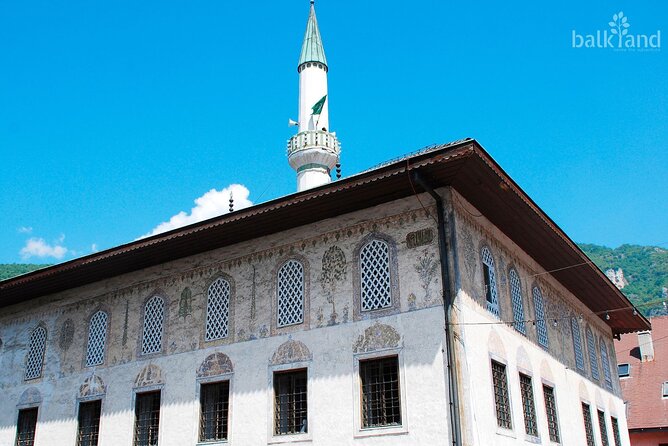
Šarena Džamija, or the Painted Mosque, dates from the 16th century. Its ornamented exterior and interior make it one of Travnik’s most distinctive buildings, and the 20-minute visit gives you time to appreciate details rather than only the outline of the building.
As with any active religious site, follow the guide’s instructions about entering and dress. The mosque is included in the tour price. Its value lies in the decoration and in the way it presents Ottoman religious architecture as something designed for both worship and visual beauty.
Travnik has several religious buildings close together, so you see how Islamic, Catholic, and other traditions share the same town. That mixture gives the visit more depth than a single monument would.
More travnik day trips in Sarajevo:
- From Sarajevo: Travnik, Jajce, Pliva Lakes & Watermills Tour
★ 5.0 · 213 reviews - Jajce, Travnik, Pliva lake and Watermills Tour
★ 5.0 · 104 reviews - Travnik, Jajce & Pliva Lakes Day Tour From Sarajevo (fees Incl.)
★ 5.0 · 50 reviews - Sarajevo: Jajce Waterfall, Travnik & Pliva Lake Tour
★ 5.0 · 40 reviews
Ivo Andrić’s birthplace adds a literary stop
The Nobel Prize-winning writer Ivo Andrić was born in Travnik on October 9, 1892. His reconstructed birthplace in the Zenjak neighborhood now presents a permanent exhibition about his life and writing.
You have 15 minutes here. That is enough for a focused look, but not a long reading session. If you already know Andrić’s work, this stop will likely carry more weight. If you do not, the guide’s explanation can help place him in the cultural setting of Bosnia.
The museum opened as a memorial in 1974 and operates as an annex to the Regional Museum of Travnik. Admission is included.
The Travnik museum and churches round out the town
The Regional Museum of Travnik occupies a building constructed in 1928 for medical and health purposes with funding from the Rockefeller Foundation. Its permanent exhibition opened in 1975. The scheduled visit is only 10 minutes, so expect a sample of the collection, not a full museum tour.
That short timing is one of the practical limits of this excursion. Travnik offers enough material for a full day by itself, but the schedule uses the museum to support the wider story before moving on.
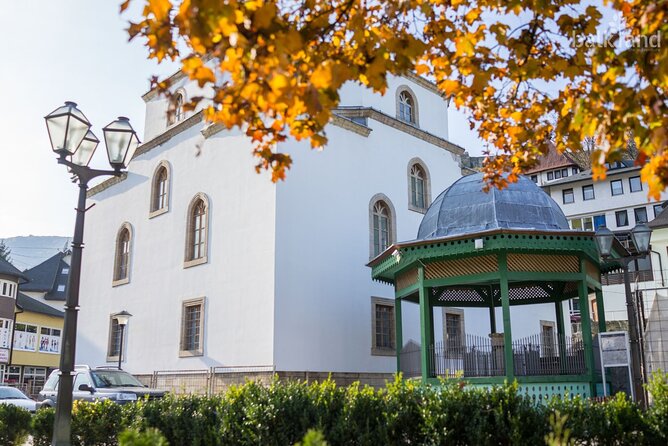
The Catholic Church of St. John the Baptist takes another 10 minutes. Built in the mid-19th century, it represents the Catholic community and offers a change from the Ottoman sites. The visit is brief but useful, especially if you want to see how several religious traditions shaped Travnik.
The Vizier’s grave and Hadži Ali Beg’s Mosque each receive about 10 minutes. The vizier’s tomb is an Ottoman-style mausoleum, while the mosque reflects the town’s Islamic heritage. Both are free stops, and both work best when your guide explains their place in Travnik’s past.
Jajce begins underground at the catacombs
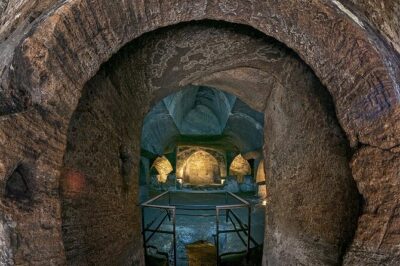
After Travnik, the tour continues to Jajce. The Catacomb of Jajce is a medieval underground tunnel system, visited for about 30 minutes with admission included.
Going below the town changes the rhythm of the day. Instead of looking across rooftops from a fortress, you move through a confined historic space. The catacombs also introduce Jajce as a town with layers of history beneath its streets, not just a scenic hilltop.
The stop may not suit anyone uncomfortable with enclosed passages, although the supplied information does not give further accessibility details. If that is a concern, ask the operator before booking.
Jajce Fortress explains the royal connection
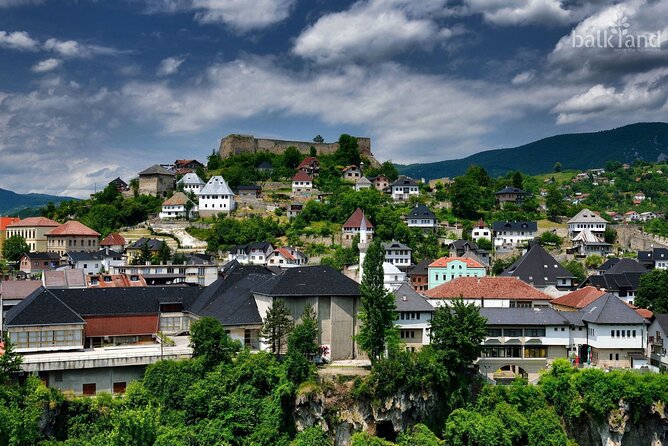
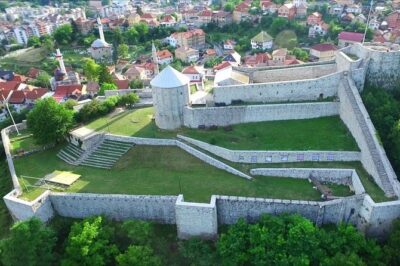
Jajce’s fortress is the central historical stop in town. Jajce served as a capital of the medieval Bosnian kingdom and was home to the last two kings. Beneath the fortress is the Coronation Church of St. Mary, associated with the crowning of the final Bosnian king.
The hilltop position gives you broad views over Jajce and its surroundings. You have about 30 minutes, with admission included. The time is enough to explore the main interior areas and take in the view, but you should not expect every corner of the fortress at a relaxed pace.
For many people, this is the clearest link to the tour’s Bosnian Kingdom theme. Travnik tells the story of Ottoman power; Jajce gives you the medieval royal chapter.
AVNOJ Museum covers a very different past
The AVNOJ Museum is devoted to the second session of the Anti-Fascist Council of the People’s Liberation of Yugoslavia, held in Jajce in 1943. That meeting helped establish the political foundations of postwar Yugoslavia.
The museum contains original objects and material from the session, along with displays about the Partisan resistance during World War II. It also explains why the event mattered for Bosnia and for the later countries of the Western Balkans.
The visit lasts about 20 minutes. This is not just another old building. It brings the 20th century into a day otherwise focused on medieval and Ottoman periods. If you have little background on Yugoslavia, listen closely to the guide, since the museum’s importance may not be obvious from the exhibits alone.
The Mithra Temple reaches back to Roman Jajce
The Temple of Mithras dates from the 3rd century AD and was built by Roman soldiers for the worship of Mithra, an Indo-Iranian god. It is described as one of the best-preserved Mithraic icons in the Balkans.
You have 20 minutes here. The site is modest in scale, but its age and religious setting make it one of the most unusual stops of the day. It shows that Jajce’s story began long before the Bosnian kingdom or Yugoslavia.
This is a good place to ask questions. Roman religious sites can be difficult to understand without context, and the guide’s explanation will matter more than the size of the remains.
Pliva Waterfall supplies the day’s big natural pause
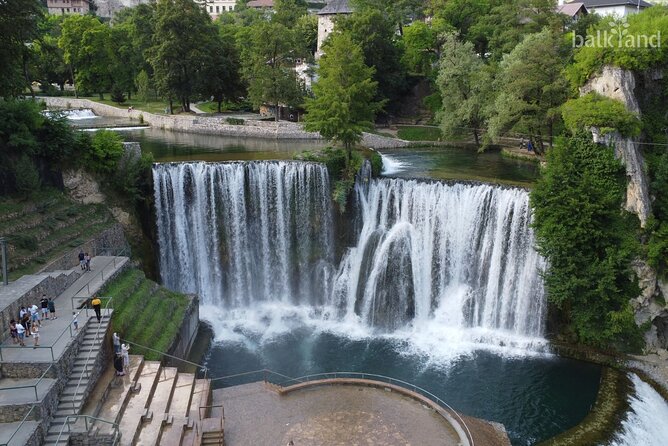
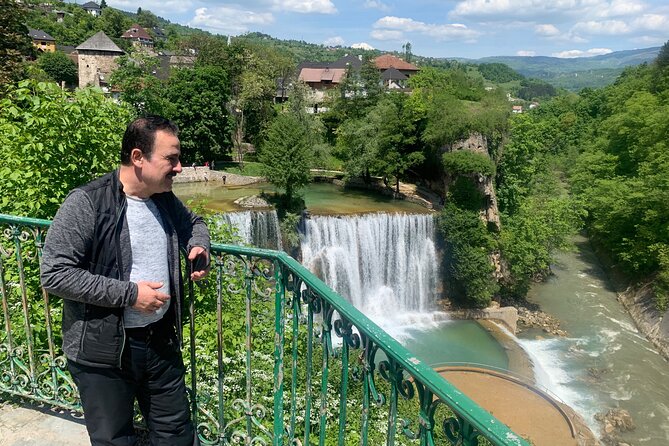
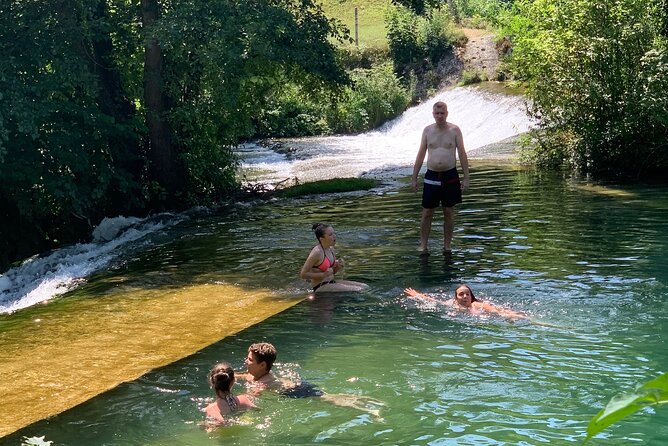
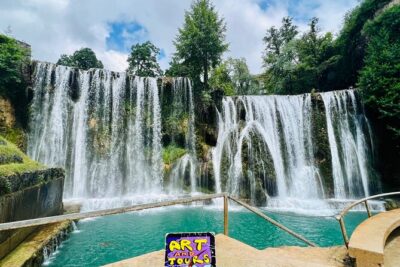
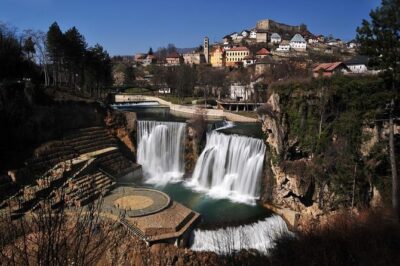
The Pliva Waterfall is one of the most memorable visual stops. Water drops through the center of Jajce over moss-covered rock, producing a loud, constantly moving focal point in town.
The schedule allows about 30 minutes, with admission included. You can take photographs and enjoy the water, but the information also mentions natural pools, so ask the guide about current access and conditions before considering a swim. Do not assume that water activities are formally supervised or included.
After several museums and historic structures, the waterfall gives your eyes and mind a break. It is also one of the few stops where the setting itself, rather than an explanation or collection, carries most of the experience.
Mlincici preserves old milling traditions
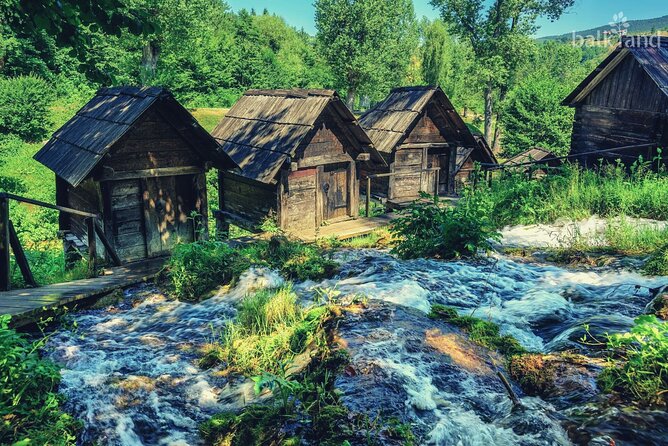
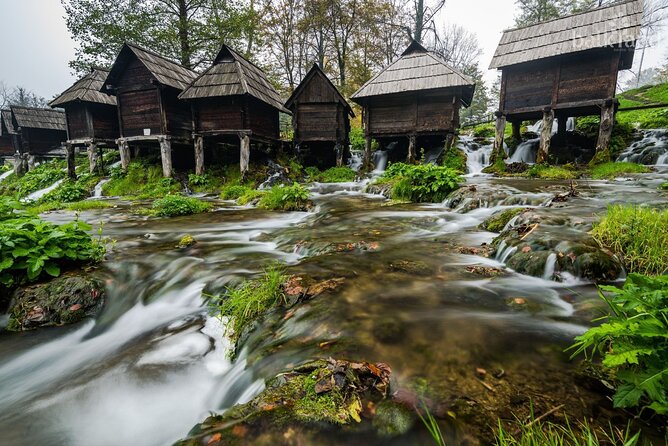
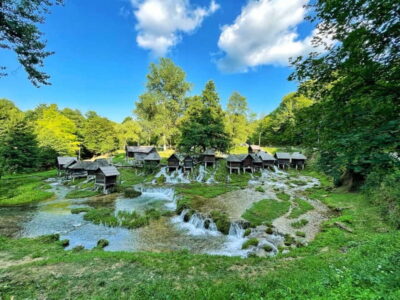
The wooden watermills at Mlincici sit along the Pliva River. Water powered these mills, which ground grain into flour and supported the local economy for centuries. They were especially important during the Ottoman period.
You have about 20 minutes at the mills. Their small size makes them easy to see, but their meaning is larger: they show how local communities used the river as a practical resource, not simply as scenery.
The mills are a particularly good match for anyone interested in traditional technology. They also provide a calmer final sightseeing stop before the meal break and long drive back.
The long return drive shapes the day
After the Jajce stops, you have a dinner break lasting about 45 minutes to one hour. Dinner is not included, and alcohol is also excluded for anyone aged 18 and over.
The drive back to Sarajevo takes about 2.5 hours. The full outing runs roughly 10 to 12 hours, and the remaining time is spent on the road. That is the key practical fact to weigh before booking. You cover a great deal, but you will be tired by the final stretch.
The air-conditioned vehicle, bottled water, snacks, and WiFi help. A chocolate bar or chips will not replace a proper meal, so plan to buy lunch and dinner. Since the vehicle is private for your group, you are not sharing the return journey with a large busload of people.
What the $150.10 price means
At $150.10 per person, this is not the cheapest way to reach Travnik and Jajce. It can still offer fair value if you want transport, entry fees, a driver, and guiding arranged in one package.
The price includes all listed fees and taxes, an air-conditioned vehicle, bottled water, snacks, and onboard WiFi. It also includes admission to the fortress, mosques, museums, catacombs, Mithra Temple, waterfall, and watermills where an entry fee is listed.
You pay separately for lunch, dinner, alcohol, and personal purchases. The value improves for a private group because the cost buys more control and less waiting than a large organized coach may provide. For one person, the price is harder to justify unless you place a high value on having a dedicated day trip from Sarajevo.
Group discounts are listed, so larger parties should check the final per-person rate. Pickup is offered, while the stated start and end point is Sarajevo City Hall at Brodac 1. Confirm the exact pickup arrangement before the day of departure.
Who should book this Bosnia day trip?
I would recommend it to you if you have limited time in Sarajevo and want to see central Bosnia without arranging several connections. It suits history-minded visitors who enjoy moving between Ottoman, medieval, Roman, and 20th-century sites.
It is also a good fit for private groups, couples, families, and solo visitors who prefer a dedicated vehicle. Most people can participate, and the tour operates with your group alone.
I would hesitate if you dislike early starts, long drives, or short museum visits. The schedule is ambitious. You will see a lot, but you will not have hours to linger at Travnik Fortress, browse every museum room, or sit beside the waterfall.
Book at least 24 hours ahead if your plans may change, since cancellations made within 24 hours are not refunded. The experience also depends on good weather and a minimum number of participants, with a different date or full refund offered if the operator cancels for those reasons.
Should you book Travnik and Jajce from Sarajevo?
Book this tour if your priority is range. In one day, you get Ottoman Travnik, medieval Jajce, Roman remains, Yugoslav history, a major waterfall, and traditional mills. That is a strong return for a single day outside Sarajevo.
Skip it if you want a slow trip with long meals and unhurried museum time. The best reason to choose this outing is its private transport and carefully packed route, especially when Muhmmnad can arrange local guides in both towns. The main compromise is simple: you trade depth for coverage.
FAQ
How long does the Travnik and Jajce tour take?
The tour lasts approximately 10 to 12 hours. The return drive from Jajce to Sarajevo takes about 2.5 hours, and additional time is spent traveling between the stops.
Where does the tour start and end?
The stated meeting point is Sarajevo City Hall, Brodac 1, Sarajevo 71000, Bosnia and Herzegovina. The activity ends back at the same meeting point.
Is this a private tour?
Yes. Only your group participates in the activity. Group discounts are also listed.
Are meals included in the price?
No. Lunch and dinner are not included. The itinerary includes a dinner break in Jajce lasting about 45 minutes to one hour. Alcoholic drinks and personal expenses are also separate.
What is included?
The price includes bottled water, a chocolate bar or chips, all listed fees and taxes, an air-conditioned vehicle, and WiFi onboard.
Can I cancel for a full refund?
You can receive a full refund if you cancel at least 24 hours before the experience start time. Cancellations or changes made within 24 hours are not refunded or accepted. If poor weather or an insufficient minimum number of participants causes the operator to cancel, you are offered another date or a full refund.
Just added around Sarajevo
- Sarajevo Under Siege: A War History Tour★ 5.0 · 10 reviews
- Private Full Day Safari Tour★ 5.0 · 8 reviews
- WAR TUNNEL – Sarajevo’s only way of a communication during the WAR – Top secret★ 5.0 · 12 reviews
- Ultimate Gastro Experience★ 4.5 · 14 reviews
- Mysterious Visoko Pyramids Driving and Walking Tour★ 5.0 · 7 reviews
- Secret Tito’s Bunker/Konjic Tour★ 5.0 · 4 reviews
- The Secret Lifeline: Sarajevo’s War Tunnel Tour★ 5.0 · 6 reviews
- Crossroads of Cultures – Sarajevo Walking Tour★ 5.0 · 8 reviews
Jajce and Pliva Lakes Tours, compared.
Jajce, Travnik and Pliva watermills – Day Tour from Sarajevo
Read our review →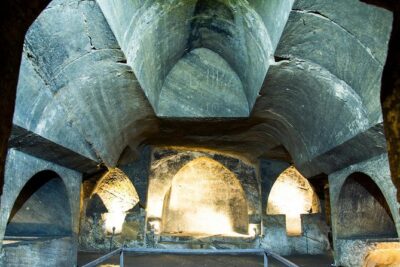
Travnik, Jajce & Pliva Lakes Day Tour From Sarajevo (fees Incl.)
Read our review →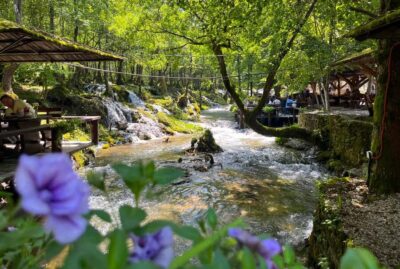
CENTRAL BOSNIA | A medieval tour (Jajce + Travnik + Pliva lakes)
Read our review →
Sarajevo to Zagreb: One-Way Tour via Jajce, Travnik, Pliva Lake and Watermills
Read our review →Browse the lists this tour appears in