
Reviewed · SARAJEVO TOURS
Sarajevo Assassination: The Spark of World War I
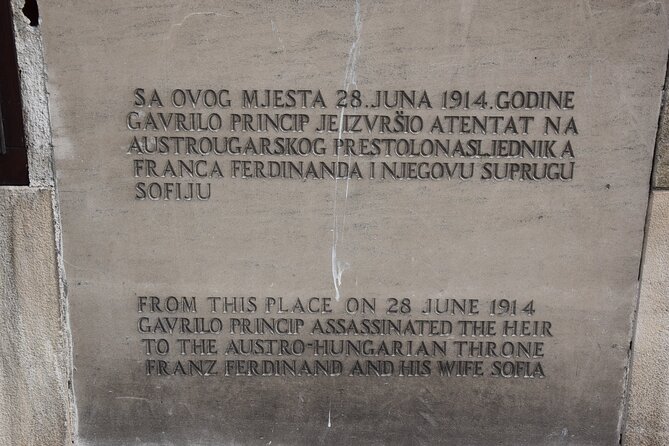
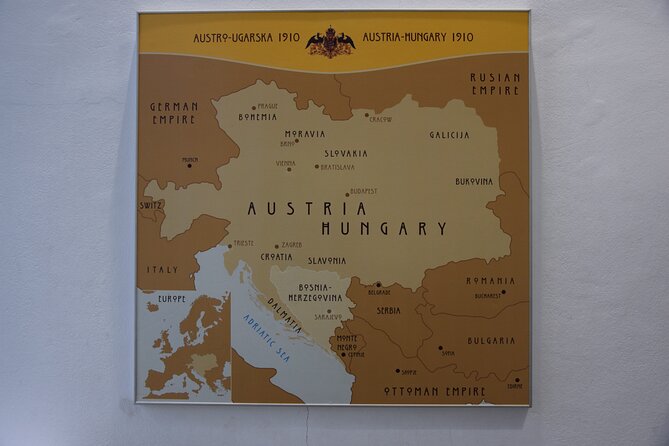
The pistol shots fired near Sarajevo’s Latin Bridge changed the course of the 20th century. This two-hour tour helps you follow that story on the ground, linking Gavrilo Princip, Archduke Franz Ferdinand, Austro-Hungarian rule, and the Young Bosnia movement.
I like the small group of no more than 15 people, which should make it easier to hear the guide and ask questions. I also like the mix of outdoor landmarks, cemetery and city streets with two museums and a virtual-reality presentation. The main drawback is that both museums require extra payment, so the $29.59 base price is not the full cost if you want the complete experience.
Key points before you book
- Princip’s grave and memorial chapel: Begin with the conspirators’ burial place at Saint Mark Cemetery and the Vidovdan Heroes Chapel.
- The actual assassination area: Latin Bridge and the nearby museum bring the events of June 28, 1914, into clear focus.
- Two optional museum visits: Budget separately for the Sarajevo Museum 1878 to 1918 and the Sarajevo VRX Immersive Museum.
- A short, focused tour: The experience lasts about two hours, leaving the rest of your day open.
- Transport is included: An air-conditioned vehicle connects the scattered locations, along with a city map.
- A useful history lesson: The tour covers more than the shooting, explaining how Austro-Hungarian rule and nationalist tensions shaped Sarajevo.
Why this Sarajevo tour matters
Many tours about the assassination stop at Latin Bridge, point toward a plaque, and move on. This experience takes a wider view. You begin with the people involved, then see the government buildings, markets, religious landmarks, residences, and public spaces that formed Sarajevo in 1914.
That wider context matters. The assassination did not happen in an empty city. Sarajevo was a meeting point of Ottoman traditions, Austro-Hungarian administration, local politics, religious communities, and competing national movements. The tour gives you a better chance to understand why the event carried such force.
You also get a practical two-hour format. I like this length for a history subject that can become dense. You have enough time to build a clear timeline without giving up an entire day of sightseeing.
The tour begins at Sarajevo Insider, at Zelenih beretki 30, with a 10:00 am start. It returns to the same meeting point. Confirmation arrives when you book, and the activity is offered in English with a licensed guide.
Other Sarajevo days people book alongside this one:
- Sarajevo: Mostar, Konjic, Blagaj Tekke, Pocitelj & Waterfall
★ 4.9 · 1,666 reviews - Fall of Yugoslavia, Sarajevo War Tour with Tunnel of Hope Museum and Frontlines
★ 5.0 · 1,314 reviews - Sarajevo: Grand Walking Tour Through Time and Cultures
★ 4.8 · 1,236 reviews
Saint Mark Cemetery and the conspirators’ memorial
The first stop is Saint Mark Cemetery, where Gavrilo Princip and his fellow conspirators were buried in secrecy by Austro-Hungarian authorities. The Vidovdan Heroes Chapel now honors the Young Bosnia movement and the people connected with the plot.
This is a strong opening because it puts names and personal choices ahead of grand political results. Princip is often reduced to a single act in a textbook. At the cemetery, you begin with the young people behind the movement and the consequences they faced.
You have about 20 minutes here, with no admission charge. That is enough time for the guide to explain who was buried here and why the authorities treated the burials as a matter of secrecy.
The cemetery is also useful for setting up the moral questions behind the story. Princip’s act helped trigger a war that killed millions, but the tour’s subject is not simply a cartoon villain or a heroic freedom fighter. Expect the guide to place him within the political pressures of the period rather than treating the assassination as a simple tale of good and evil.
The Presidency and Sarajevo under imperial rule
The Bosnia and Herzegovina Presidency building comes next. Built during Austro-Hungarian administration, it represents the imperial government that controlled Bosnia at the time.
You spend only about five minutes here, so this is primarily an exterior orientation stop. The building helps you picture the machinery of government behind the motorcade and the official visit.
The connection is close to the assassination route. On June 28, 1914, Franz Ferdinand’s motorcade passed through Sarajevo near this area. The stop is brief, but it adds political weight to the streets you are seeing. You are not only following a doomed procession. You are also tracing the visible presence of an empire trying to govern a complicated province.
Sarajevo VRX and the road to June 28, 1914
The Sarajevo VRX Immersive Museum offers a different way to approach the story. Its presentation recreates Sarajevo under Austro-Hungarian rule and lets you virtually witness the moments leading up to the assassination.
The visit lasts about 15 minutes. Admission is not included, and the listed price is 20 BAM, shown as about 10 euros per person. Check your budget before you arrive, especially if you plan to visit both museums.
The strength of this stop is visual storytelling. A virtual presentation can help you grasp the sequence of roads, vehicles, and decisions more quickly than a page of dates. If you already know the assassination story well, you may find the presentation less essential than the historical explanations at the other stops. If the sequence is new to you, it can make the timeline easier to follow.
I would treat this as an optional supplement, not the reason to book the tour. The best value comes from having a guide connect the virtual material to the real streets outside.
Same country, a completely different kind of day:
- Sarajevo: Mostar, Konjic, Sufi House, Pocitelj & Kravice Falls
★ 5.0 · 1,179 reviews - Sarajevo: Tunnel Museum Yugoslavia War Tour with War Veteran
★ 5.0 · 1,111 reviews - ROSES OF SARAJEVO (Official WAR + CITY tour)- Story of a Survivor
★ 5.0 · 770 reviews - Sarajevo: Tunnel of Hope Tour – Survival and Resilience
★ 4.8 · 630 reviews
Eternal Flame and Markale Market
The Eternal Flame is a very short stop, about three minutes. It is mainly a World War II memorial, not a direct assassination site, but it sits near important Austro-Hungarian-era buildings.
This stop shows how Sarajevo’s public spaces carry several layers of memory. The tour is focused on 1914, yet the city cannot separate that story from the later wars that shaped its identity. Since there is no admission charge, the brief pause costs you little time.
Markale Market also receives about five minutes. Founded during Austro-Hungarian rule, it reflected the empire’s modernization efforts and Sarajevo’s growing commercial life.
The market gives you a more ordinary picture of the city. Before Sarajevo became a headline around the world, people were shopping, trading, and going about their morning. The market helps you imagine daily life around the official route, even though no dramatic event occurred there during the assassination itself.
Because the stop is short, do not expect time for a full market visit or a long explanation of its later history. Think of it as a quick piece of social context.
Sacred Heart Cathedral and the motorcade route
The Cathedral of the Sacred Heart of Jesus was built in 1889. Its Neo-Gothic design reflected Austro-Hungary’s attempt to make its authority visible in Bosnia.
You spend about five minutes here. The cathedral is important not only as a church but also as a marker of imperial planning and religious presence. Along with mosques, Orthodox churches, synagogues, administrative buildings, and markets, it forms part of Sarajevo’s layered urban character.
The cathedral also sat along the route taken by Franz Ferdinand’s motorcade. That detail makes the street feel less abstract. You can picture the official procession moving through a city where different communities and political loyalties lived close together.
This is another exterior-focused stop. You should not book the tour expecting extended church sightseeing. Its value comes from the guide’s explanation of the building’s place in the city and on the route.
Latin Bridge, the tour’s key moment
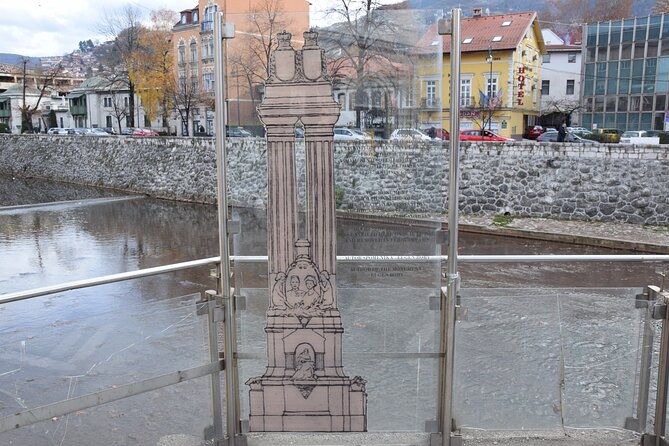
Latin Bridge is the central stop. This Ottoman-era bridge became famous because Gavrilo Princip fired the fatal shots nearby.
You have about 15 minutes here, enough to orient yourself and hear the sequence of events. The area lets you connect the final turn of the motorcade, the position of the assassin, and the confusion that followed.
One especially useful detail from the experience is the chance to identify the former coffee shop doorway associated with the fatal shot. That kind of physical reference can sharpen the story. Instead of hearing only that Princip fired near a bridge, you can relate the event to a precise urban setting.
The bridge itself is not large or theatrical. That is part of its power. The location looks like a normal city crossing, which makes the scale of the historical result feel even stranger. A short walk, a wrong turn by the driver, and a few gunshots helped set off a chain of diplomatic decisions that led to global war.
Your guide is important here. The site has attracted so much attention that it can be easy to rush through, take a photograph, and miss the sequence. Ask questions about the route and the timing if you want the clearest account.
Sarajevo Museum 1878 to 1918
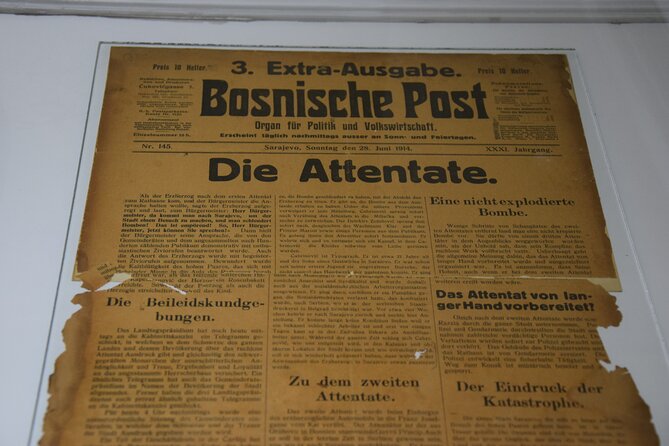
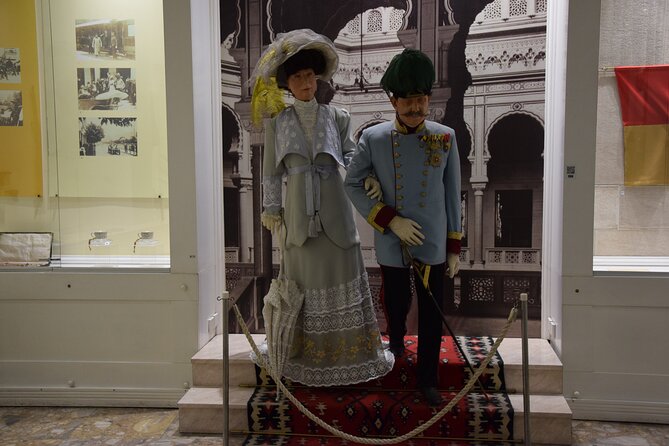
Near Latin Bridge, the Sarajevo Museum 1878 to 1918 focuses directly on the Austro-Hungarian period and the assassination. Its displays cover Franz Ferdinand’s visit, the imperial administration, and the nationalist movements that grew during this period.
The museum visit is scheduled for about 15 minutes, with an entry fee of 5 BAM, listed as about 3 euros per person. That is a modest extra charge, and I consider this the more useful of the two paid museum options for most history-minded visitors.
The museum can give you objects and visual evidence to support what the guide has explained outdoors. It also helps place the assassination within the years from 1878 to 1918, rather than presenting it as an isolated afternoon.
Fifteen minutes is not a long museum visit. You may need to move at a brisk pace, and you should not expect to read every panel. Still, the stop adds substance to the tour and is worth including if you want more than street explanations.
Konak, Sarajevo Brewery, and the official visit
Konak was once the residence of Austro-Hungarian governors. It played a role in hosting officials during Franz Ferdinand’s visit and was tied to decision-making in the hours before the assassination.
You spend about three minutes here, so this is another quick exterior stop. Its importance is administrative and political. It reminds you that the official visit was carefully arranged and connected to the governing structure of the city.
Sarajevo Brewery receives the same short treatment. The brewery represented industrial progress and served as a place for social gatherings. On the day of the assassination, it was part of the urban setting through which events unfolded.
These stops will appeal most to visitors who enjoy connecting small city details to larger events. If you prefer long visits at fewer sites, the number of brief pauses may feel hurried. The advantage is range: you see more of the city and get a broader sense of the world surrounding the motorcade.
City Hall and the last official welcome
Sarajevo City Hall, or Vijećnica, is one of the grandest buildings on the route. Its design reflects Austro-Hungarian influence, and it hosted the official reception for Franz Ferdinand shortly before his assassination.
You have about 10 minutes here. Admission is not included, and the tour information does not list an entry fee for the building, so confirm locally if you plan to go inside. The scheduled stop may focus on the exterior and the events linked to the reception.
This is a fitting final location because it brings the official pageant of the visit into view. Franz Ferdinand appeared on the steps for a public welcome, unaware of what would happen soon afterward. The contrast between ceremony and danger gives the day its grim shape.
Ending at City Hall also leaves you back near the central meeting area. From there, your afternoon remains free for Sarajevo’s other sights.
What the $29.59 price really covers
At $29.59 per person, this is a reasonable price for a two-hour guided history tour, especially if you value transport between sites and a small group. The licensed guide, air-conditioned vehicle, and city map are included.
The price does not cover the two museum admissions. If you visit both, add 5 BAM for the 1878 to 1918 Museum and 20 BAM for the VRX Museum, for a total of 25 BAM in extra fees. That makes the true cost higher than the headline price, but still gives you control over how much you spend.
You can keep the tour affordable by treating the outdoor stops and guide commentary as the main experience. I would pay for the 1878 to 1918 Museum if you want artifacts and a more focused look at the period. Add VRX if you prefer a visual, technology-based presentation.
The group limit of 15 is another value point. It is not a private tour, but it is small enough to avoid the feel of a large coach group. The air-conditioned vehicle matters because the sites are spread across the city and the weather may make moving between them less pleasant on foot.
Who will enjoy this experience most
I would recommend this tour to first-time visitors who want a clear introduction to Sarajevo’s 1914 story. It also suits history teachers, students, and anyone who knows the broad facts but wants to connect them to actual places.
The format works well if you have only a short stay in Sarajevo. Two hours gives you a focused lesson, then you can spend the rest of the day exploring on your own.
You may want a different tour if you are looking for a slow walking tour with long museum visits. Several stops last only three to five minutes, and the whole route covers many locations. The experience favors breadth, context, and efficient transport over lingering at one site.
The guide’s style will shape the experience. The tour is designed to deliver details with enthusiasm and humor, and it can include a small book about the fates of the five conspirators. That extra touch gives you something useful to read after the tour and extends the story beyond the shooting itself.
Free cancellation is available if you cancel at least 24 hours before the 10:00 am start time. Changes made less than 24 hours before the start are not accepted, and a minimum group size is required for the tour to operate.
Should you book this Sarajevo assassination tour?
Book it if you want the assassination explained as part of Sarajevo’s political and urban story, not as a single stop at Latin Bridge. The cemetery, government buildings, cathedral, market, museums, and City Hall give the subject useful shape.
I especially like the balance between a licensed English-speaking guide and time-efficient transport. The small group and city map add practical value, while the optional museum fees let you control your spending.
Skip it if you want a full-day history program or dislike short stops. For most visitors with an interest in 1914, though, this is a sensible way to get oriented, see the essential locations, and keep the rest of the day open.
FAQ
Where does the tour begin and end?
The tour begins at Sarajevo Insider, City Tours and Excursions, at Zelenih beretki 30 in Sarajevo. It ends back at the same meeting point.
What time does the tour start?
The scheduled start time is 10:00 am.
How long does the experience last?
The tour lasts approximately two hours.
Is the tour offered in English?
Yes. The experience is offered in English.
Are museum entry fees included?
No. Entry to the Sarajevo Museum 1878 to 1918 costs 5 BAM per person, listed as about 3 euros. Entry to the Sarajevo VRX Museum costs 20 BAM per person, listed as about 10 euros.
What is included in the tour price?
A licensed guide, an air-conditioned vehicle, and a city map are included.
How large is the tour group?
The activity has a maximum of 15 participants.
Just added around Sarajevo
- Sarajevo Under Siege: A War History Tour★ 5.0 · 10 reviews
- WAR TUNNEL – Sarajevo’s only way of a communication during the WAR – Top secret★ 5.0 · 12 reviews
- Private Full Day Safari Tour★ 5.0 · 8 reviews
- Ultimate Gastro Experience★ 4.5 · 14 reviews
- Mysterious Visoko Pyramids Driving and Walking Tour★ 5.0 · 7 reviews
- Secret Tito’s Bunker/Konjic Tour★ 5.0 · 4 reviews
- The Secret Lifeline: Sarajevo’s War Tunnel Tour★ 5.0 · 6 reviews
- Crossroads of Cultures – Sarajevo Walking Tour★ 5.0 · 8 reviews
Sarajevo Tours, compared.

Fall of Yugoslavia, Sarajevo War Tour with Tunnel of Hope Museum and Frontlines
Read our review →
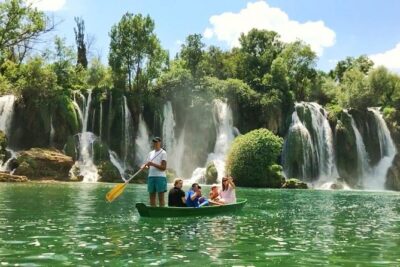
Mostar, Konjic, Sufi House, Pocitelj & Kravice Falls
Read our review →
Mostar, Konjic, Dervish House, Pocitelj & Kravica Falls
Read our review →
Bosnian War & Fall of Yugoslavia Tour with Tunnel
Read our review →Browse the lists this tour appears in