
Reviewed · WALKING TOURS
InstaSarajevo – Photography Walking Tour of Sarajevo
Sarajevo can explain much of its story in a short walk, and this tour uses a camera to help you notice the details. In two to three hours, you move from the Ottoman-era market around Sebilj Fountain to Austro-Hungarian City Hall, the site of Franz Ferdinand’s assassination, and the visual meeting point of East and West.
I like the small maximum of four people, which gives Kenan, the guide and professional photographer, room to help with photos instead of simply leading a crowd. I also like that professional photographs are part of the experience, a real benefit if you are exploring alone and want more than quick phone snaps.
The main consideration is scope. This is a compact walking tour, not a full museum visit or a deep architectural study. Most stops last about 15 minutes, and entrance tickets are not included, so you should book it for photography, orientation, and focused city stories rather than long indoor visits.
Key points at a glance
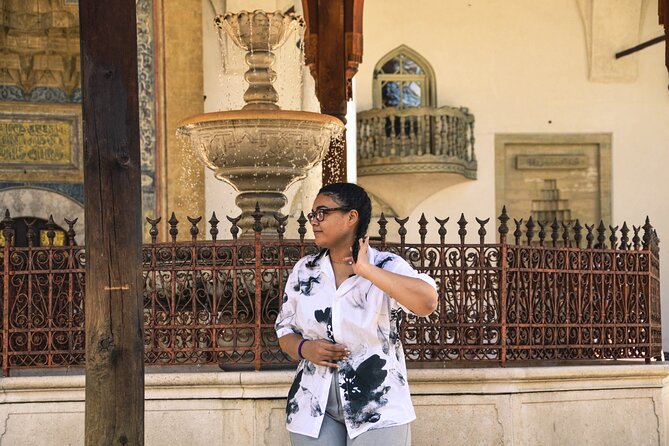
- Professional photos included: Guide and photographer Kenan can help create images you can keep and share, especially useful for solo visitors.
- A four-person maximum: The small group makes it easier to ask questions and get practical photography guidance.
- Eight central Sarajevo sights: The route links Baščaršija, City Hall, Latin Bridge, major religious buildings, and the Meeting of Cultures.
- A clear East-West contrast: One stop lets you make two very different photographs from the same place.
- A short, manageable format: The walk lasts about two to three hours and begins at 10:00 a.m.
- Weather matters: The experience requires good weather, with a new date or full refund offered if conditions force cancellation.
Why this Sarajevo photo walk works
The best thing about this experience is its sense of visual movement. You are not seeing Sarajevo as a set of isolated monuments. You are walking through a compact center where Ottoman streets, Austro-Hungarian buildings, religious landmarks, and modern public life meet within a few blocks.
That makes the tour useful on your first day in the city. You get your bearings while learning what to look for: the shape of a copper tray, the line of a minaret, the contrast between a Moorish facade and a European cathedral, or the way a public square fills a frame.
I especially like the combination of street photography and local history. A standard sightseeing walk may tell you what a building is. A photography walk asks you to look at its light, angles, people, textures, and relationship to the street around it.
The format also suits solo visitors. Your own phone or camera is welcome, but the included professional photos mean you do not have to rely entirely on selfies or ask strangers to take your picture. The experience was created in part for people traveling alone, and that is one of its clearest practical strengths.
A few more Sarajevo trips to weigh up
- Sarajevo Private Photography Tour
★ 5.0 · 10 reviews
Starting at Sebilj and entering Baščaršija
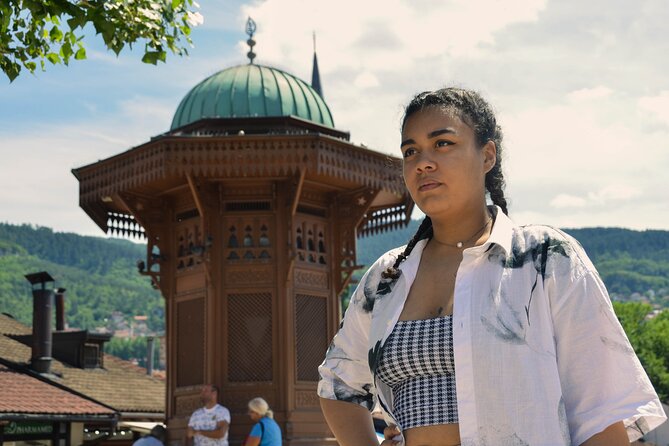
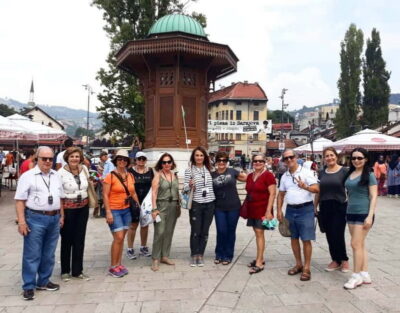
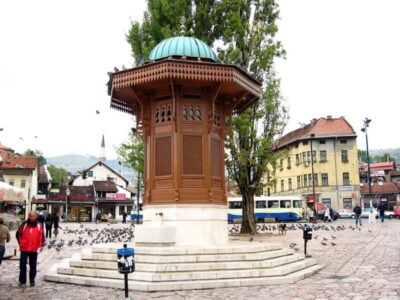
The walk begins at Kovači 25 at 10:00 a.m. From there, the first major stop is Sebilj Fountain on Baščaršija Square. This kiosk-shaped public fountain is one of Sarajevo’s best-known symbols, and the square around it is often called Pigeon Square.
The name refers to the birds that gather around the fountain, giving you an easy subject for a lively opening photograph. The setting also introduces the older side of Sarajevo: public water, market streets, small shops, and a square that functions as a meeting place.
Your scheduled time here is about 15 minutes. That is enough for a few compositions and an introduction to the area, but not enough for a long wait in changing light. If you want careful architectural shots, keep your camera ready before arriving.
From Sebilj, you continue into Baščaršija and Kazandžiluk, one of Sarajevo’s oldest and most recognizable streets. The street takes its name from the kazandžijas, the coppersmiths who first made kettles for the army and later produced ewers, pitchers, coffee pots, trays, and other household pieces.
At the height of Ottoman Sarajevo, these metalworkers made roughly 100 types of objects. That detail gives the street more meaning than a quick shopping stop. Look for the repeated patterns, hammered surfaces, and warm metal tones that make copperwork so effective in close-up photographs.
The nearby streets of Luledžina and Oprkanj were once part of a larger coppersmiths’ quarter. You get only about 15 minutes here, so think in terms of a focused visual study rather than browsing every shop or purchasing something. The tour can show you what makes the street photograph well, while you can return later if you want more time to shop.
City Hall and Sarajevo’s Austro-Hungarian face
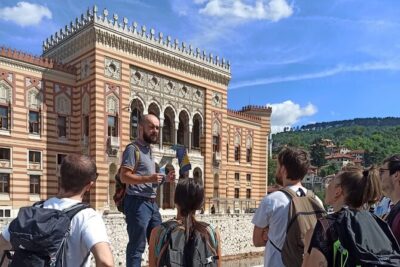
The route then shifts sharply in style at Sarajevo City Hall. Completed in 1896, the building is the most representative example of the Austro-Hungarian period in the city and is known for its Neo-Moorish design.
This is one of the tour’s best architectural contrasts. The decorative forms draw from Islamic art in Spain and North Africa, yet the building belongs to the Austro-Hungarian chapter of Sarajevo’s past. That mixture is a useful reminder that the city’s visual identity cannot be reduced to one tradition.
You have roughly 15 minutes at City Hall. The exterior is the main focus of this route, and entrance tickets are not included. If you want to go inside, confirm the current admission arrangements separately and allow extra time beyond the scheduled walk.
For photography, this stop rewards attention to shape. Rather than pointing straight at the whole building every time, try framing a tower, arch, or decorative section against the surrounding street. Kenan’s role as a professional photographer should be most useful here, where small changes in position can make a formal building look far more interesting.
Latin Bridge and the event that changed Europe
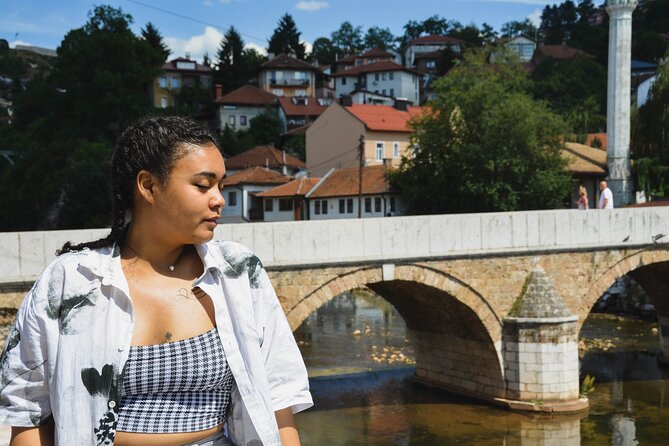
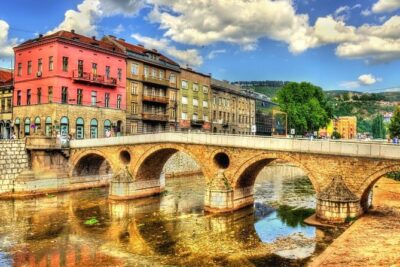
The next stop is Latin Bridge, beside the place connected with the assassination of Archduke Franz Ferdinand and Sophie. That event in Sarajevo helped trigger the First World War, making this an important point for anyone interested in European history.
The value here is not only the famous event. The site also shows how world-changing history can happen in an ordinary urban setting. The bridge, street, and nearby buildings do not look like a grand stage. That contrast gives the stop its power.
Again, the planned time is about 15 minutes. You will get the essential story and a chance to photograph the bridge and its setting, but not a long lecture on every political cause of the war. If this subject matters greatly to you, treat the tour as an introduction and seek a separate museum or historical visit afterward.
Same country, a completely different kind of day:
- Sarajevo: Mostar, Konjic, Blagaj Tekke, Pocitelj & Waterfall
★ 4.9 · 1,666 reviews - Fall of Yugoslavia, Sarajevo War Tour with Tunnel of Hope Museum and Frontlines
★ 5.0 · 1,314 reviews - Sarajevo: Grand Walking Tour Through Time and Cultures
★ 4.8 · 1,236 reviews - Sarajevo: Mostar, Konjic, Sufi House, Pocitelj & Kravice Falls
★ 5.0 · 1,179 reviews
The covered bazaar and Gazi Husrev Bey’s mosque
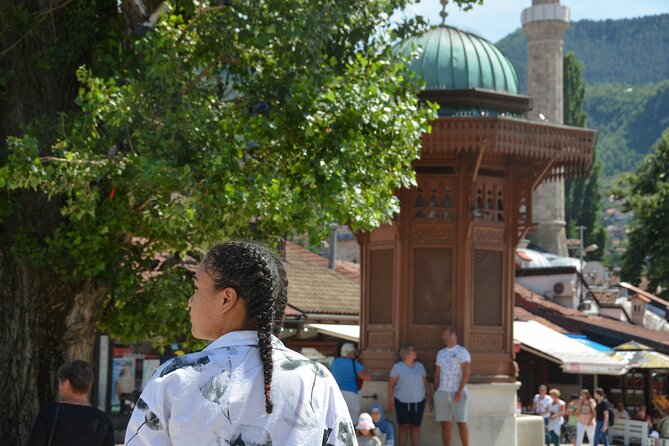
Gazi Husrev Bey’s Bezistan, also called the Old Bezistan or Great Bezistan, brings you back into the Ottoman center. This covered bazaar is part of Gazi Husrev Bey’s charitable endowment and is thought to date from around 1540.
The covered market changes the feel of the walk. After the open square and broad facade of City Hall, you are looking at a more enclosed space shaped by trade, shade, and repeated passage. The name bezistan refers to this type of covered bazaar, and its surviving structure helps you picture Sarajevo as an important Ottoman commercial center.
The route allows about 15 minutes here. Since entrance tickets are not included, check whether any interior access requires a separate ticket on the day you visit. Even from the outside, the building provides useful lines and shadows for photography.
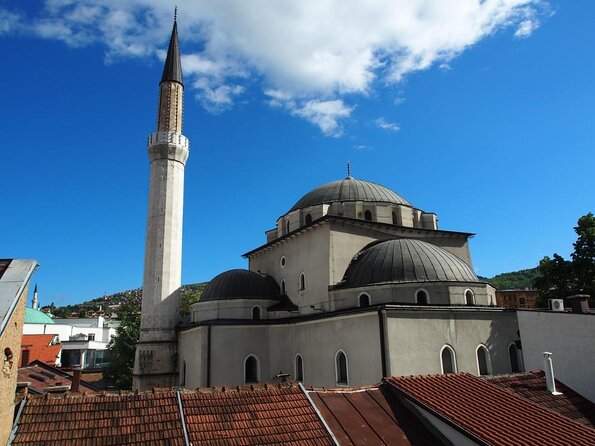
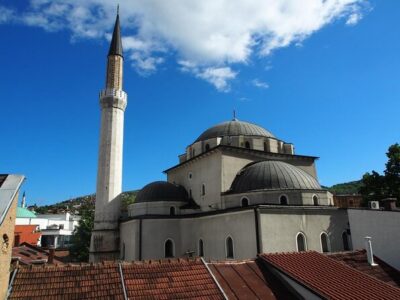
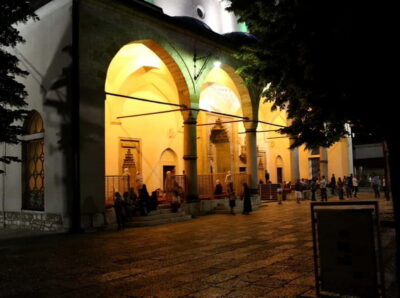
Nearby, Gazi Husrev-beg Mosque is the largest historic mosque in Bosnia and Herzegovina. Built in the 16th century, it is one of the most important Ottoman buildings in the Balkans and has served as Sarajevo’s central mosque since its construction.
This is a place to slow down and show respect. The tour description does not promise an interior visit, so do not assume you will enter during the walk. Dress and behave appropriately around the mosque, and follow any local instructions about access.
Photographically, the mosque offers a chance to study balance and proportion. The minaret, courtyard elements, and surrounding market streets create a strong sense of place. The 15-minute schedule keeps this stop concise, which is helpful for a general city walk but limiting if you want detailed architectural photography.
Sarajevo Cathedral and the Meeting of Cultures
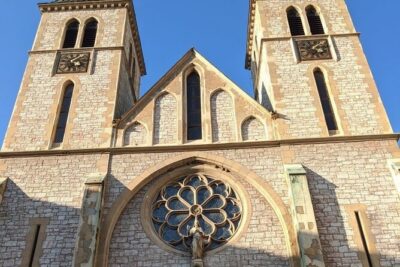
Sarajevo Cathedral of the Sacred Heart gives the route another abrupt change. Architect Josip Vancaš drew inspiration from Notre Dame Cathedral in Dijon and St. Teyn Cathedral in Prague, but the finished building became its own work rather than a simple copy.
The cathedral fits into the old center beside Ottoman-era buildings, including the Gazi Husrev Bey’s Hamam in the background. That proximity is one of Sarajevo’s most useful visual lessons. Within a short walk, you can see Islamic, Catholic, and Austro-Hungarian influences sharing the same city space.
You have about 15 minutes here. The stop is best for exterior views and for understanding how the cathedral relates to its surroundings. As with the mosque and bazaar, entrance tickets are not included, so any interior visit would need separate planning.
The final stop is Sarajevo Meeting of Cultures. This is the point where East meets West, and it offers one of the tour’s most clever photography ideas: make two different photographs from the same spot.
The value is in the comparison. One direction presents the Ottoman character of the old market, while the other points toward the Austro-Hungarian side of the center. You do not need a long explanation to grasp the city’s unusual character. Two frames from one position can say it quickly.
This stop is especially good for anyone who enjoys visual storytelling. You are not merely collecting another landmark. You are showing how Sarajevo changes from one street view to the next.
What the photography element adds
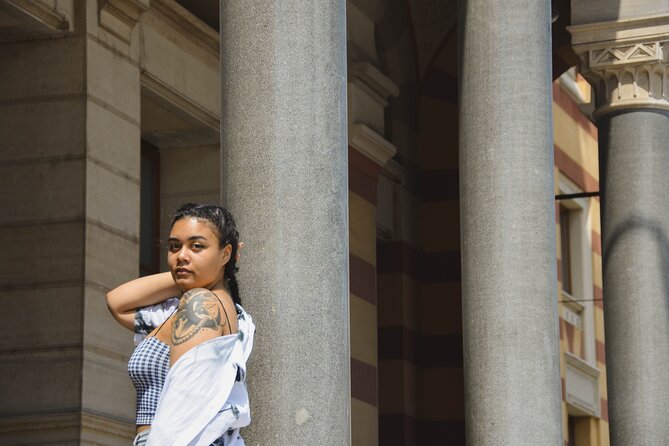
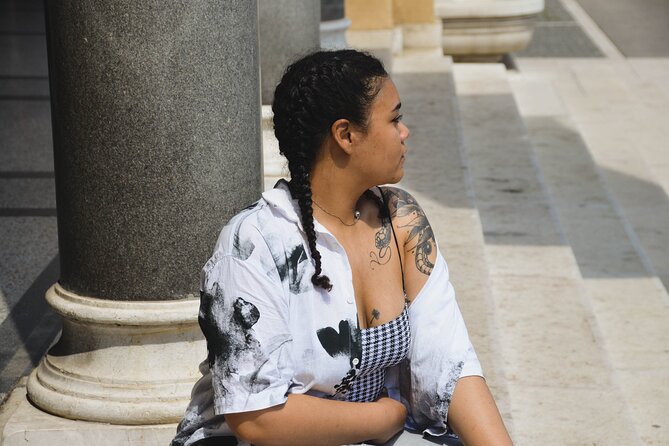
The professional photography component is more than a decorative extra. It changes the purpose of the walk. You can take your own photographs while receiving help with street scenes, framing, and the small choices that make a picture useful as a memory rather than just proof that you were there.
The strongest practical advantage comes if you are alone. Solo visitors often have to choose between being in the photograph and taking it. Having a professional photographer along addresses that problem directly.
The supplied details identify Kenan from Adventure in Bosnia as the guide connected with this experience. He is described as both a certified guide and professional photographer, so you get two kinds of help: context for the places you see and practical attention to the images you make.
Do not expect a long technical photography workshop. The tour lasts only two to three hours and includes eight stops, with about 15 minutes assigned to each. Think of it as a guided city walk with a photography focus, not a full-day class on camera settings.
You can still get value from it with a phone. The key lessons are likely to concern observation, positioning, and selecting a strong subject, all of which apply to a phone camera as well as a dedicated camera.
Price, timing, and group size
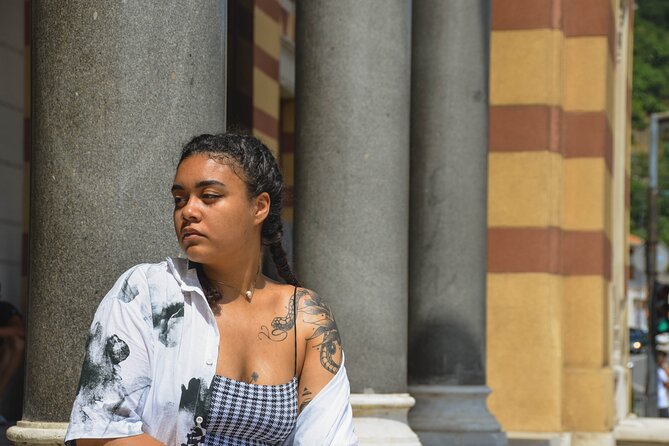
At $34.92 per person, the price is reasonable if you want both a guided walk and professional photographs. A basic sightseeing walk may cost less, while a private photography session can cost more. Here, the value depends on how much you care about leaving with better images as well as better orientation.
The maximum group size is four people. That is a major advantage at this price. A tiny group gives you more chance to ask Kenan questions, request help with a particular photo, and avoid the stop-start feeling of a large tour.
The timing is also easy to fit into a Sarajevo visit. The 10:00 a.m. start leaves the afternoon open, and the end point is back at Kovači 25. The route is located near public transportation, which helps if you are staying outside the center.
All listed stops have free admission, but tickets and interior entrances are not included. That keeps the base price clear, but you should not assume the walk covers entry to City Hall, the Bezistan, the mosque, or the cathedral.
The experience requires good weather. If poor weather cancels the walk, you are offered another date or a full refund. You can cancel for a full refund up to 24 hours before the start time. Changes or cancellations inside that 24-hour window are not accepted.
Who should book this walk?
I would choose this tour if you want a quick introduction to Sarajevo and care about photographs. It is particularly well suited to solo visitors, couples who want images of themselves together, and anyone who prefers a small group to a standard city tour.
It also works well early in a stay. The route connects the main old-center sights, so you can return later to the copperworkers’ street, market, mosque, cathedral, or City Hall with a better sense of where everything fits.
You may want something else if your priority is long indoor sightseeing, extensive war history, or a slow specialist architecture tour. Eight stops in two to three hours means the pace is purposeful. You will see a lot, but you will not linger everywhere.
People with service animals can participate, and the tour is near public transportation. Most people can take part, but it remains a walking experience, so choose comfortable shoes and be ready to spend the morning moving between close city-center sights.
Should you book InstaSarajevo?
Book it if professional photos, a four-person group, and a compact old-town route match what you want from Sarajevo. The combination is hard to beat for a solo visitor who wants useful pictures and a clear introduction to the city’s Ottoman, Austro-Hungarian, and religious landmarks.
Skip it if you want included museum entry or a long historical seminar. This tour is best understood as a focused photographic walk with strong city context. At $34.92, it offers good value for that purpose, especially with guide and photographer Kenan leading a very small group.
FAQ
How long does the photography walking tour last?
The tour lasts approximately two to three hours.
What time does the tour start?
The stated start time is 10:00 a.m.
Where does the tour begin?
The meeting point is Kovači 25, Sarajevo 71000, Bosnia and Herzegovina.
Does the tour return to the starting point?
Yes. The activity ends back at the meeting point.
Are entrance tickets included?
No. Tickets and entrance fees are not included. The listed stops themselves have free admission.
How many people can join the tour?
The activity has a maximum of four participants.
What happens if bad weather cancels the tour?
Because the experience requires good weather, you will be offered a different date or a full refund if poor weather causes cancellation.
Just added around Sarajevo
- Sarajevo Under Siege: A War History Tour★ 5.0 · 10 reviews
- WAR TUNNEL – Sarajevo’s only way of a communication during the WAR – Top secret★ 5.0 · 12 reviews
- Private Full Day Safari Tour★ 5.0 · 8 reviews
- Ultimate Gastro Experience★ 4.5 · 14 reviews
- Mysterious Visoko Pyramids Driving and Walking Tour★ 5.0 · 7 reviews
- Secret Tito’s Bunker/Konjic Tour★ 5.0 · 4 reviews
- The Secret Lifeline: Sarajevo’s War Tunnel Tour★ 5.0 · 6 reviews
- Crossroads of Cultures – Sarajevo Walking Tour★ 5.0 · 8 reviews
Walking Tours, compared.
Private Walking Tour, Food Tasting and Bosnian Coffee in Sarajevo
Read our review →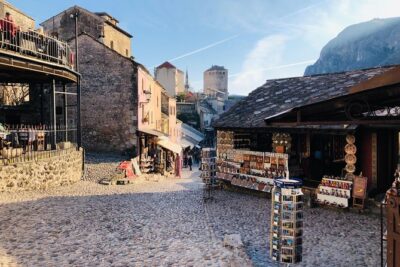
PROFESSIONAL SARAJEVO WALKING TOUR – With guide who guided STING!
Read our review →Browse the lists this tour appears in