
Reviewed · CITY TOURS
ROSES OF SARAJEVO (Official WAR + CITY tour)- Story of a Survivor
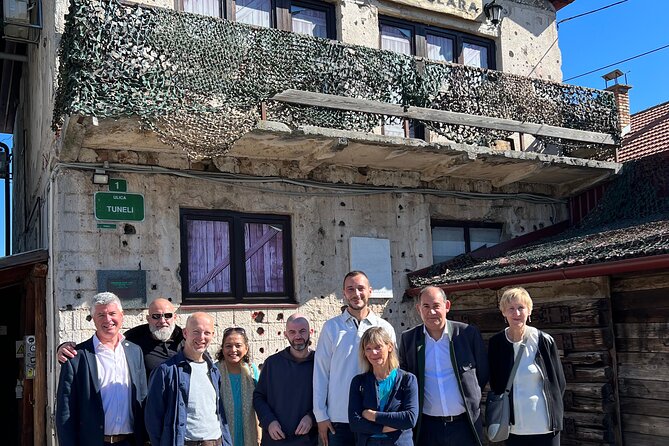
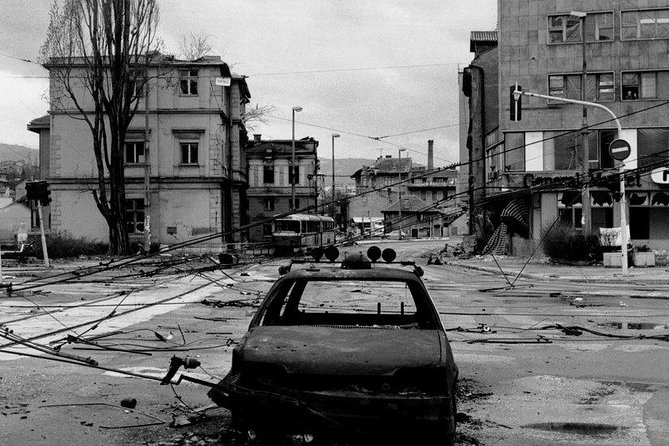
Sarajevo’s recent past is not tucked away in a museum. It is marked into apartment walls, mountain slopes, bridges, cemeteries, and streets where ordinary people tried to live through nearly four years of siege. Roses of Sarajevo brings those places together with a survivor’s personal account, then adds the city’s Ottoman, Austro-Hungarian, Jewish, Yugoslav, and modern political stories.
I like the way this tour connects the Tunnel of Hope with sniper positions, the bobsleigh track, East Sarajevo, and the city center instead of treating each site as a separate history lesson. I also like the small-group format, air-conditioned minivan, and the chance to hear Sarajevo explained by guides such as Mak, whose childhood was shaped by the siege.
The main consideration is emotional weight. This is not a light sightseeing ride, although humor and beautiful views appear along the way. The Tunnel of Hope admission costs an extra €10, and four hours and 15 minutes is a fast pace for so many subjects.
Key points to know before booking
- A survivor’s account: Mak and other guides connect the siege to their own childhood and family experience.
- The Tunnel of Hope: Walk through the wartime passage beneath the airport after seeing the museum, film, war room, and minefield area.
- Sarajevo from above: Trebević, Urijan Dedina, and Yellow Fortress provide some of the city’s clearest views.
- History in layers: Ottoman, Austro-Hungarian, Yugoslav, Jewish, Olympic, and wartime sites all appear in one route.
- A small group by design: One guide can handle up to eight people, with a maximum of 15 people on the activity.
- Good value for a first Sarajevo day: The $53.21 price includes transport and guiding, but not the €10 Tunnel of Hope entry.
Why this Sarajevo tour feels different
Many city tours can show you the Latin Bridge, City Hall, Yellow Fortress, and Olympic sites. This one adds the human story of growing up on a frontline. That changes how you read the city.
You are not only told that Sarajevo was surrounded from 1992 to 1995. You are shown the routes people used, the slopes from which the city was fired on, the neighborhoods caught between opposing forces, and the places where families tried to keep going. The guide’s personal story gives the war a child’s scale: streets, schools, homes, fear, escape, and the difficult return afterward.
Mak receives especially strong praise for explaining both personal memories and the current political system. Other named guides include Alen and Alnan, so the exact guide may vary. If Mak is important to you, request him when booking, but do not assume he is guaranteed.
The tour also avoids making Sarajevo only about war. You see the Sacred Heart of Jesus Cathedral, Ottoman remains, Austro-Hungarian buildings, Jewish sites, Yugoslav architecture, the 1984 Olympic village, and the city’s famous viewpoints. That broader frame matters. Sarajevo’s siege was devastating, but it is not the whole identity of the city.
A few more Sarajevo trips to weigh up
- Sarajevo: Guided City Highlights Tour with Sarajevo Tunnel
★ 4.8 · 79 reviews - Sarajevo: Sarajevo City Market, Old Town Food Tasting Tour
★ 4.9 · 69 reviews - Sarajevo: Nighttime City Highlights Walking Tour
★ 4.9 · 52 reviews
From Sacred Heart Cathedral to Little Yugoslavia
The route begins at Đulagina 2, near the central city area, and starts with a brief explanation of the Sacred Heart of Jesus Cathedral. This is a useful opening because Sarajevo’s religious mix is visible from the first minutes. The route then introduces the city’s nickname, Little Yugoslavia, a reminder of its mix of communities and traditions.
As you ride toward the Tunnel of Hope, the guide points out more than 20 monuments from Ottoman, Austro-Hungarian, and Yugoslav periods. This is not a slow architectural walk, so you should treat it as an orientation rather than a detailed building tour. Still, it helps you see how the city grew in layers instead of as one uniform place.
You will also hear about Sarajevo’s current political structure, including the Presidency of Bosnia and Herzegovina. The guide describes why it is often called Europe’s most complicated institution. That explanation is valuable because the war and its political aftermath are closely linked, yet the subject can be hard to grasp from a map or textbook alone.
Inside the Tunnel of Hope
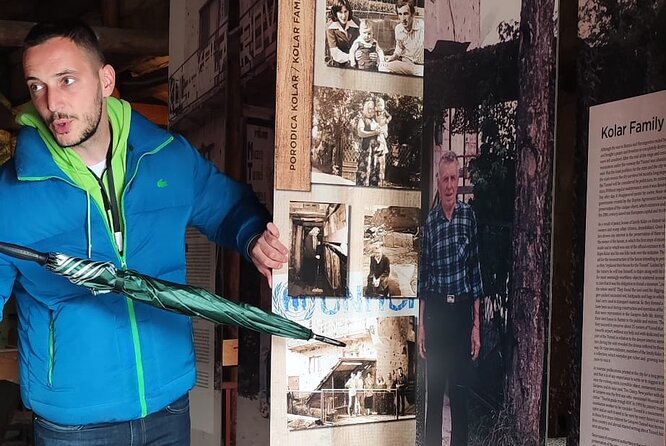
The Tunnel of Hope is the emotional center of the tour. The site includes the Kolar family war house, a 17-minute, 44-second film, minefield areas, the 1992 to 1995 Sarajevo War Museum, a war room, and a war journal display.
You then walk through part of the tunnel itself. The passage was a survival route during the siege, when Sarajevo’s airport separated the city from free Bosnian territory. The tunnel allowed supplies and people to move under the airport area, making it one of the clearest physical reminders of how the city survived.
Plan on roughly two hours for the Tunnel of Hope portion, including the journey there and time at the museum. You get about 10 to 15 minutes of free time, which is enough for a short look around but not a leisurely museum visit.
The €10 entrance fee is not included. That is a small extra cost compared with the total tour price, but you should budget for it. The site includes uneven surfaces and a confined passage, so anyone uncomfortable in tight spaces should consider that before booking.
Frontlines, Dobrinja, and the survivor’s childhood
The tour makes the wartime geography easier to understand by visiting Butmirska cesta and Dobrinja. Butmirska cesta includes the survival path and the edge of free Bosnian territory. The stop lasts about 10 minutes and has no extra admission charge.
Dobrinja is more personal. The survivor guide was born near one of the main frontlines and explains what childhood was like there before, during, and after the war. This is one of the strongest reasons to choose this tour over a standard city sightseeing route.
You should be prepared for difficult material. The guide’s story includes the effect of the siege on family life, escape to Switzerland, and the challenges of returning after the war. The tone is described as moving and sometimes heartbreaking, but also warm and occasionally funny. That balance helps, though the subject never becomes casual.
The route also points out Sarajevo’s largest Rose of Sarajevo and explains the victims recorded in 1994 and 1995. These red resin marks fill shell impact sites where people were killed. They are among the most direct memorials in the city because they remain part of the pavement rather than being separated from daily life.
Same country, a completely different kind of day:
- Sarajevo: Mostar, Konjic, Blagaj Tekke, Pocitelj & Waterfall
★ 4.9 · 1,666 reviews - Fall of Yugoslavia, Sarajevo War Tour with Tunnel of Hope Museum and Frontlines
★ 5.0 · 1,314 reviews - Sarajevo: Grand Walking Tour Through Time and Cultures
★ 4.8 · 1,236 reviews - Sarajevo: Mostar, Konjic, Sufi House, Pocitelj & Kravice Falls
★ 5.0 · 1,179 reviews
East Sarajevo and the mountains that surrounded the city
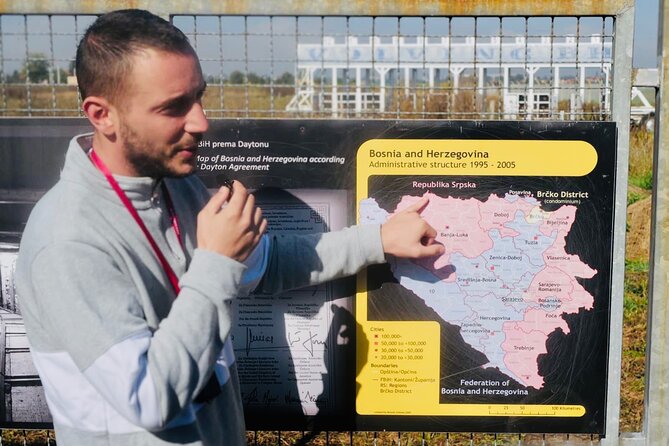
You cross into East Sarajevo, located in the Republika Srpska entity. The guide explains the difference between Bosnia and Herzegovina’s two entities and discusses the country’s ethnic and political divisions. This section requires attention, but it gives you context for the city you are seeing today.
You will also see current war murals in East Sarajevo. The point is not simply to collect another photo stop. It is to show how memories of the conflict can differ on opposite sides of the same urban area.
From Trebević Vidikovac, the city opens below you. The stop lasts about 20 minutes and includes a panorama and explanations of the first and second sniper zones. On the way, the guide points out SunnyLand, described here as a former sniper zone and now a local amusement facility nicknamed Bosnian Disneyland.
Trebević helps you understand the siege better than a flat city map can. You see how the hills dominate Sarajevo and why the surrounding heights were so important to the defensive strategy. The guide also explains the core Bosnian army defensive zone and gives the United Nations’ official statistics for grenade fire from Trebević during the siege.
The Olympic bobsleigh track and Sarajevo’s Yugoslav chapter
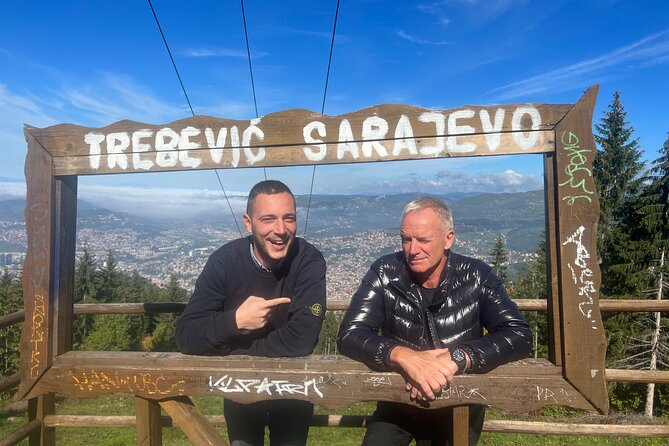
The Sarajevo Olympic bobsleigh and luge track is one of the tour’s most striking contrasts. Built for the 1984 Winter Olympics, it later became associated with the war because of its position in the hills. You walk along the track for about 30 minutes and have time for the best-known photo spot.
The bobsleigh track is partly an architectural and sporting site, partly a war site, and partly a place where nature has begun to reclaim concrete. The tour does not force you to choose one interpretation. It shows how Sarajevo’s Olympic pride and wartime damage occupy the same mountain.
The route also passes through the Olympic village and the Communist-Yugoslav part of Sarajevo. You see Yugoslav-era architecture and hear about the former local war journal institution, Oslobođenje, or the Liberation Journal. These stops add an important before-and-after view. The city was not created by the 1990s conflict, and life did not begin with the war.
You also move through a hilly neighborhood, or mahala, to see a more ordinary side of Sarajevo. This is a useful change from memorials and viewpoints. It gives you a sense of local urban life and the way Sarajevo’s hills shape its neighborhoods.
Sniper Alley, Jewish Sarajevo, and wartime bridges
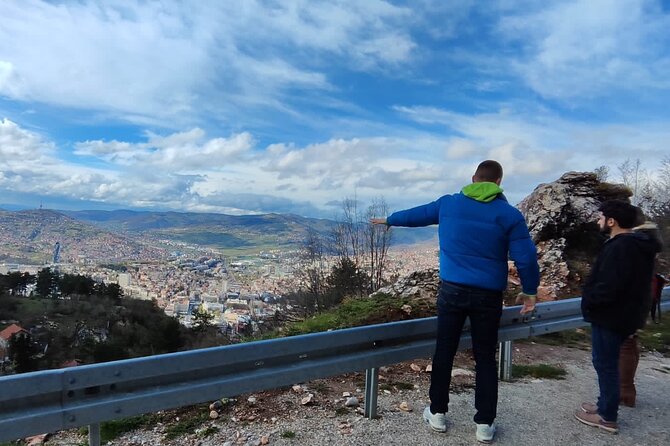
Urijan Dedina provides what is described as the best viewpoint over Sarajevo’s Sniper Alley. The stop lasts about 10 minutes. From here, the boulevard’s position between the hills becomes much clearer, and the guide explains why crossing it was so dangerous.
The tour passes the Holiday Inn, known during the siege as a base for war journalists and a place used in the exchange of soldiers. You also pass the National Museum and the Historical Museum of Bosnia and Herzegovina, including the section of the main sniper-alley route connected to the 1992 to 1995 siege.
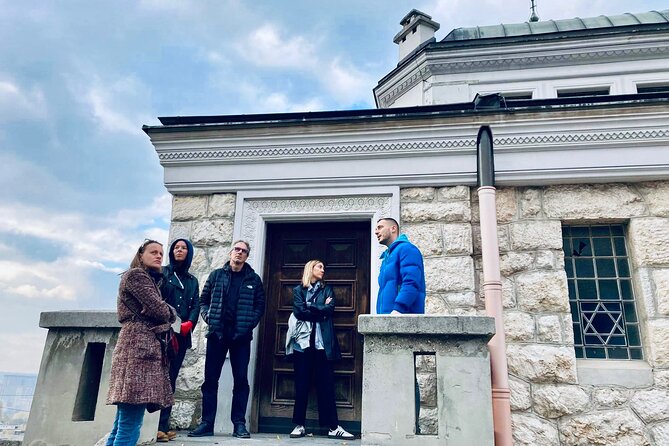
The Jewish Cemetery adds an older layer to the city. You spend about 25 minutes seeing 16th-century monuments, the memorial to Jewish victims of World War II, and the Jewish synagogue. The guide introduces Sarajevo as the European Jerusalem and explains the Ashkenazi Jewish community, including the Ashkenazi Synagogue.
This stop is valuable because it widens the story beyond the Bosniak, Serb, and Croat divisions often used to explain modern Bosnia and Herzegovina. Sarajevo’s Jewish community is part of the city’s long urban story, not a footnote.
At Suada and Olga Bridge, you hear two wartime stories connected to the Vrbanja Bridge. One side is linked to the first victim of the Sarajevo siege, while the other is tied to the Romeo and Juliet story of a couple killed while trying to cross the bridge. It is a short five-minute stop, but the human detail makes the location memorable.
The old city, Franz Ferdinand, and the City Hall
The tour returns to Sarajevo’s central districts and passes Skenderija, an Olympic hall and a wartime frontline. From there, the focus shifts to the most handsome Austro-Hungarian part of the city, with its Neo-Gothic architecture.
You hear about the Sarajevo Haggadah at the National Museum, an important Jewish manuscript with a long and troubled history. You also pass Ashkenazi Jewish sites and At Mejdan Park, where the guide explains a lesser-known local story.
At the Latin Bridge, the guide discusses the assassination of Archduke Franz Ferdinand, the event that helped trigger World War I. The stop also includes Hotel Saray. This is where Sarajevo’s older imperial story connects with the conflicts of the 20th century.
The City Hall, formerly the National Library, gets its own explanation. The building burned twice during its history, making it another symbol of cultural loss and survival. I like that the tour places this story beside the war sites rather than treating Sarajevo’s past as a series of unrelated facts.
Finishing at Yellow Fortress
Yellow Fortress is the final major stop, with about 20 minutes for Ottoman history and a broad panorama over Sarajevo. It is also known as one of the city’s best sunset viewpoints.
The timing of the sunset depends on the departure time and season, so do not book the tour expecting a guaranteed sunset. Still, the viewpoint is a fitting end. After seeing the city from sniper positions and military hills, you finish with Sarajevo’s rooftops, minarets, church towers, and surrounding mountains spread out below.
The panoramic stops are not filler between museums. They are what make the siege understandable. Sarajevo’s beauty and vulnerability are visible at once.
What the $53.21 price really includes
At $53.21 per person, the tour is fairly priced for more than four hours of guiding, a private-feeling air-conditioned minivan, and a route that covers much more ground than you could manage on foot. You are paying for interpretation and transport, not just a list of monuments.
The Tunnel of Hope admission is extra at €10 per person. No other listed stop has an added entrance charge, and the final Yellow Fortress stop includes admission. The total cost remains reasonable if the war history is a major reason for your visit.
The maximum group size is 15, while one guide handles no more than eight people. That suggests the activity may be split between guides or vehicles when needed. Ask at booking if you want to know your exact group arrangement.
The tour is usually booked about 23 days ahead, so I would reserve early for a specific date. Free cancellation is available up to 24 hours before the start time. Children must be accompanied by an adult, and the tour requires a minimum number of participants to operate.
Who should book this experience
I would choose this tour early in a Sarajevo stay. The explanations of the city’s political structure, wartime geography, religious communities, and architecture will help you understand later walks through the old town.
It is especially suited to you if you:
- Want a serious introduction to the Siege of Sarajevo
- Value a survivor’s personal account
- Have only one day and need to cover the city by vehicle
- Want both major sights and less obvious wartime locations
- Are interested in Bosnia and Herzegovina’s current divisions
- Prefer a small group to a large coach
You should think twice if you want a relaxed sightseeing trip with little discussion of violence. The tour is packed, the subject is painful, and some museum or viewpoint stops are brief. You will also spend substantial time in a minivan, though that is what makes the wide route possible.
Should you book Roses of Sarajevo?
Book it if you want Sarajevo explained through real places and personal memory, not only dates and monuments. The strongest parts are the Tunnel of Hope, Dobrinja, the sniper viewpoints, the Olympic bobsleigh track, and Mak’s firsthand account when he is your guide.
It is not the gentlest introduction to the city, but it is one of the most useful. You will leave with a clearer idea of how Sarajevo’s past shaped its streets, politics, and people. Add the €10 museum fee, allow for an emotional afternoon, and request Mak if available. For most first-time visits, this is a strong use of four hours.
FAQ
How long does the Roses of Sarajevo tour last?
The tour lasts approximately four hours and 15 minutes. The Tunnel of Hope section takes about two hours, and the remaining route includes city landmarks, war sites, viewpoints, Olympic locations, and historic neighborhoods.
What is included in the tour price?
The price includes a driver-guide and transport in an air-conditioned minivan. It does not include the €10 per person entrance fee for the Tunnel of Hope Museum.
Where does the tour start and finish?
The tour starts at Đulagina 2, Sarajevo 71000, Bosnia and Herzegovina. It ends back at the same meeting point.
Is the Tunnel of Hope Museum admission included?
No. Admission costs €10 per person and must be paid separately. The tour includes the visit to the museum area and a walk through the Tunnel of Hope.
Which guide leads the tour?
Guides named in the tour information and feedback include Mak, Mac, Alen, and Alnan. Guide assignment can vary, so request Mak when booking if you specifically want his survivor’s account.
How large is the group?
One guide has a maximum of eight people. The overall activity has a maximum of 15 participants, so more than one guide or vehicle may be used when necessary.
Is this tour available in English?
Yes. The tour is offered in English and includes a mobile ticket.
Are children allowed to join?
Yes, most people can participate, but children must be accompanied by an adult.
Can I cancel for a full refund?
Yes, if you cancel at least 24 hours before the experience start time. Cancellations or changes made less than 24 hours before the start are not refunded or accepted. If the minimum number of participants is not reached, you will be offered another date or experience, or a full refund.
Just added around Sarajevo
- Sarajevo Under Siege: A War History Tour★ 5.0 · 10 reviews
- WAR TUNNEL – Sarajevo’s only way of a communication during the WAR – Top secret★ 5.0 · 12 reviews
- Private Full Day Safari Tour★ 5.0 · 8 reviews
- Ultimate Gastro Experience★ 4.5 · 14 reviews
- Mysterious Visoko Pyramids Driving and Walking Tour★ 5.0 · 7 reviews
- Secret Tito’s Bunker/Konjic Tour★ 5.0 · 4 reviews
- The Secret Lifeline: Sarajevo’s War Tunnel Tour★ 5.0 · 6 reviews
- Crossroads of Cultures – Sarajevo Walking Tour★ 5.0 · 8 reviews
City Tours, compared.
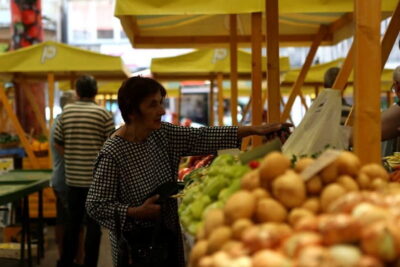
Sarajevo City Market, Old Town Food Tasting Tour
Read our review →
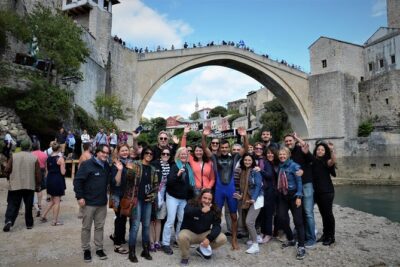
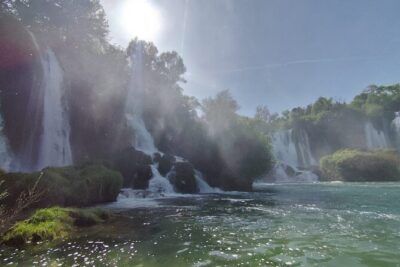
Half Day Trip to Kravice Waterfalls From Mostar with City Voucher
Read our review →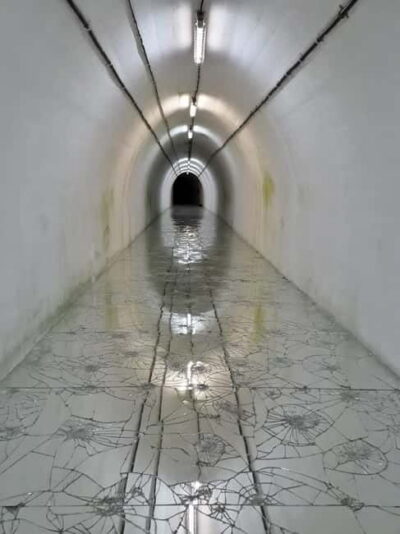
Banja Luka City Tour & A magical journey on Dayak boat
Read our review →
Browse the lists this tour appears in