
Reviewed · HISTORICAL TOURS
SARAJEVO STREET ART TOUR (art, history & mystery) – sARTajevo!
Sarajevo’s street art does more than brighten a wall. It records war, grief, humor, local identity, and the city’s changing creative life. This small-group evening walk connects pieces you could easily miss with the stories that give them weight.
I like the personal angle, especially when guides such as Alan, Ado, or Mak are leading the walk. I also like the tiny group, capped at five people, which gives you room to ask questions and keep the conversation moving. The main drawback is that the tour’s art selection is fairly focused, so anyone expecting a huge gallery of murals may find the two to three hours a little narrow.
Key points to know before you book
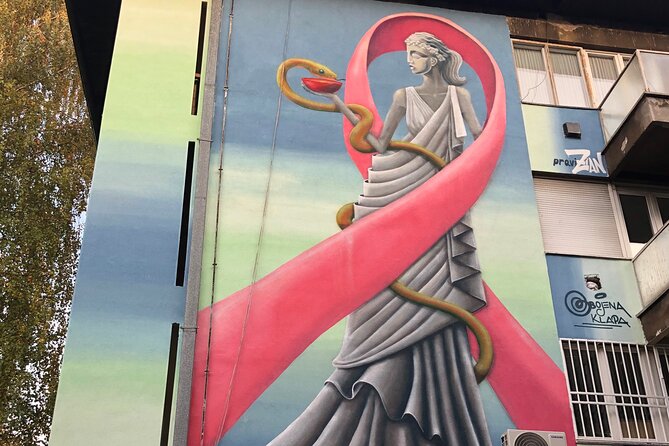
- The route links five art-rich areas: Bentbaša, Papagajka, the Academy of Fine Arts, Aria, and Ferhadija.
- The art carries serious history: The Srebrenica 1992/1995 mural and other works help explain Sarajevo beyond its usual landmarks.
- The guide is central to the experience: Alan, Ado, and Mak have led departures, with a focus on local art and city life.
- You see more than murals: Expect stickers, graffiti, gallery references, and the work of artists such as Mr. Chat.
- The group is very small: A maximum of five people makes this feel more like a guided conversation than a standard walking tour.
- It begins at 6 p.m.: The evening timing suits a warm-weather city walk and leaves the day free for Sarajevo’s museums and historic sights.
Sarajevo told through paint, paper, and walls
I would not book this tour simply to collect photographs of colorful walls. Its real value is the explanation around the art. Sarajevo’s public images can point toward painful events, local artists, social memory, and the ordinary life that continues around them.
That makes the walk useful even if you know little about street art. One participant with no background in the subject found the early development of Sarajevo’s street-art scene easy to follow. That is important because you do not need to arrive knowing the difference between a mural, sticker art, graffiti, or a formal gallery piece.
The tour also gives you another way to read the city. You can visit Sarajevo’s main sites on your own, but a guide can show how modern art sits beside older buildings, postwar memories, and daily routines. The result is less a lesson in decoration and more a portrait of how people use public space.
The company, Art and Tours Sarajevo, prices the experience at $30.04 per person. For a two to three-hour walk, that is reasonable if you value interpretation and a small group. You are paying less for admission, since the listed stops are free, and more for access to works that are easy to overlook plus the guide’s local understanding.
A few more Sarajevo trips to weigh up
- Mostar Street Art & Graffiti Tour
★ 5.0 · 19 reviews
Bentbaša and the first mural of the walk
The route starts at Đulagina 2 at 6 p.m. From there, the first stop is Bentbaša, where you see the mural titled In the preservation of monuments of the past. The title alone signals the approach of the tour: the wall is not treated as a stand-alone image, but as part of a conversation about Sarajevo’s past.
You can expect the guide to explain the mural in detail and place it within the city’s artistic and historical setting. That context is especially useful here because a quick look at a wall rarely tells you why it was made, what it refers to, or how local people might read it.
The stop lasts about 20 minutes. It is a short opening section, but that works well. You get an introduction to the guide’s method without spending the whole first hour on one piece.
Bentbaša is also a good place to begin because it moves you away from the most familiar tourist script. Instead of starting with a museum label or a grand architectural façade, you begin with art in the open air. Bring your attention, not just your camera.
Papagajka, a building with a street-art past
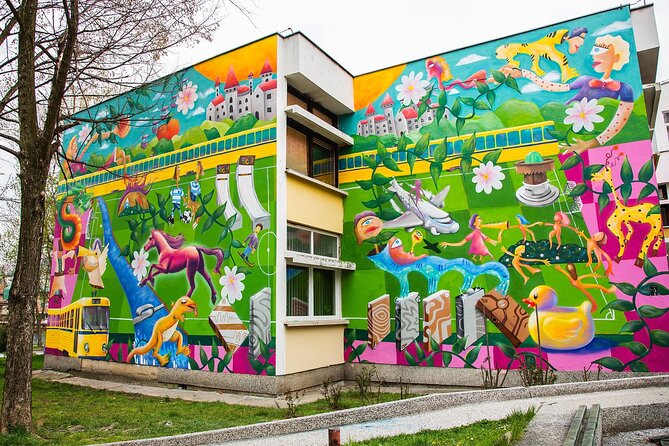
The next stop is Copy Papagajka, an art building also called Papagajka, or Perrot. The site is linked to Sarajevo’s first street-art festival, and wall-art examples appear here as part of the visit.
This is one of the more distinctive stops because the building itself matters. You are not simply stopping beside an isolated mural. You are looking at a place connected to the growth of the local street-art scene, where the setting and the art help explain each other.
The scheduled visit takes about 20 minutes. That is enough time for a clear explanation and a look at the work, though not enough for a long survey of every artistic detail. If you enjoy tracing how a city’s creative movements begin, this should be one of the most interesting parts of the route.
The name Copy Papagajka may be unfamiliar, so take note of it when you meet the group. The guide’s explanation is likely to make more sense than a quick search later, since the tour connects the building with people, events, and local art practice.
The Academy of Fine Arts and Sarajevo’s visual identity
At the Academy of Fine Arts, the tour shifts toward architecture, formal art, and stickers. The stop lasts about 30 minutes, making it the longest single visit on the route.
The academy is presented as one of Sarajevo’s most beautifully designed objects. That gives you a chance to consider how street art relates to an established art institution. The walk does not place public art in opposition to formal art. Instead, it shows several ways that Sarajevo expresses itself through images, buildings, and small interventions.
Sticker art is demonstrated and explained here. This matters because stickers are easy to miss. They may be smaller than murals, placed at eye level or tucked into a busy wall, and gone before a guidebook catches up with them. A guide can point out what you would otherwise walk past.
I like this part of the tour because it broadens the definition of street art. You are not limited to large painted walls. You see how artists can work on a much smaller scale, and how a city’s visual culture includes both carefully designed buildings and quick, portable pieces.
Same country, a completely different kind of day:
- Sarajevo: Mostar, Konjic, Blagaj Tekke, Pocitelj & Waterfall
★ 4.9 · 1,666 reviews - Fall of Yugoslavia, Sarajevo War Tour with Tunnel of Hope Museum and Frontlines
★ 5.0 · 1,314 reviews - Sarajevo: Grand Walking Tour Through Time and Cultures
★ 4.8 · 1,236 reviews - Sarajevo: Mostar, Konjic, Sufi House, Pocitelj & Kravice Falls
★ 5.0 · 1,179 reviews
Aria, Mr. Chat, and the Singer mural
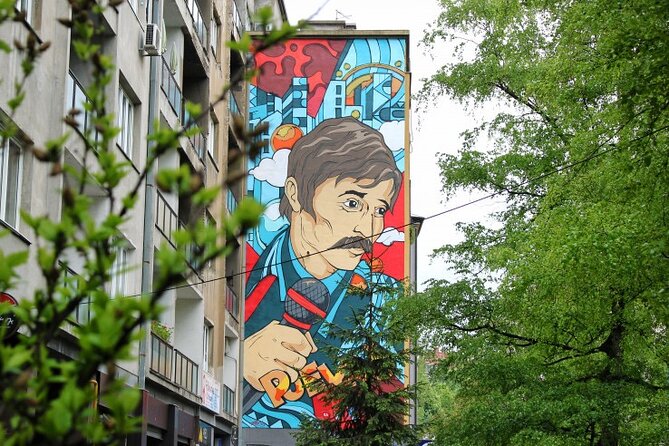
The Aria stop lasts about 20 minutes and brings together several different references: Mr. Chat, the Singer mural, known locally as Pjevač, and Gallery Boris Smoje.
This section should appeal to you if you like seeing how public art can cross styles and borders. Mr. Chat is a recognizable street-art figure, while the Singer mural and the gallery connection give the stop a more local frame. The guide’s job here is to explain what you are seeing and why these places belong on the same route.
Because the visit is brief, you should expect an introduction rather than a full art-history lecture on every artist. That is a fair trade on a walking tour with five separate areas. The route keeps moving, and you get a varied selection instead of one long stop.
This is also where a personal guide can make a difference. Alan has been described as an artist who discusses his own work as well as Sarajevo’s wider scene. Ado has been praised for clear English and strong knowledge of the city, while Mak has offered insight into the artists and people connected with the works. The guide on your departure may differ, but the experience clearly depends on someone who knows the scene from close range.
Ferhadija and the Srebrenica mural
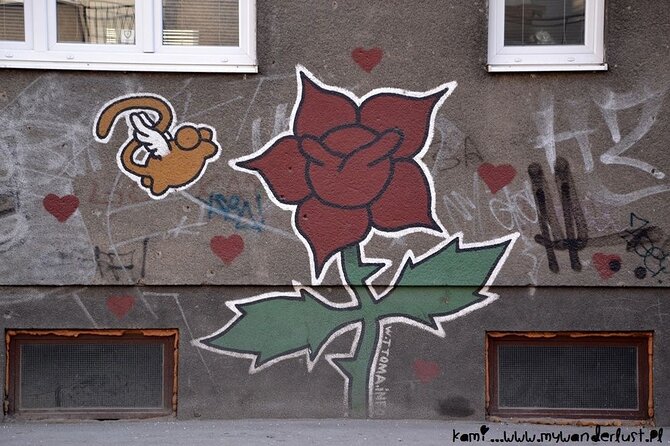
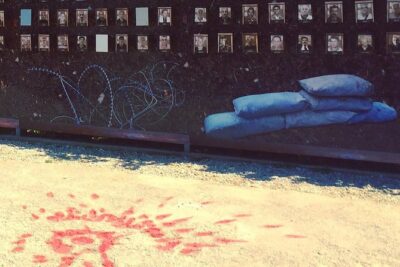
The final major stop is behind Ferhadija Pedestrian Street, where you see the mural Srebrenica 1992/1995. The tour also uses the surrounding area to introduce Sarajevo’s graffiti scene.
This is the most emotionally serious part of the route. A mural naming Srebrenica is not casual decoration, and the guide’s explanation helps you approach it with care. You should expect the tour to connect the image to Bosnian and Sarajevo history, while also showing how public art can keep memory present in a busy city center.
The stop lasts about 30 minutes, giving it enough time for context rather than a quick photograph. I see this as one of the strongest reasons to choose the tour. You can stand in front of a memorial image and understand its subject more clearly, rather than passing it without knowing what you are looking at.
The surrounding graffiti discussion keeps the stop from becoming only a memorial visit. Sarajevo’s public walls also show humor, experimentation, personal expression, and the city’s current creative energy. The contrast is useful. It shows that remembrance and everyday life share the same streets.
Why the guide matters more than the free admission
Every listed stop has free admission. That is good news, but it also means you could technically walk near the sites without buying a ticket. The question is what you would understand without the guide.
I would not expect the tour to provide a printed museum-style catalog for every piece. Its value is the live explanation, the route between works, and the chance to ask about art that is not always easy to identify. Several guides have been described as friendly, clear in English, and closely connected to Sarajevo’s art community.
The small group matters here. With no more than five participants, you are less likely to lose the guide’s explanation in a crowd. You can ask why a particular image matters, how sticker art differs from a mural, or how the city’s street-art culture developed.
There is also a useful personal touch in seeing a guide’s own work when applicable. That gives you a direct connection to the people making art in Sarajevo now, rather than hearing only a general explanation from someone passing through.
Still, keep your expectations in check. One assessment found the structure and content could be more developed, with more works available to include. That criticism is fair. Sarajevo has more public art than this route can cover, and this experience offers a selective introduction rather than a complete survey.
Timing, walking pace, and group size
The tour starts at 6 p.m. and returns to the same meeting point. The timing is practical: you can spend the day at Sarajevo’s major historic sites, then use the evening to see a different side of the city.
The stated duration is approximately two to three hours. The five stops have listed visit times totaling about two hours, with the remaining time likely used for walking and explanations between locations. Wear comfortable shoes and leave enough room in your schedule for the longer end of that range.
The tour is offered in English. The guide names connected with past departures include Alan, Ado, and Mak. Since the assigned guide can vary, you should think of the strength of the format as local, personal interpretation rather than a guarantee that one particular person will lead every date.
A maximum of five travelers is a real advantage. It suits you if you prefer a conversational walk and want to ask questions. It may be less suitable if you want to stay anonymous in a large group or if your main goal is a fast list of photo stops.
The activity is near public transportation, and most people can participate. Service animals are allowed. No special admission tickets are needed at the five stops.
Who will get the most from this walk
I would recommend this experience to you if you have already seen some of Sarajevo’s main sights and want more context about present-day city life. It also works early in a visit, since the guide may help you notice public art during the rest of your stay.
You do not need to call yourself an art person. One of the best features is the way the guide explains the subject for people starting from zero. If you enjoy history, the Srebrenica mural and the references to Sarajevo’s past give the walk serious purpose.
It is also a good match for anyone interested in local voices. The tour shows a city where people make art, gather, remember, and continue with daily life. You see Sarajevo through walls and small details rather than only through famous monuments.
I would hesitate if you want a large number of finished murals, a broad citywide survey, or a heavily structured art course. The route has five main areas and a limited set of works. Its strength is the conversation and context, not sheer quantity.
Is $30.04 a fair price?
At $30.04 per person, the cost makes sense for a maximum group of five and a two to three-hour guided walk. Since the stops are free, the price is easy to understand: you are paying for the guide’s time, route planning, interpretation, and local access to a part of Sarajevo that is not always obvious.
The value improves if you are curious and willing to ask questions. A silent walk past the walls would offer less. The more you want to know about artists, symbols, wartime memory, and the city’s changing creative culture, the more useful the fee becomes.
You should also consider what the tour replaces. If you already plan to wander Sarajevo on foot, this gives that wandering a clear purpose. If you only want a short evening stroll, the price may feel high compared with exploring independently.
Free cancellation is available if you cancel at least 24 hours before the 6 p.m. start time. Changes made within 24 hours are not accepted, and a minimum number of participants is required for the tour to operate. If that minimum is not met, you are offered another date or experience, or a full refund.
Should you book the Sarajevo Street Art Tour?
Book it if you want Sarajevo explained through modern public art, wartime memory, and local creative life. The strongest parts are the tiny group, the personal guide approach, the Srebrenica mural, and the chance to find stickers and wall art that you might miss alone.
Do not book it expecting a giant open-air museum or a complete record of every mural in town. This is a focused route with a few key areas, and its quality rests heavily on the guide.
For most visitors, I think it is a worthwhile addition to a Sarajevo stay, especially after you have seen the main historic sights. At $30.04, it offers a thoughtful evening walk and a more personal view of the city than a standard sightseeing circuit.
FAQ
Where does the Sarajevo Street Art Tour start?
The tour starts at Đulagina 2, Sarajevo 71000, Bosnia and Herzegovina.
What time does the tour begin?
The scheduled start time is 6 p.m.
How long does the tour last?
The tour lasts approximately two to three hours.
Where does the tour finish?
The activity ends back at the meeting point.
What language is the tour offered in?
The tour is offered in English.
How many people can join the tour?
The maximum group size is five travelers.
Are admission tickets included?
The five listed stops have free admission, so no admission fee is listed for them.
Can I cancel for a full refund?
Yes. You can cancel at least 24 hours before the experience start time for a full refund. Cancellations or changes made less than 24 hours before the start time are not accepted for a refund.
Just added around Sarajevo
- Sarajevo Under Siege: A War History Tour★ 5.0 · 10 reviews
- WAR TUNNEL – Sarajevo’s only way of a communication during the WAR – Top secret★ 5.0 · 12 reviews
- Private Full Day Safari Tour★ 5.0 · 8 reviews
- Ultimate Gastro Experience★ 4.5 · 14 reviews
- Mysterious Visoko Pyramids Driving and Walking Tour★ 5.0 · 7 reviews
- Secret Tito’s Bunker/Konjic Tour★ 5.0 · 4 reviews
- The Secret Lifeline: Sarajevo’s War Tunnel Tour★ 5.0 · 6 reviews
- Crossroads of Cultures – Sarajevo Walking Tour★ 5.0 · 8 reviews
Historical Tours, compared.
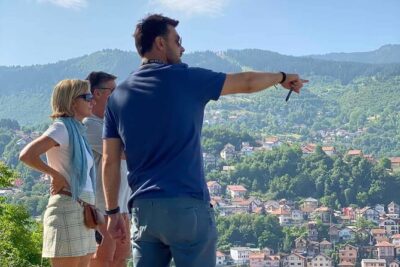
Sarajevo Full Day Tour: History, Culture, Nature, War & Olympics
Read our review →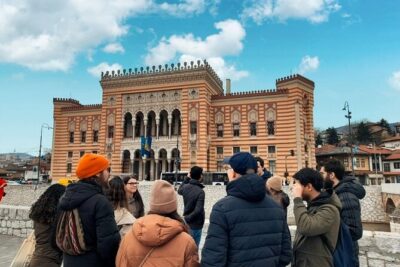
Sarajevo genuine walking tour: Steps through history
Read our review →
BOSNIAN PYRAMIDS TOUR (nature, history & archeology)
Read our review →
Browse the lists this tour appears in