
Reviewed · TOURS
Sarajevo: Islamic Traditions and Daily Life Tour
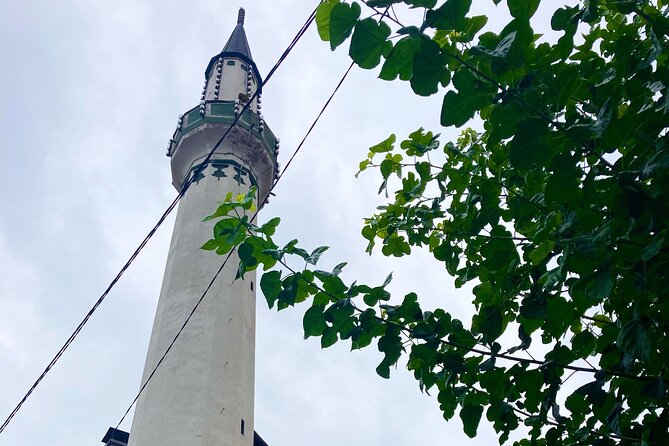
Sarajevo’s Islamic story is best understood on foot, where a mosque, market, cemetery, school, and coffee stop still fit into the rhythm of daily life. This tour links those pieces across the old city, from the city’s founding site to Ottoman homes and the famous lunar clock.
I like the small-group feel, with a maximum of 25 people and the chance of a very personal walk with guides such as Suad or Fuad. I also like the practical mix of major sights and ordinary details, including water at Sebilj, food on Bravadžiluk Street, and the restored rooms of Svrzo’s House.
The main caution is the pace. You cover a lot in about two hours, and part of the route includes an uphill walk. Entrance fees are also extra, so budget for 5 BAM for Svrzo’s House and 8 BAM for the Gazi Husrev-beg Mosque and Museum if you want to go inside.
Key points at a glance
- Ottoman Sarajevo in two hours: Cover mosques, a madrasa, an old inn, a cemetery, a bazaar, and an 18th-century house.
- A useful first-day walk: The tour gives you a clear framework for understanding Sarajevo’s Muslim heritage before exploring alone.
- Suad and Fuad are named guides: The experience is designed around conversation, questions, and local explanation rather than a silent sightseeing circuit.
- Some walking uphill: Comfortable shoes matter, especially if you want to keep up without rushing.
- Two paid cultural stops: Svrzo’s House costs 5 BAM, while the Gazi Husrev-beg Mosque and Museum costs 8 BAM.
- Open to Muslim and non-Muslim visitors: You do not need a particular religious background to take part.
Why this walk helps you understand Sarajevo
Sarajevo is not a city where Islamic heritage sits in one isolated quarter. It is woven into streets, schools, markets, fountains, cemeteries, and the shape of the old town. That is what makes this experience more useful than a quick mosque visit.
Your guide connects religious buildings with the social life around them. You see where people gathered, studied, traded, prayed, traveled, and remembered the dead. The result is a walk about daily Muslim life in Bosnia, not only about architectural decoration.
The route also gives you a gentle introduction to the Ottoman influence that shaped Sarajevo. You will see how public buildings and private homes worked together, then move into Baščaršija, where trade and food still give the old center much of its character.
The tour is offered in English and lasts about two hours. That is enough time for a strong overview, but not enough for long visits at every stop. Think of it as a focused orientation walk, with the option to return later to the places that catch your interest.
Other Sarajevo days people book alongside this one:
- Sarajevo: Mostar, Konjic, Blagaj Tekke, Pocitelj & Waterfall
★ 4.9 · 1,666 reviews - Fall of Yugoslavia, Sarajevo War Tour with Tunnel of Hope Museum and Frontlines
★ 5.0 · 1,314 reviews - Sarajevo: Grand Walking Tour Through Time and Cultures
★ 4.8 · 1,236 reviews
Starting at Mejdan Park and the Jedileri Sanctuary
The walk begins at Mejdan Park, a historic place linked with the official establishment of Sarajevo. It was also a gathering place for social activity, which makes it a useful opening stop. You start with the city as a community, not just as a collection of monuments.
The stop is brief, only about five minutes, so expect an explanation rather than a long visit. I like this beginning because it gives the rest of the walk a clear question: how did Sarajevo grow around its religious and social institutions?
From there, you reach Turbe sedam braće, also called the Jedileri Sanctuary. This sacred Islamic site offers a chance to discuss spiritual practice and the place of faith in Muslim life in Bosnia.
Again, the stop is short. The value comes from listening to the guide’s context and asking questions. If you want a quiet moment, you may need to take it quickly before the group moves on.
The Emperor’s Mosque and Sarajevo’s name
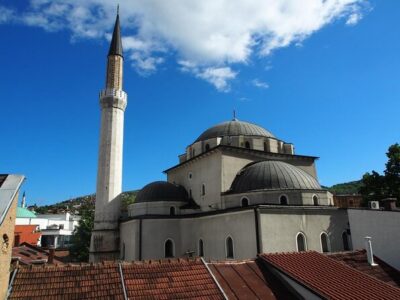
The Emperor’s Mosque is described as Sarajevo’s oldest mosque. It is an important early marker of the city’s Islamic development, and the guide uses it to explain how Islamic heritage helped shape Sarajevo’s name and identity.
You have only about three minutes here, so do not expect a full architectural tour. Still, this brief stop matters because it places the city’s story in a wider historical setting before you reach the more substantial visit at Gazi Husrev-beg Mosque.
This is also a point where your questions can make a difference. A guide such as Fuad or Suad can help you connect the building to the broader story of Bosnia and Herzegovina, rather than treating it as a quick photo stop.
Gazi Husrev-beg Mosque and the lunar clock
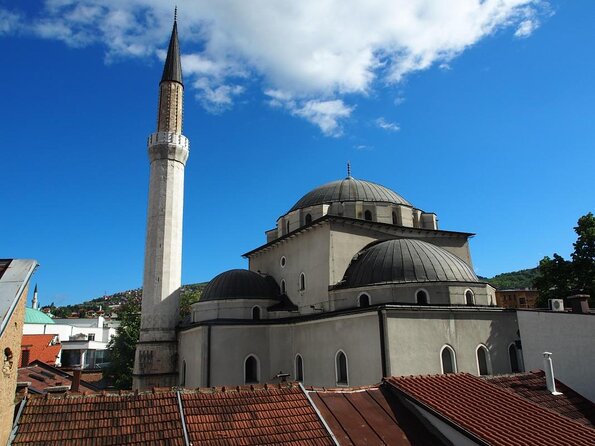
The Gazi Husrev-beg Mosque is the central religious and cultural stop. You spend around 30 minutes in this area, making it the longest pause on the walk.
The mosque is presented as a key symbol of Sarajevo’s Islamic heritage and community life. You will have more time here to look closely, listen, and understand why this place has such weight in the city. The accompanying museum entrance is not included in the tour price, and admission is 8 BAM, listed as about €4.50.
Nearby, Sarajevo’s historic Clock Tower offers one of the route’s most unusual details. It is a lunar clock, designed around the Islamic lunar calendar rather than the time system used by most modern public clocks.
That small piece of working city infrastructure tells you a lot. Religious time was not separate from public life. It shaped how the city marked the day and organized its routines. The clock is worth noticing even though the stop is not given a separate duration.
Same country, a completely different kind of day:
- Sarajevo: Mostar, Konjic, Sufi House, Pocitelj & Kravice Falls
★ 5.0 · 1,179 reviews - Sarajevo: Tunnel Museum Yugoslavia War Tour with War Veteran
★ 5.0 · 1,111 reviews - ROSES OF SARAJEVO (Official WAR + CITY tour)- Story of a Survivor
★ 5.0 · 770 reviews - Sarajevo: Tunnel of Hope Tour – Survival and Resilience
★ 4.8 · 630 reviews
The madrasa and Sarajevo’s tradition of learning
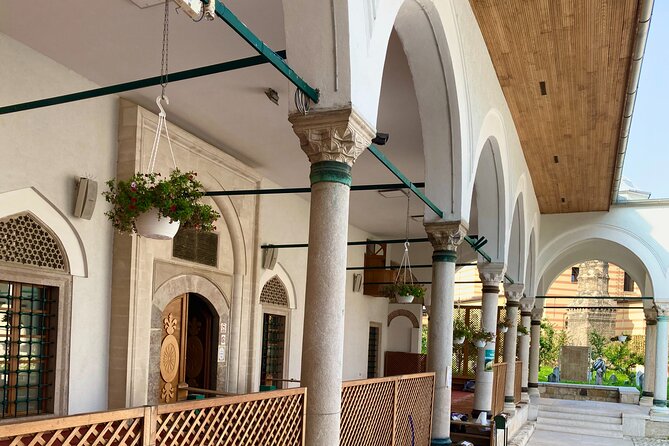
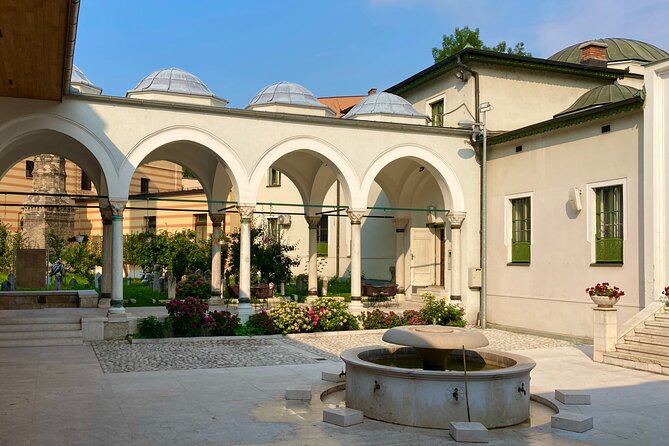
Gazi Husrev Begova Medresa was founded in 1537 and is described as Sarajevo’s first Islamic high school. The building links religious life with education, a theme that helps explain why the city’s Islamic institutions mattered beyond worship.
You spend about ten minutes here. That is long enough for a useful introduction, though access to the interior may depend on the tour arrangements. Admission is not included in the base price.
I find this one of the strongest stops for anyone interested in how a city’s culture is passed on. Mosques show public faith. A madrasa shows how knowledge and religious teaching were organized for future generations.
Svrzo’s House and the details of private life
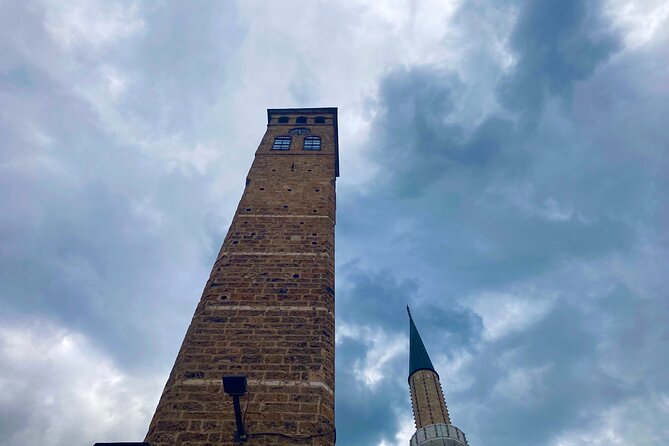
Svrzo’s House is likely to be one of the most rewarding stops for visitors who want to see how people lived, rather than only where they prayed. This well-preserved Ottoman home presents Muslim domestic life in Bosnia during the 18th century.
You spend about 20 minutes here, and the entrance fee is 5 BAM, listed as about €3. That is a modest extra cost for a stop that adds texture to the tour. Without it, the walk would lean more heavily toward public monuments.
An old house can explain social customs in a way a grand building cannot. Rooms, household arrangements, and domestic design help you picture the people who used these spaces. The visit also gives you a break from the street and a more intimate look at Ottoman-era Sarajevo.
This is another place where the short overall duration matters. You will get an introduction, not an unhurried museum visit. If the house interests you, note it as a place to revisit after the tour.
The Faculty of Islamic Studies and Baščaršija
The Faculty of Islamic Studies at the University of Sarajevo brings the story into the modern period. Its architecture combines Neo-Moorish-inspired elements with modern design, linking education, faith, and contemporary Sarajevo.
The stop lasts only about a minute, so think of it as a visual pause. Your guide points out the building and explains its role, while you take in the contrast between older Ottoman forms and later architectural ideas.
The route then moves into Baščaršija, Sarajevo’s old bazaar. You spend about 20 minutes walking through its cobbled streets and craft areas.
This is where the tour’s themes become easy to see in everyday form. Trade, food, religious buildings, fountains, and public meeting places all sit close together. Baščaršija can be busy, so stay near the guide and listen carefully during street explanations.
Sebilj and Bravadžiluk Street
Sebilj Fountain is one of Sarajevo’s best-known symbols and a central point in local Muslim tradition. The stop lasts only about a minute, but the fountain works as a quick reminder that water, charity, and public gathering were part of the old city’s social life.
You may have the chance to drink from the fountain. It is a simple act, but it connects you to a custom that is more meaningful than a standard photo stop.
Bravadžiluk Street follows with about 20 minutes focused on Muslim culinary traditions and crafts. This is a good place to pay attention to the smells, shop displays, and food culture around you.
The route does not include a meal, so plan to buy food separately if something catches your eye. A previous guide also spent extra time suggesting places to eat, which is the sort of useful local advice that can make the rest of your stay easier.
Alifakovac Cemetery and Morića Han
Alifakovac Cemetery is an optional stop. You spend only about two minutes there, but the setting offers a quiet counterpoint to the market streets. It is associated with notable Muslims in Bosnia and gives you a chance to reflect on the people who shaped Sarajevo’s religious and civic life.
Because the visit is so short, it will not be a detailed cemetery tour. It is best understood as a brief pause and a chance to see another form of Islamic heritage.
Morića Han is the final historic stop. It is Sarajevo’s best-preserved Ottoman inn and once served Muslim travelers moving through Bosnia. The stop is also brief, around three minutes, but it rounds out the tour’s picture of movement and commerce.
You have seen where people worship, study, live, shop, gather, and rest. That range is the real strength of the route.
Walking demands, group size, and timing
The tour starts at 10:00 a.m. at Sarajevo Insider, 30 Zelenih beretki, and returns to the same meeting point. It is near public transportation, which makes the starting location practical if you are staying elsewhere in the city.
The maximum group size is 25 people. That is not a private tour by definition, but it is small enough for a guide to handle questions. In one reported case, a participant had the guide to themselves, so the actual group can sometimes be much smaller.
The route includes quite a bit of walking uphill. Wear comfortable shoes, and do not treat this as a flat stroll through the bazaar. Most people can participate, but the climb is the main physical point to consider when deciding if this is right for you.
The two-hour length is both an advantage and a limit. You can fit it into a busy morning, but several stops are very short. If you want extended time inside the mosque, museum, house, or madrasa, you may need to return independently.
What the $30.04 price includes
At $30.04 per person, the tour is reasonably priced for a guided cultural walk in Sarajevo, especially because it covers many different sites and includes a certified guide plus a city map.
The price is strongest if you want interpretation. You are not simply paying to be led from one building to another. The guide explains the connection between Islamic belief, Ottoman institutions, education, architecture, food, and ordinary life.
You should add 13 BAM if you plan to pay for both listed entrances. That brings the known additional cost to 5 BAM for Svrzo’s House and 8 BAM for the Gazi Husrev-beg Mosque and Museum.
The base price does not include meals or drinks. It also does not turn the tour into a full museum visit. I would see it as good value for a first look, especially if you are curious about Bosnia’s Muslim-majority culture and want a clear introduction without committing to a full-day program.
Who should book this experience
I would recommend it to first-time visitors who want a historical framework for Sarajevo. It is especially useful if you are interested in Ottoman history, Islamic architecture, Bosnia and Herzegovina, or the way religion shapes public life.
You do not need to be Muslim. The walk is designed to explain Islamic traditions and daily life, and it suits both Muslim and non-Muslim visitors. The tone is also a good fit if you like asking questions and learning through conversation.
It may be less suitable if you want a slow architectural photography walk or a full museum tour. The short stops and uphill section require you to accept a brisk overview.
The guide can also add value beyond the formal route. Suad is described as friendly and welcoming, while Fuad is noted for clear explanations about Sarajevo’s Islamic history and culture. Guide availability can vary, but the experience is built around this personal approach.
Booking and cancellation details
Confirmation is provided at booking, and the activity requires good weather. If poor weather cancels the tour, you are offered another date or a full refund.
You can cancel for a full refund up to 24 hours before the start time. Changes or cancellations made less than 24 hours before the 10:00 a.m. start are not accepted for a refund.
The tour also requires a minimum number of participants. If that number is not reached, you are offered another date or experience, or a full refund.
Should you book the Sarajevo Islamic Traditions and Daily Life Tour?
Book it if you want context, conversation, and a compact route through Sarajevo’s Muslim heritage. The strongest parts are the Gazi Husrev-beg area, the madrasa, Svrzo’s House, and the way Baščaršija connects religious history with food and trade.
Before booking, be ready for uphill walking, short visits, and extra entrance fees. If those points suit you, this is a smart way to begin your Sarajevo stay. You will leave with a clearer sense of how mosques, schools, homes, markets, fountains, and Ottoman inns fit together in the life of the city.
FAQ
How long does the Sarajevo Islamic Traditions and Daily Life Tour last?
The tour lasts approximately two hours.
What time does the tour start?
The tour starts at 10:00 a.m.
Where does the tour begin and end?
It begins at Sarajevo Insider, City Tours and Excursions, at Zelenih beretki 30 in Sarajevo. It ends back at the same meeting point.
Is the tour offered in English?
Yes. The tour is offered in English.
What is included in the tour price?
The price includes a certified guide and a city map.
Are entrance fees included?
No. Admission to Svrzo’s House costs 5 BAM per person, and admission to the Gazi Husrev Bey’s Mosque and Museum costs 8 BAM per person.
How large can the group be?
The maximum group size is 25 people.
Is the tour suitable for most people?
Most people can participate, but the walk includes some uphill sections. Comfortable shoes are recommended.
Can I cancel for a full refund?
Yes. You can cancel at least 24 hours before the start time for a full refund. Cancellations or changes made less than 24 hours before the start time are not accepted for a refund.
Just added around Sarajevo
- Sarajevo Under Siege: A War History Tour★ 5.0 · 10 reviews
- WAR TUNNEL – Sarajevo’s only way of a communication during the WAR – Top secret★ 5.0 · 12 reviews
- Private Full Day Safari Tour★ 5.0 · 8 reviews
- Mysterious Visoko Pyramids Driving and Walking Tour★ 5.0 · 7 reviews
- Ultimate Gastro Experience★ 4.5 · 14 reviews
- Secret Tito’s Bunker/Konjic Tour★ 5.0 · 4 reviews
- Crossroads of Cultures – Sarajevo Walking Tour★ 5.0 · 8 reviews
- The Secret Lifeline: Sarajevo’s War Tunnel Tour★ 5.0 · 6 reviews
Tours, compared.

Fall of Yugoslavia, Sarajevo War Tour with Tunnel of Hope Museum and Frontlines
Read our review →
Blagaj, Počitelj & Kravice Waterfalls Day Tour
Read our review →
Bosnian War & Fall of Yugoslavia Tour with Tunnel
Read our review →
Herzegovina Day Tour from Mostar: Blagaj, Pocitej, Kravice falls (Join Us! :D)
Read our review →Browse the lists this tour appears in