
Reviewed · SARAJEVO SIEGE TOURS
The Death of Yugoslavia: Unique thematic Tour in Mostar
The most unusual thing about this Mostar tour is its structure: Yugoslavia’s story unfolds in four chapters, each at a different location. You move through the Cold War, Tito’s socialism, the wars of the 1990s, and Bosnia and Herzegovina today rather than hearing one long lecture in a city square.
I like the use of music and visual material, including historical photographs and secret documents. I also like the guides’ personal connection to the subject. Simon, for example, has drawn on family experiences across three generations, while Marko, Marco, and Saddy have each been praised for clear English, humor, storytelling, and a measured approach. The main consideration is that this is a serious history tour, not a light sightseeing outing, and the route includes several short walks in addition to van rides.
Four reasons this tour is different
- A four-part storyline: The tour follows Yugoslavia from its creation to its breakup and then asks what Bosnia and Herzegovina faces now.
- Unannounced locations: Each stop represents a chapter in the story, and the exact character of the places is kept quiet to make the route feel more revealing.
- Music as historical evidence: Popular songs and cultural shifts help explain daily life in the 1970s and 1980s.
- Rare visual material: Photographs and documents give the political story a human scale.
- Guides with different voices: Marko, Simon, Marco, and Saddy are among the named guides praised for storytelling and strong English.
- A useful Mostar starting point: You meet close to the Old Bridge, then leave the tourist center for places you would be unlikely to find alone.
Why Yugoslavia is best understood in chapters
Yugoslavia is easy to reduce to a few familiar words: Tito, communism, nationalism, and war. That shortcut misses the point. The country was not simply a failed state waiting to break apart. It was a complicated political experiment that gave many people a distinct identity, a certain degree of freedom compared with other socialist countries, and a shared culture that still carries emotional weight.
This tour tries to show that full arc. You begin with the creation of Socialist Yugoslavia after World War II. You then move into the Cold War, the split with the Soviet Union, Tito’s version of socialism, ordinary life, economic problems, rising nationalism, the wars, and the difficult present.
I find this approach useful because it links the big events to ordinary choices. A discussion of militarization becomes easier to understand when placed at a real location. A talk about industrialization has more force when it includes cars, brands, music, youth work, and changing lifestyles. The tour is not only about presidents and armies. It asks what the country felt like to live in.
The subject can also be painful. The war in Bosnia and Herzegovina caused enormous destruction and loss of life, and many people still carry direct memories of it. The guides appear to handle the topic with care, but you should come prepared for serious discussion rather than neat answers.
More sarajevo siege tours in Mostar:
- Break-up of Yugoslavia & The War in Mostar: Life Under Siege
★ 5.0 · 136 reviews - The Death of Yugoslavia Tour in Mostar
★ 5.0 · 102 reviews - Fall of Yugoslavia, Sarajevo War Tour with Tunnel of Hope Museum and Frontlines
★ 5.0 · 1,314 reviews
Meeting near the Old Bridge and leaving Mostar behind
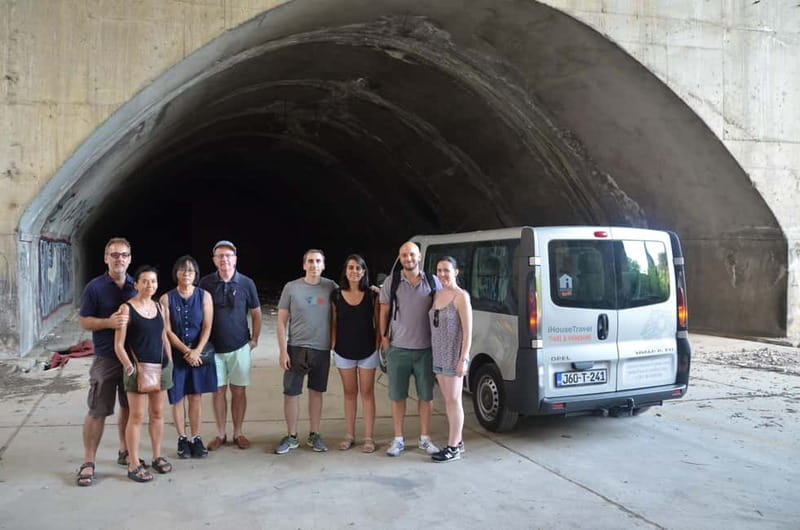
The tour starts in front of iHouse Travel, a short walk from Mostar’s Old Bridge. That is a practical meeting point if you are already exploring the old town, though the center can be busy and confusing. Give yourself time to locate the office before the scheduled departure.
From there, you ride in a modern car or van. The first drive to Gnojnice is listed at about 20 minutes. Further transfers are shorter, around 15 minutes between Gnojnice and Rodoč, another 15 minutes before Španski trg, and about 10 minutes on the final legs.
The van matters more than it might seem. The tour is built around places outside the standard Mostar sightseeing circuit, so walking between them would not be practical. During the drives, your guide continues the story, which keeps the time useful. One particularly strong feature is the steady flow of information during transport, but if you prefer a quiet ride, this is not that kind of excursion.
The exact locations are presented as part of the experience, so do not expect a complete advance map with a description of every stop. The itinerary identifies Gnojnice, Rodoč, Španski trg, and Bijeli Brijeg 1, but the tour’s presentation treats them as four story settings rather than ordinary photo stops.
Chapter One at Gnojnice: fear, independence, and the Cold War
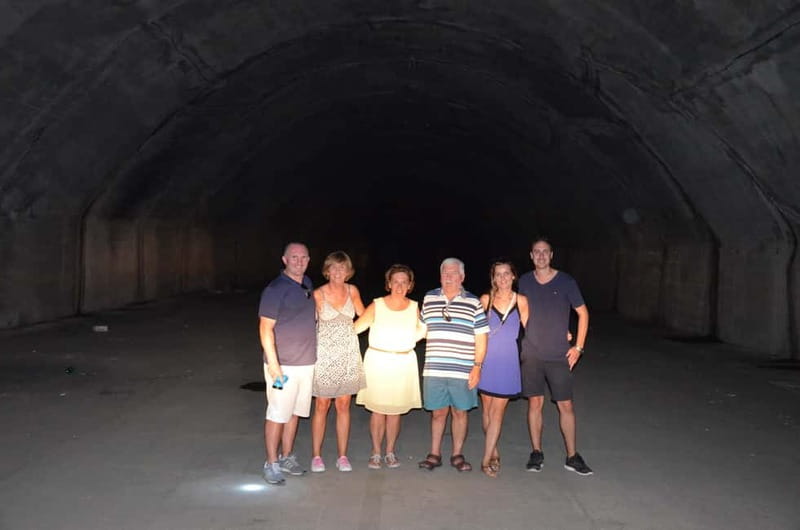
The first substantial stop is Gnojnice, with about 45 minutes of guided discussion. Here the story begins with World War II and the birth of Socialist Yugoslavia before moving into the Cold War.
The key subject is the Informbiro period, when Yugoslavia broke with the Soviet Union and followed its own political path. That split created a country surrounded by suspicion. Yugoslavia was socialist, yet it refused to follow Moscow’s orders. The result was a period marked by fear, political pressure, and an intense concern with defense.
The stop also covers militarization during the 1950s. Rather than treating this as a dry policy issue, the tour connects it to the country’s wider sense of danger. Yugoslavia had to prepare for possible conflict while proving that its version of socialism could survive outside the Soviet bloc.
This is where the tour’s use of photographs and documents can help. Written material can show how states present threats and justify decisions. Images can show the physical side of that fear. The combination gives you more than a timeline.
You should also expect the first stop to set the tone for the rest of the experience. The subject is political, but the aim is not to turn the tour into a debate between competing national narratives. The guides are expected to explain why events happened and how people experienced them, while avoiding easy slogans.
Chapter Two in Rodoč: Tito, work, and everyday life
The second stop is in Rodoč, reached after roughly 15 minutes in the van. The guided portion is listed at about 30 minutes and focuses on Josip Broz Tito and the lives people built under his rule.
Tito is often treated either as a hero or as a dictator. This tour gives you room to consider both the political achievements and the limits of his system. You hear about his personal life, his leadership, and his effort to create a distinct form of socialism for Yugoslavia.
The useful shift here is from Tito himself to ordinary people. The tour covers Youth Work Actions, a major part of the country’s effort to involve young citizens in construction and public projects. It also discusses industrialization during the 1950s and 1960s, when factories, transport, and modern consumer habits changed daily life.
This section should help you understand why many former Yugoslav citizens remember the country with genuine affection. Memory is not only about political control or economic shortages. It can also include a first job, a popular song, a family car, a holiday, a sports event, or the feeling of belonging to a larger country.
The discussion of the 1970s and 1980s adds useful detail. You look at brands, cars, music, popular culture, and lifestyle trends. These topics may sound modest beside Cold War politics, but they are exactly what makes a national story understandable. People experience political systems through shopping, work, television, music, school, and family life.
The guide’s personal stories can be especially valuable here. Simon has been praised for bringing in the experiences of his grandfather and father, which allows the era to be viewed across three generations. That does not make one family’s experience a complete picture, but it can make an abstract period feel real.
Same country, a completely different kind of day:
- Dubrovnik: Kravica Waterfalls, Mostar and Pocitelj Day Trip
★ 4.5 · 3,045 reviews - From Mostar: Blagaj, Počitelj & Kravice Waterfalls Day Tour
★ 5.0 · 1,310 reviews - From Mostar: Kravice Waterfalls, Blagaj, & Počitelj
★ 5.0 · 565 reviews - Herzegovina Day Tour from Mostar: Blagaj, Pocitej, Kravice falls (Join Us! :D)
★ 5.0 · 372 reviews
Chapter Three at Španski trg: the golden era and the break
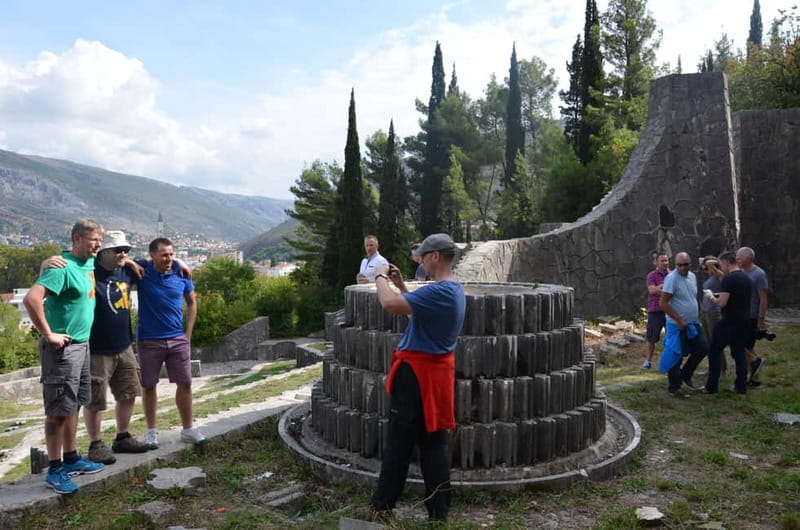
The third stop is Španski trg, after another approximately 15-minute drive. The guided time is listed at about 40 minutes. This chapter covers the 1980s, including the 1984 Sarajevo Winter Olympics, which the tour presents as a high point for Yugoslav socialism.
The Olympics are an effective turning point. They represent international recognition, confidence, and a shared Yugoslav identity. The country could present itself to the world as modern and capable, and many people remember the period as a golden era.
Then the mood changes. The tour examines economic decline and the growth of nationalism. These forces did not work in isolation. Financial strain made political promises harder to keep, while nationalist leaders increasingly defined their communities against one another.
You follow the first conflicts in Slovenia and Croatia before moving toward the war in Bosnia and Herzegovina. The point is not simply to list dates or battles. It is to consider how a shared political project lost its ability to hold together, and how the Yugoslav dream gave way to fear, division, destruction, and death.
This may be the most emotionally difficult section. The subject is close to Mostar, and the consequences are not distant history. A guide who can explain the period without turning it into a one-sided national story is essential. Marco has been praised for offering an objective account of local history, and that balanced tone is particularly important here.
The stop is also where the earlier chapters pay off. You have already heard about Yugoslavia’s creation, its Cold War position, Tito’s system, and daily life. Now the breakup is presented as the collapse of a country people had actually inhabited, not just the end of an administrative arrangement.
Chapter Four at Bijeli Brijeg 1: Bosnia and Herzegovina now
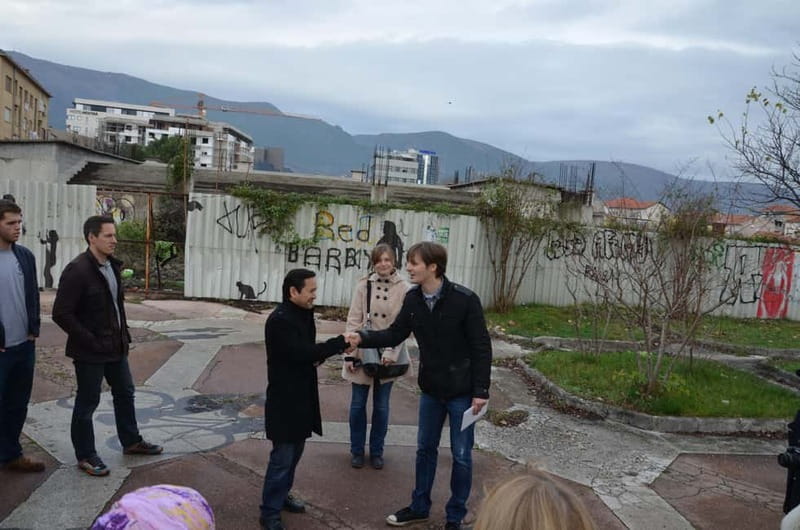
The final location is Bijeli Brijeg 1, reached after a short drive from Španski trg. The listed guided time is about 45 minutes, making this the longest of the four discussions.
Here the tour turns to present-day Bosnia and Herzegovina. You examine the country’s political structure and the problems it faces in the early 21st century. The final discussion also considers the possibility of European Union membership and the economic, cultural, and political recovery still needed.
This closing chapter is important because it prevents the tour from ending in 1995. Bosnia and Herzegovina is not only a place marked by war. It is a country trying to manage a difficult political system, rebuild confidence, protect cultural life, and find a workable future.
The final walk is meant to bring together the physical remains of an earlier period and the country’s current reality. You may find the contrast striking: traces of a once-powerful state beside the practical problems of a modern country still working through its past.
Do not expect a simple answer about EU membership or Bosnia’s future. The value is in seeing how history continues to shape politics, identity, and economic choices. For me, that makes the final stop more useful than a sentimental ending about old Yugoslavia.
Music, photographs, and documents make the story stick
The tour uses an experimental method, bringing music into the discussion of cultural change. That is a smart choice. Songs often cross political borders more easily than official speeches, and popular music can show what people were listening to, celebrating, and arguing about.
The cultural section also covers consumer brands, the car industry, and lifestyle trends. These details help you picture the decades rather than treating them as black-and-white political blocks.
Historical photographs and secret documents add another layer. They can show how official institutions described the country, how public life was presented, and how the state wanted its citizens to see the world. They also give the guide something concrete to explain at each stop.
The visual material will not replace careful historical context. It works best when the guide explains what you are seeing, why it matters, and what it leaves out. The strongest guides on this tour appear to use the material as a prompt for discussion rather than as decoration.
How the $41 price works out
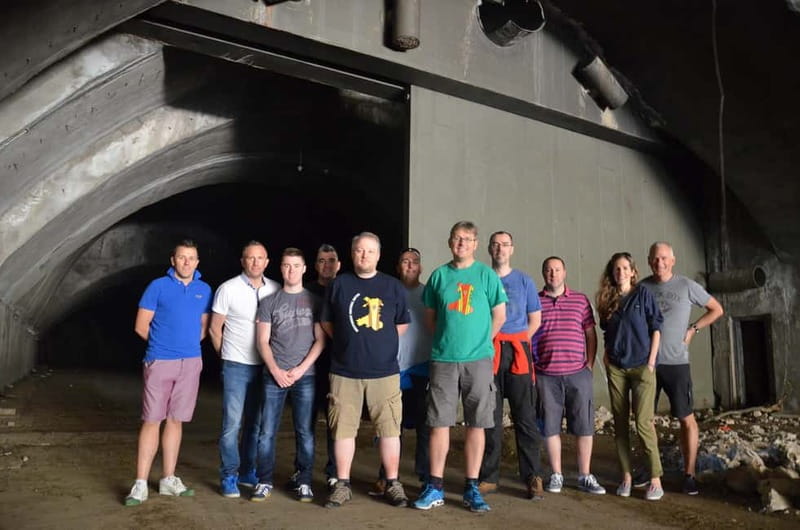
At $41 per person, the tour is not the cheapest way to spend two and a half hours in Mostar. It is also more than a basic walking tour, because you are paying for transport beyond the old town, a live English-speaking guide, four locations, special equipment, and a carefully planned theme.
I think the price is fair if you want historical context and a route you could not easily create yourself. The van saves time, and the guide links the stops into one story rather than offering four disconnected visits. The inclusion of visual material and music also gives the tour more structure than a standard talk.
The value is lower if you mainly want scenic views or casual sightseeing. The secret sites are described as breathtaking, but the main reward is the story attached to them. You should book this for the interpretation, not for a guaranteed collection of classic Mostar viewpoints.
The advertised duration is 150 minutes. The listed stop times add up to more than that before all driving is counted, so I would confirm the exact timing when you book or meet the guide. Either way, allow at least the full stated period and avoid scheduling a tight connection afterward.
Cancellation is free up to 24 hours before departure, and you can reserve now and pay later. Those policies are useful if your Mostar plans are still shifting.
Who will get the most from this experience
This tour suits you best if you have an interest in 20th-century Europe, modern Balkan politics, or the way personal memory shapes history. It is also a good choice if you have already seen the Old Bridge and want a broader understanding of the region.
First-time visitors can follow it, but a little preparation helps. You do not need to know the difference between the major Yugoslav republics before arriving. You should, however, be ready to listen closely, since the story moves through several political systems and conflicts in a short period.
The tour may appeal to families with older teenagers, especially if they are interested in politics, music, or recent European history. It is less suitable for anyone wanting a relaxed panoramic ride with only brief commentary.
Wear comfortable shoes. You will ride between the sites, but each stop includes a guided visit, and the final location involves walking. English is the stated tour language, and the guides are expected to provide live commentary rather than prerecorded audio.
Should you book The Death of Yugoslavia tour?
I would book it if you want Mostar to mean more than its famous bridge and Ottoman-era streets. The tour takes you into four different settings and explains how a country was built, lived in, broken apart, and remembered.
The strongest reasons to go are the chapter-based format, the unusual locations, the music and visual material, and the guides’ storytelling. Marko, Simon, Marco, and Saddy have each been singled out for qualities that matter here: clear English, humor, personal insight, and a careful account of local events.
Skip it if you want a short, cheerful introduction to Mostar or if war history is not something you want on your holiday. But if you are willing to spend 150 minutes on a serious, thoughtful subject, $41 buys a well-organized way to understand why Yugoslavia still matters to people across the Balkans.
FAQ
Where does the tour start?
It starts in front of iHouse Travel, a few steps from Mostar’s Old Bridge.
How long does the tour last?
The stated duration is 150 minutes, or two and a half hours. The individual stop timings provided add up to more than this, so confirm the precise schedule when booking.
What language is the tour offered in?
The tour is offered in English with a live guide.
How many locations does the tour visit?
The route includes four locations, each linked to one chapter of the Yugoslav story. The itinerary identifies them as Gnojnice, Rodoč, Španski trg, and Bijeli Brijeg 1.
Are the tour locations announced in advance?
The locations are kept secret as part of the experience. The route information names the four stops, but the tour presents them as undisclosed story locations.
What should I bring?
Bring comfortable shoes. You will travel by car or van but also walk during the guided stops.
Can I cancel the booking?
You can cancel up to 24 hours in advance for a full refund. You can also reserve your place and pay later.
Just added around Mostar
- Mostar Old Town Walking Tour – Best Seller★ 5.0 · 4 reviews
- Stolac, the crossroads of civilisations, private walking tour.★ 5.0 · 9 reviews
- Neretva kayak canoe safari★ 5.0 · 12 reviews
- Private Transfer from Mostar to Split★ 5.0 · 3 reviews
- Mystical Sutjeska National Park★ 5.0 · 3 reviews
- Private Transfer Mostar–Dubrovnik English Speaking Local Driver★ 5.0 · 13 reviews
- Mostar gastro and historical treasures★ 5.0 · 6 reviews
- Mostar War Heritage Walking Tour★ 5.0 · 6 reviews
Sarajevo Siege Tours, compared.

Fall of Yugoslavia, Sarajevo War Tour with Tunnel of Hope Museum and Frontlines
Read our review →
Bosnian War & Fall of Yugoslavia Tour with Tunnel
Read our review →
Sarajevo War Tour: A Veteran’s Story of the Siege (fees included)
Read our review →
Srebrenica Genocide Study Tour with War Veteran
Read our review →
Break-up of Yugoslavia & The War in Mostar: Life Under Siege
Read our review →
Sarajevo to Srebrenica: Genocide Study Tour with War Veteran
Read our review →
Browse the lists this tour appears in