
Reviewed · WALKING TOURS
Old Town Sarajevo Walking Tour
Sarajevo’s story changes street by street. On this 150-minute walking tour, you move from Ottoman lanes and copper workshops to Austro-Hungarian avenues, passing the Latin Bridge, the scene linked to the assassination of Franz Ferdinand and the start of World War I. You also hear about the Siege of Sarajevo and the 1984 Winter Olympics, so the city’s past does not stop in the distant past.
I like the small price of $17, especially since the route covers many of Sarajevo’s major sights. I also like the range: mosques, churches, a synagogue, a market, an old inn, and a war-torn modern capital all fit into one clear walk. The main thing to consider is pace. Two and a half hours is enough for an excellent introduction, but not enough for long visits at every stop.
- The route crosses two Sarajevos: Ottoman Baščaršija gives way to Austro-Hungarian streets and public buildings.
- Morića Han adds a quieter pause: This preserved Ottoman inn includes a coffee-tasting stop.
- The Latin Bridge connects local streets to world history: Your guide explains the 1914 assassination and its consequences.
- Religious variety is built into the walk: You see a mosque, Orthodox church, synagogue, and Catholic cathedral.
- Recent history gets real attention: The Siege of Sarajevo and the 1984 Winter Olympics are part of the story.
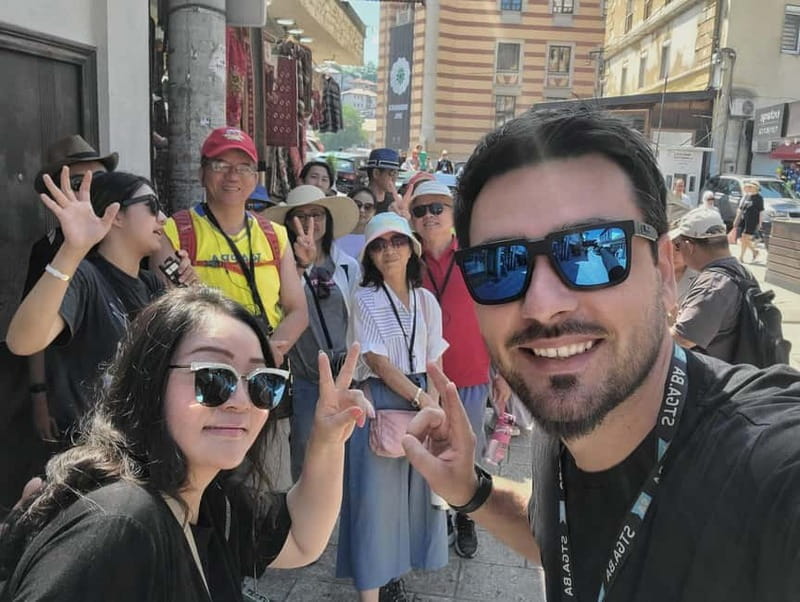
- English guidance is included: Guides named Elvis and Kiki have received especially warm praise for their storytelling and cultural explanations.
Start beside Sarajevo City Hall
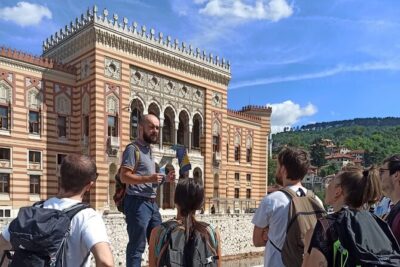
Meet at the square across the river from Sarajevo City Hall, also identified as Veliki Alifakovac 1. This is a useful starting point because City Hall marks the beginning of urban Sarajevo in the tour’s story. It also gives you an immediate sense of how the city sits between river, hills, and old neighborhoods.
The guide begins on foot, so wear shoes that can handle roughly two and a half hours of walking. The route is built around short walks and frequent stops rather than one long march. That makes it manageable for most people, and the activity is listed as wheelchair accessible, though you may still want to ask about the exact route if you need detailed access information.
From the opening stop, the tour sets up Sarajevo as a meeting place of different powers, faiths, and building styles. That theme returns at nearly every corner.
Kazandžiluk and the copper streets
The first real taste of Ottoman Sarajevo comes on Kazandžiluk, the coppersmiths’ street. The name points to the craft practiced here, and the route gives you a chance to see artisans working with metal rather than simply looking at finished souvenirs in a shop window.
This is one of the walk’s most human stops. Your guide can explain how the craft fits into the old market quarter, while the shops provide close-up details of Sarajevo’s handmade tradition. You might hear the sound of metalwork and see the tools and patterns that give the street its character.
Do not expect a long workshop visit or a formal demonstration. The stop is part of a moving walking tour. If you want to buy a copper item, remember that purchases are not included in the $17 price.
A few more Sarajevo trips to weigh up
- Sarajevo: Grand Walking Tour Through Time and Cultures
★ 4.8 · 1,236 reviews - Sarajevo: 2 Hours Old Town Walking Tour With Local Guide
★ 5.0 · 505 reviews - Private Walking Tour, Food Tasting and Bosnian Coffee in Sarajevo
★ 5.0 · 255 reviews
Baščaršija Square and the Sebilj fountain
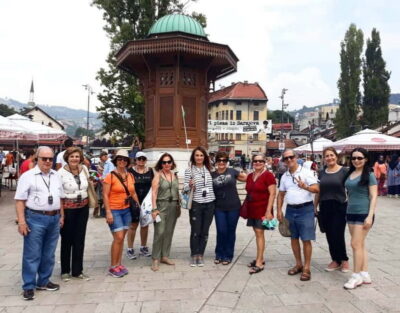
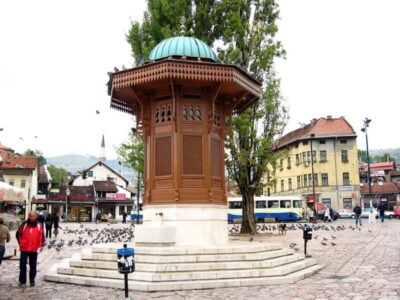
Baščaršija is the heart of Sarajevo’s Ottoman quarter. Narrow streets, small shops, handcraft businesses, and mosques replace the broader lines of the newer city. The famous Sebilj fountain sits on the square, where merchants and residents have gathered around water for centuries.
Your guide uses the square to explain how the bazaar worked and how the old quarter still functions today. You can taste water from the fountain, as people have done for generations, though the experience is simple rather than staged for tourists.
This is likely to be one of the livelier parts of the walk. Shops and pedestrians share the same tight lanes, so you will want to stay close enough to hear the guide. Baščaršija is also a useful place to return later if you want more time for shopping or a meal. Food is not included in the tour.
Morića Han, an Ottoman inn with a coffee pause
Morića Han is one of the route’s most appealing historical stops. It is a preserved sixteenth-century Ottoman inn, once part of the commercial world that supported traders and visitors passing through Sarajevo.
The building also helps you understand the old quarter as more than a collection of pretty lanes. Sarajevo’s bazaar needed places for merchants to rest, store goods, and meet. Morića Han connects the market stalls outside with the wider trading system behind them.
A coffee-tasting stop is included in the itinerary here. The pause breaks up the walking and gives you a chance to listen without trying to keep moving through a crowded lane. Since the activity lists only an English-speaking guide among its inclusions and excludes food, bring a little money for anything you choose to order or buy.
Gazi Husrev-beg Mosque and the clock tower
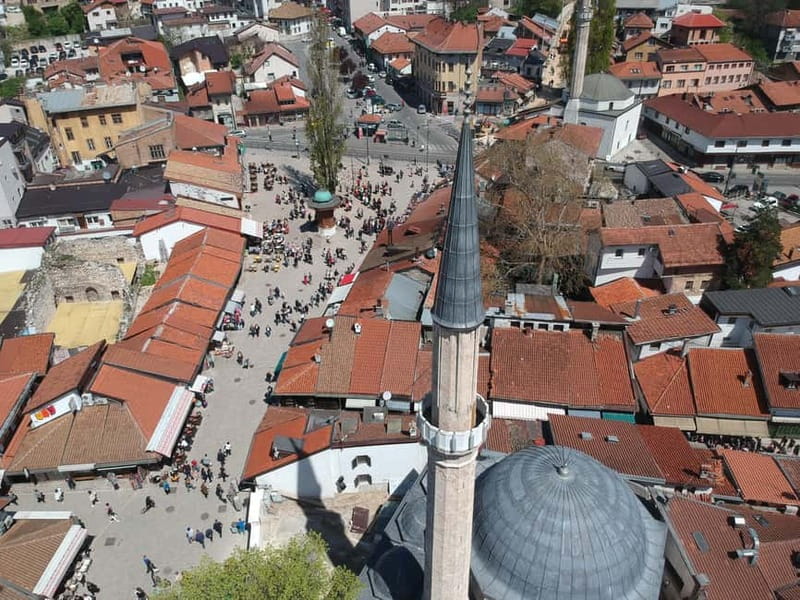
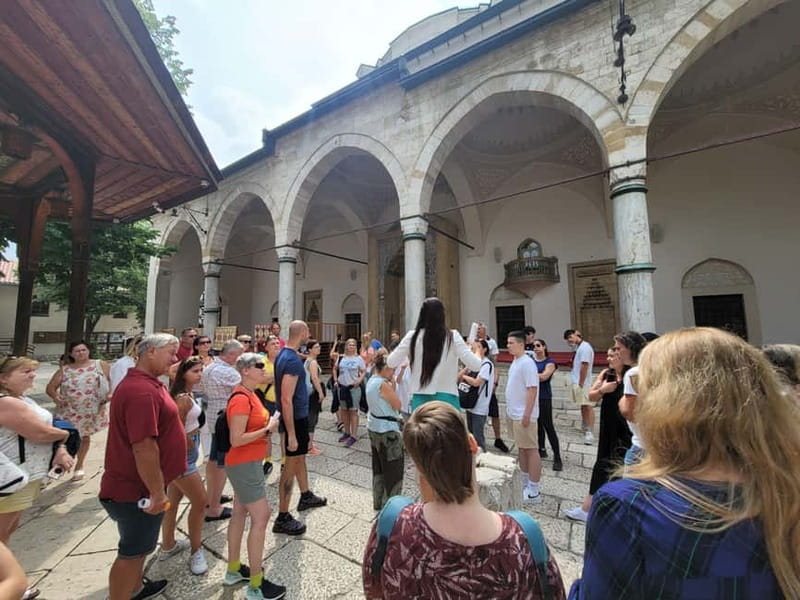
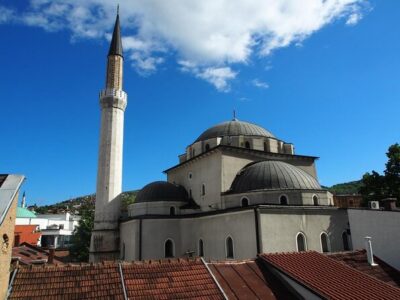
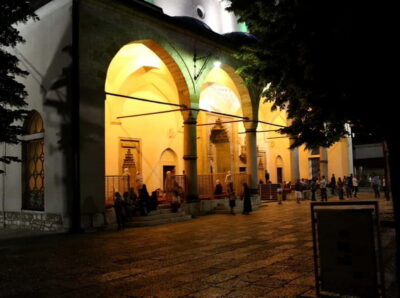
The Gazi Husrev-beg Mosque is the main religious and architectural highlight of the Ottoman section. The tour includes a guided visit, not just an outside look, so you can hear why this mosque matters to Sarajevo’s cultural life and city plan.
The stop is valuable even if you have already seen mosques elsewhere. It shows how the Ottoman period shaped Sarajevo through religious buildings, public spaces, commercial streets, and charitable institutions. Your guide also helps explain the place within the city’s Muslim heritage without treating it as an isolated monument.
The nearby clock tower is a brief passing stop. Do not expect an extended visit there. It works as a quick landmark while the group continues toward the European part of Sarajevo.
As with any religious building, dress and behavior should be respectful. The supplied information does not state a dress code or interior access rules beyond the scheduled visit, so follow the guide’s instructions on the day.
Same country, a completely different kind of day:
- Sarajevo: Mostar, Konjic, Blagaj Tekke, Pocitelj & Waterfall
★ 4.9 · 1,666 reviews - Fall of Yugoslavia, Sarajevo War Tour with Tunnel of Hope Museum and Frontlines
★ 5.0 · 1,314 reviews - Sarajevo: Mostar, Konjic, Sufi House, Pocitelj & Kravice Falls
★ 5.0 · 1,179 reviews - Sarajevo: Tunnel Museum Yugoslavia War Tour with War Veteran
★ 5.0 · 1,111 reviews
The Latin Bridge and the event that changed Europe
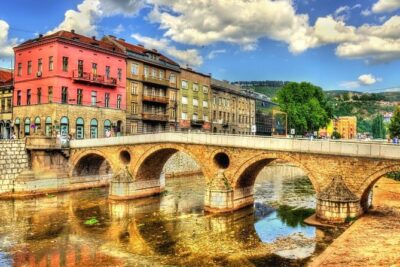
At the Latin Bridge, the tour shifts from Ottoman Sarajevo to a story known across the world. This is the site associated with the assassination of Archduke Franz Ferdinand in 1914, an event that helped trigger World War I.
The value here is the local setting. Textbooks can make the assassination feel like a distant European event, but the bridge places it on an ordinary Sarajevo street, beside the river and within walking distance of the bazaar. Your guide explains the event in context instead of leaving you with only a date and a famous name.
This stop can become crowded or visually underwhelming if you expect a grand monument. The bridge itself is modest. Its importance comes from what happened here and from the way the guide connects that moment to Sarajevo’s place in European history.
The Bezistan and Sarajevo’s Meeting of Cultures
Gazi Husrev-beg’s Bezistan is an enclosed Ottoman market. It gives you another look at the commercial side of the old town, with a different feel from the open streets of Baščaršija.
The route then reaches the Sarajevo Meeting of Cultures marker. Here, the city’s Ottoman and Austro-Hungarian sections meet in a particularly clear way. One direction leads back toward the older bazaar, while the other opens into the more formal European center.
I find this a useful point for understanding Sarajevo’s layout. You do not need a long lecture to grasp the change. The street plan, buildings, and atmosphere do much of the work, while the guide explains how the two parts function together.
The Jewish Museum and Sarajevo’s religious mix
The Museum of the Jews of Bosnia and Herzegovina is one of the more distinctive stops. It broadens the tour beyond the better-known Ottoman and Austro-Hungarian stories and gives space to Jewish life in the city.
The visit lasts about fifteen minutes, so it is an introduction rather than a full museum program. Still, it helps you see Sarajevo as a city shaped by several communities, not simply as an Ottoman town with later European buildings.
This is also where the tour’s wider religious theme becomes clear. Along the route, you encounter Muslim, Jewish, Catholic, and Orthodox places of worship. Your guide explains how those traditions fit into Sarajevo’s urban story, giving the city a human dimension that a building-by-building sightseeing walk can miss.
Sacred Heart Cathedral and the city center
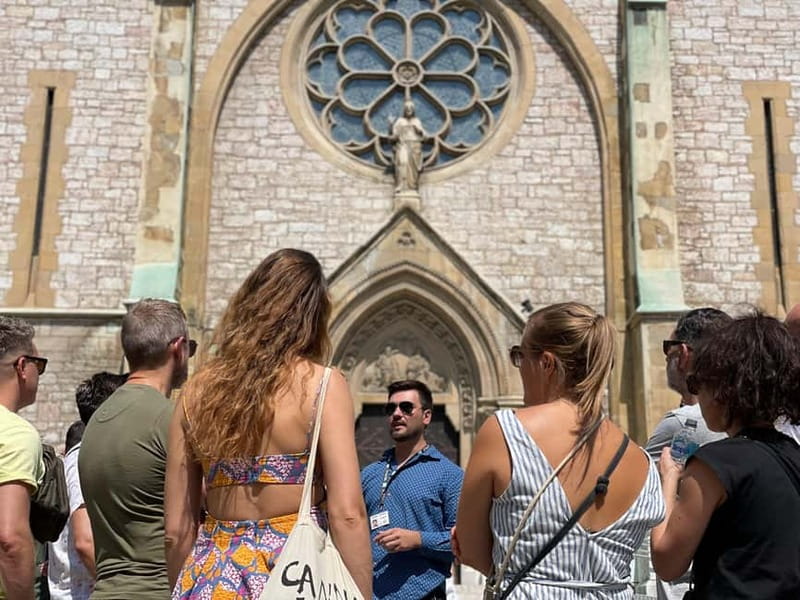
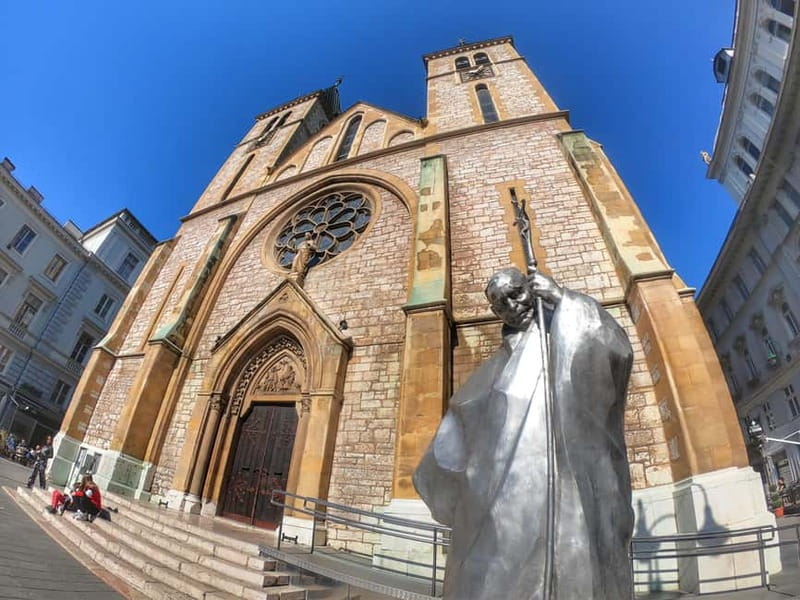
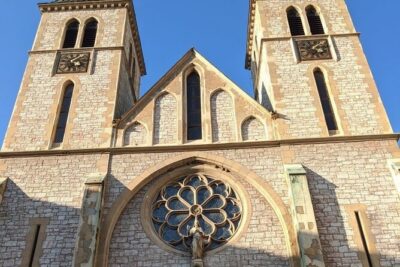
Sacred Heart Cathedral brings you into Sarajevo’s Catholic history and the Austro-Hungarian chapter of the city. The visit is guided and lasts about ten minutes. The cathedral also sits along the main promenade, making it an easy place to notice how the city’s public center differs from Baščaršija.
The building is not presented alone. It forms part of a sequence that includes the Jewish Museum, the Orthodox Cathedral, and the mosque visited earlier. That sequence is one of the strongest parts of the tour because it lets you compare faiths and architectural traditions within a compact area.
The stop is short, so you should not expect a detailed architectural study. If you want extra time inside, make a note to return after the tour, if opening hours allow. The walk gives you orientation and context first.
Market Hall and the Orthodox Cathedral
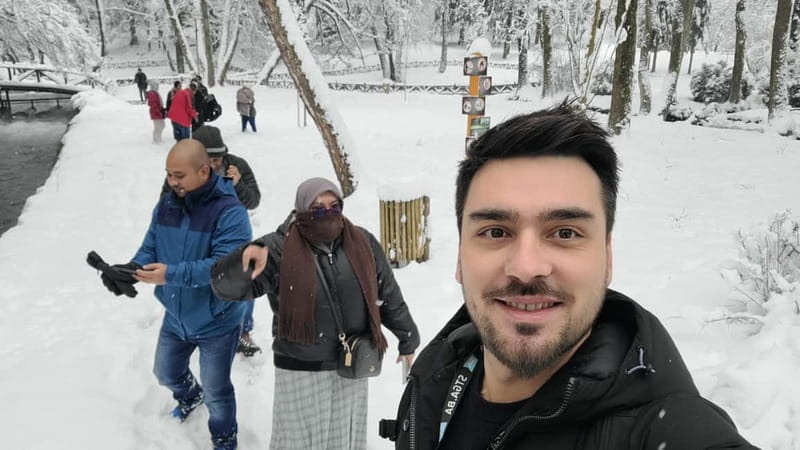
The City Market Hall adds another practical side of Sarajevo. Markets tell you how a city feeds itself and where daily life happens, and this stop shifts attention from grand events to ordinary commerce.
The route finishes its religious and architectural sweep at the Cathedral Church of the Nativity of the Theotokos, the Orthodox cathedral. The visit lasts about five minutes, making it a quick final stop rather than a long interior tour.
Taken together, the market, cathedral, promenade, and older bazaar show how close Sarajevo’s different worlds are. You do not need a bus or a long transfer to move between them. That compact layout is one reason this tour works well as a first activity in the city.
The Siege of Sarajevo and the 1984 Winter Olympics
The tour is not limited to Ottoman and Austro-Hungarian history. Your guide also discusses the Bosnian War and the Siege of Sarajevo, placing the recent past alongside the city’s older landmarks.
That balance matters. Sarajevo can be reduced to the 1914 assassination in a quick sightseeing talk, but the siege is central to understanding modern Sarajevo and the lives of its residents. The walk gives you a framework for thinking about the war without requiring a separate full-day history program.
The 1984 Winter Olympics also enter the story. This reminder of Sarajevo before the war helps you see the city as more than a place defined by conflict. It adds a modern civic chapter to the route and rounds out the timeline from Ottoman foundations to contemporary Bosnia and Herzegovina.
The exact amount of time spent on each subject depends on the guide and the group. Elvis has been praised for putting real feeling into his stories, while Kiki has been singled out for her clear understanding of Sarajevo. Those comments suggest that the guide’s storytelling is a major part of the experience, but your assigned guide may differ.
What $17 buys you
At $17 per person, this is an inexpensive way to get a structured first look at Sarajevo. You receive an English-speaking live guide and a route that links major landmarks across the old and newer parts of town. The price is particularly fair if you value explanation more than admission-heavy sightseeing.
The cost does not include hotel pickup, food, or gratuities. You should plan to reach the meeting point yourself and carry money for snacks, drinks, or shopping. The coffee-tasting stop at Morića Han is listed as part of the route, but the stated inclusions do not promise that every personal purchase is covered.
The tour is also flexible at booking: you can reserve and pay later, and cancellation is free up to 24 hours before the start time. Check the available starting time when booking, since the exact departure schedule is not fixed in the information provided.
Who will get the most from this walk
I would choose this tour for a first morning or afternoon in Sarajevo. It gives you a working map of the center, introduces the major historical layers, and helps you decide which places deserve a longer return visit.
It suits you especially well if you want:
- A short orientation before exploring alone
- Clear historical context at the Latin Bridge and City Hall
- A mix of religious, commercial, and political history
- A guide-led introduction rather than a museum-only visit
- An accessible activity with no transport between stops
- A low-cost way to cover many central sights
It may be less suitable if you want long museum visits, a private tour, or a deep study of the Bosnian War. The schedule includes many stops, so visits are measured in minutes. You get breadth and connection rather than prolonged time inside each building.
Practical details before you go
The meeting point is the square across the river from City Hall, Vijecnica, at Veliki Alifakovac 1. Arrive ready to walk, and keep the guide in sight through the narrow bazaar streets.
The tour is conducted in English and is listed as wheelchair accessible. Because the route includes old lanes, market areas, religious buildings, and several short walking sections, anyone needing specific access arrangements should confirm the details before booking.
The experience lasts 150 minutes. That is longer than the simple two-hour description used for the walk, so allow two and a half hours in your day. Add extra time afterward if you want to shop in Kazandžiluk, eat in Baščaršija, or revisit one of the religious sites.
Should you book the Old Town Sarajevo Walking Tour?
Book it if you want Sarajevo explained as a connected city rather than a checklist of monuments. The combination of Baščaršija, Morića Han, Gazi Husrev-beg Mosque, the Latin Bridge, the Jewish Museum, Sacred Heart Cathedral, and the Orthodox Cathedral gives you a strong first picture for $17.
I would be realistic about the limits. The pace is steady, the museum and cathedral visits are brief, and food and personal purchases cost extra. But if you want a friendly English guide, a compact route, and a serious look at Sarajevo’s Ottoman, European, religious, wartime, and Olympic chapters, this is a sound-value introduction.
FAQ
Where does the Old Town Sarajevo Walking Tour meet?
The meeting point is the square across the river from Sarajevo City Hall, Vijecnica. The address provided is Veliki Alifakovac 1.
How long does the tour last?
The activity lasts 150 minutes, or two and a half hours.
What language is the tour conducted in?
The tour is conducted in English with a live English-speaking guide.
How much does the tour cost?
The listed price is $17 per person.
Is hotel pickup included?
No. Hotel pickup is not included, so you must make your own way to the meeting point.
Does the price include food?
No. Food is not included. The route includes a coffee-tasting stop at Morića Han, but the stated inclusions list only the English-speaking guide.
Which major Ottoman sights are visited?
The route includes Kazandžiluk, Baščaršija, Morića Han, Gazi Husrev-beg Mosque, the clock tower, and Gazi Husrev-beg’s Bezistan.
Does the tour visit the Latin Bridge?
Yes. The Latin Bridge is a guided sightseeing stop, where the guide discusses the assassination of Archduke Franz Ferdinand and its connection to World War I.
Does the tour cover the Bosnian War?
Yes. The guide discusses the Bosnian War and the Siege of Sarajevo. The tour also includes the 1984 Winter Olympics as part of the city’s modern story.
Is the tour wheelchair accessible?
The activity is listed as wheelchair accessible. If you require specific access arrangements, confirm the route details before booking.
Just added around Sarajevo
- Sarajevo Under Siege: A War History Tour★ 5.0 · 10 reviews
- WAR TUNNEL – Sarajevo’s only way of a communication during the WAR – Top secret★ 5.0 · 12 reviews
- Private Full Day Safari Tour★ 5.0 · 8 reviews
- Ultimate Gastro Experience★ 4.5 · 14 reviews
- Mysterious Visoko Pyramids Driving and Walking Tour★ 5.0 · 7 reviews
- Secret Tito’s Bunker/Konjic Tour★ 5.0 · 4 reviews
- The Secret Lifeline: Sarajevo’s War Tunnel Tour★ 5.0 · 6 reviews
- Crossroads of Cultures – Sarajevo Walking Tour★ 5.0 · 8 reviews
Walking Tours, compared.
Private Walking Tour, Food Tasting and Bosnian Coffee in Sarajevo
Read our review →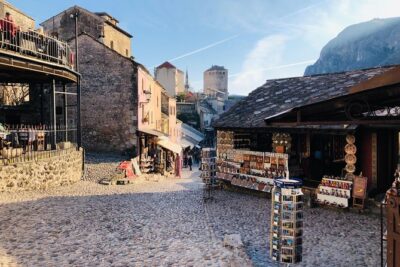
PROFESSIONAL SARAJEVO WALKING TOUR – With guide who guided STING!
Read our review →Browse the lists this tour appears in