
Reviewed · SARAJEVO SIEGE TOURS
Utopia of Tito’s Yugoslavia, Tito’s Bunker & Siege of Sarajevo
The Tito’s Nuclear Bunker is the star here: a vast Cold War command center hidden near Konjic, built to protect Yugoslavia’s leaders from a nuclear attack. In the same day, you’ll visit Sarajevo’s War Tunnel, Olympic ruins, mountain battle sites, and the Jewish Cemetery, which gives this tour unusual range.
I like the small maximum of eight people, since it leaves room for questions and a more personal discussion. I also like the guides’ firsthand connection to Sarajevo’s war years. Ahmed, for example, is praised for explaining the siege with personal feeling, while guides such as Hamza, Emir, Salem, Mustafa, Amir, and Agnar have led different departures.
The catch is the length. This is a full 10-hour day with a lot of driving, walking, history, and emotional subject matter. Lunch is not included, so plan ahead and expect a packed schedule rather than a relaxed sightseeing outing.
Key points to know before booking
- Tito’s bunker is the main attraction: Walk through a secret 6,500-square-meter facility built for 350 Yugoslav leaders and military commanders.
- The Sarajevo War Tunnel adds the human story: See the museum, watch a short film, and walk through part of the wartime passage.
- Olympic ruins meet recent conflict: Visit Igman, the damaged Olympic hotel, Trebević, and the famous bobsleigh track.
- A group of eight keeps the day personal: Hotel pickup in Sarajevo is included, with an English-speaking guide and driver.
- Entrance fees are covered: The €10 bunker admission and €5 adult War Tunnel fee are included in the listed price.
- This is a serious history day: You’ll hear about Cold War fears, the breakup of Yugoslavia, the Siege of Sarajevo, and the people caught in both.
Why this Sarajevo day trip covers so much ground
At about $101.85 per person, this is not a cheap walking tour. It is a full-day excursion with a vehicle, a professional English-speaking guide, hotel pickup, and the main admission fees already paid.
The value comes from the combination. You are not simply visiting one museum and returning to Sarajevo. You are linking Yugoslavia’s Cold War military planning with the 1984 Winter Olympics and the brutal siege that followed less than a decade later.
That combination helps you understand the region in layers. Tito’s bunker shows the closed, anxious world of Yugoslav military planning. The Olympic sites show a country presenting itself as modern, united, and outward-looking. Sarajevo’s tunnel, ruined hotels, battle positions, and cemeteries show how quickly that public image was shattered.
The day starts at 8:00 a.m. from the Funky Tours office in Sarajevo’s old town, or you can arrange pickup from your Sarajevo hotel. You return to the same meeting point. Since the group is limited to eight, the vehicle should feel more like a guided road trip than a large coach excursion.
More sarajevo siege tours in Sarajevo:
- Fall of Yugoslavia, Sarajevo War Tour with Tunnel of Hope Museum and Frontlines
★ 5.0 · 1,314 reviews - Sarajevo: Tunnel Museum Yugoslavia War Tour with War Veteran
★ 5.0 · 1,111 reviews - Tunnel Museum: Bosnian & Yugoslav Wars Tour with War Veteran
★ 5.0 · 551 reviews
Konjic Bridge and the road to Tito’s secret bunker
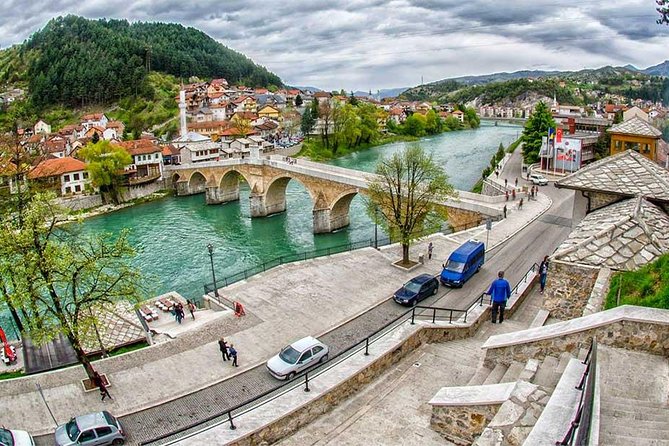
The first stop is Konjic, a town with a long settlement history and a striking 17th-century six-arch bridge over the turquoise Neretva River. You get about 30 minutes here, enough for photographs and a short look at the old part of town.
The bridge is more than a quick photo stop. It gives you a sense of Konjic as a historic river town before the tour turns toward one of Yugoslavia’s most expensive military projects. The contrast is sharp: from an open, sunny town center to a concealed underground command facility built in fear of nuclear war.
The time is brief, so you should not expect a full visit to Konjic. Think of it as a pause that places the bunker in its local setting.
Inside ARK D-0, Tito’s 6,500-square-meter bunker
ARK D-0, also called Tito’s Nuclear Bunker or the Atomic War Command, was built over 26 years. Its purpose was to protect and house more than 350 Yugoslav leaders and army generals if nuclear war broke out.
The scale is hard to grasp from the outside because the whole idea depended on concealment. Inside, the structure becomes a maze of rooms, corridors, and military planning spaces. You walk through a facility designed not for public display, but for the survival and command of a country’s political and military leadership.
The project reportedly cost about $4.6 billion in today’s stated figure, making it the third most expensive Yugoslav military project. That expense tells you something about Cold War thinking in Yugoslavia: official independence from both major blocs did not remove the fear of attack.
A local guide leads the bunker visit, while your tour guide provides the wider political setting. You hear about communist secrecy, military paranoia, the possible reasons Yugoslavia later fell apart, and the consequences that reached Sarajevo.
The bunker also serves as a venue for a biennial of contemporary art. That detail gives the place a second life. The bare military structure now provides a setting for modern works, creating an unusual meeting of Cold War architecture and present-day art.
This is likely the day’s strongest stop. It is unusual, visually memorable, and hard to experience without organized transport. The main limitation is that anyone expecting a polished museum may find the bunker stark and maze-like. Its appeal comes from the raw structure and the story attached to it.
Igman and the broken promise of the 1984 Olympics
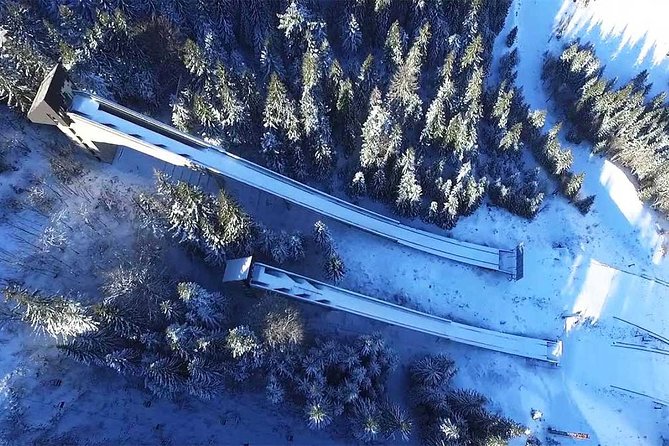
From Konjic, the tour heads back toward Sarajevo and Igman Mountain. The mountain was part of the 1984 Sarajevo Winter Olympics, and the visit includes the Olympic ski jumps and the old Igman Olympic Hotel.
You can take photographs from the Olympic podium or climb the ski jumps and picture the energy of the Games. This is an important change of mood after the bunker. The Olympics represented optimism, cooperation, and a city presenting itself to the world.
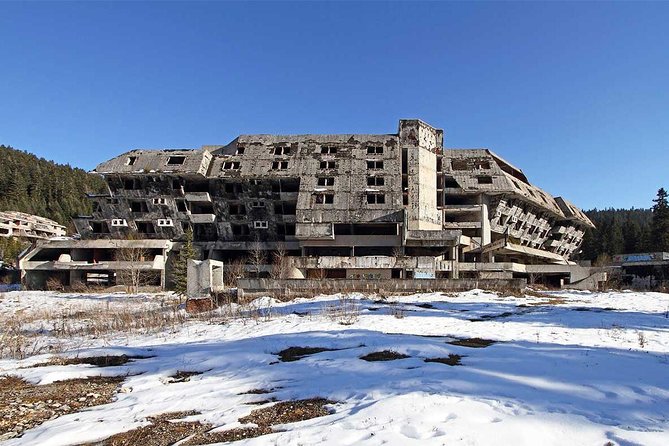
The Igman Hotel tells the darker side of that story. Built with 162 rooms as a mountain retreat for the Olympics, it was later badly damaged during the Balkan War and Siege of Sarajevo. The remains connect a specific building to the larger collapse of the city’s Olympic promise.
You have about an hour at Igman. The exact experience can depend on conditions and access, but the tour is designed to show both the Olympic remains and the scars left by war. Do not expect restored facilities or a neatly arranged historic site. The appeal is in seeing structures that remain damaged rather than rebuilt for display.
Same country, a completely different kind of day:
- Sarajevo: Mostar, Konjic, Blagaj Tekke, Pocitelj & Waterfall
★ 4.9 · 1,666 reviews - Sarajevo: Grand Walking Tour Through Time and Cultures
★ 4.8 · 1,236 reviews - Sarajevo: Mostar, Konjic, Sufi House, Pocitelj & Kravice Falls
★ 5.0 · 1,179 reviews - ROSES OF SARAJEVO (Official WAR + CITY tour)- Story of a Survivor
★ 5.0 · 770 reviews
The Sarajevo War Tunnel and the city’s lifeline
The War Tunnel is the day’s most direct encounter with the Siege of Sarajevo. The museum exhibition presents objects linked to the siege, and a short film explains why the passage had to be built.
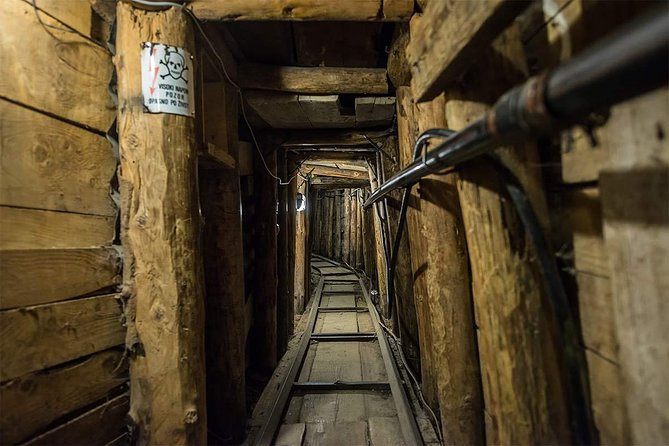
You then walk through the tunnel itself. Only part of the original passage is open for the public, but even that short section makes the project easier to understand. The tunnel was an urgent link beneath the airport area, built to connect besieged Sarajevo with the outside world.
The visit lasts about 90 minutes, giving you time for the exhibits, film, and tunnel walk. The space is narrow and practical, not designed as a grand monument. That plainness is part of its force. You are seeing an improvised wartime route that helped keep people and supplies moving during years of encirclement.
This stop works best when your guide adds local context. Guides named Ahmed, Salem, Mustafa, and others have been praised for making the siege understandable rather than treating it as a list of dates. Several guides connected the subject to their own experiences of living through the period, which can give the conversation a personal weight.
The tunnel can be emotionally difficult. The subject involves starvation, danger, military attacks, and civilian survival. If you want only light sightseeing, this is not the right day. If you want to understand Sarajevo beyond its cafes and old-town streets, it is essential.
Dobrinja and Trebević, where the Olympic story turns military
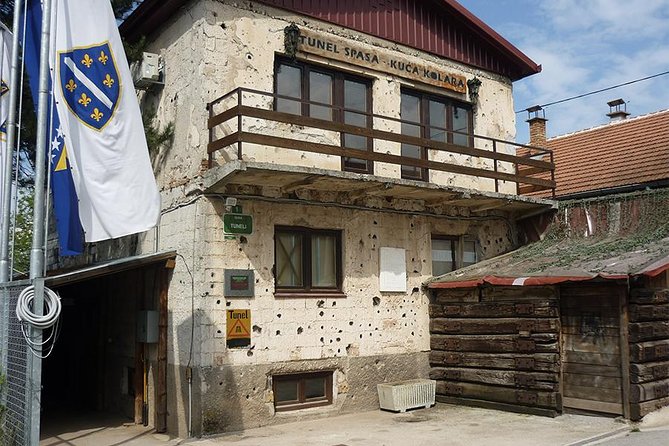
After the tunnel, the route passes through Dobrinja, an Olympic Village that also became a besieged neighborhood during the war. Here, the tour joins the city’s Olympic story to the daily reality of living inside a city under attack.
Trebević Mountain was a major front-line area during the siege. From the mountain, you can see why control of the heights mattered. The views toward Sarajevo give you a clearer sense of the military position and the difficult contest between the city and the forces surrounding it.
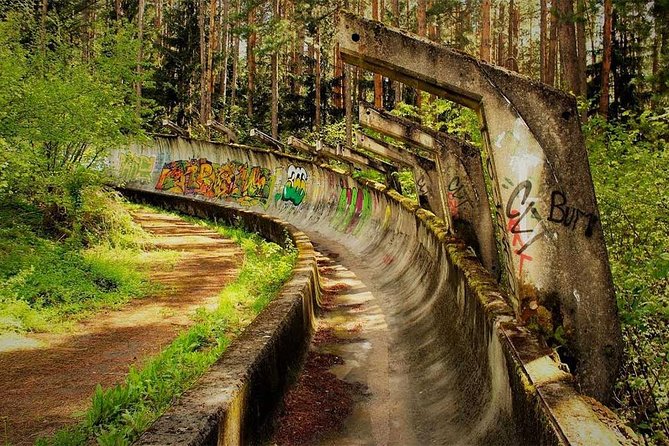
The tour points out places connected with fighting, including Zlatište and Osmice, along with bunker remains, trenches, minefields, tank tracks, and marks from bullets and grenades. Some Olympic structures were damaged and left unrestored, including the bobsleigh facilities.
This part of the day rewards anyone who wants physical evidence rather than only museum displays. You see how war occupied places built for sport and leisure. The mountain visit also adds fresh air and wide views after several enclosed or heavy historical sites.
At the same time, conditions can affect what you see and how long you can spend outside. The tour includes walking, climbing, and uneven historic remains, so comfortable shoes are sensible. The schedule is active, but the guide and driver handle the long connections between sites.
Walking Sarajevo’s abandoned Olympic bobsleigh track
The 1984 Olympic Bobsleigh and Luge Track on Trebević is one of the most distinctive stops. You walk down the famous track, now known for its abandoned concrete form and layers of street art.
This is a more physical and visual stop than the War Tunnel. The track lets you see how an Olympic venue can become a wartime relic and later an informal canvas for artists. Its long curves and graffiti make it one of the day’s best places for photographs.
You get about 45 minutes here. That is enough for a walk and pictures, but not a leisurely mountain hike. The track is part of a larger route that includes several sites, so keep an eye on the schedule.
The Jewish Cemetery and Sarajevo’s sniper positions
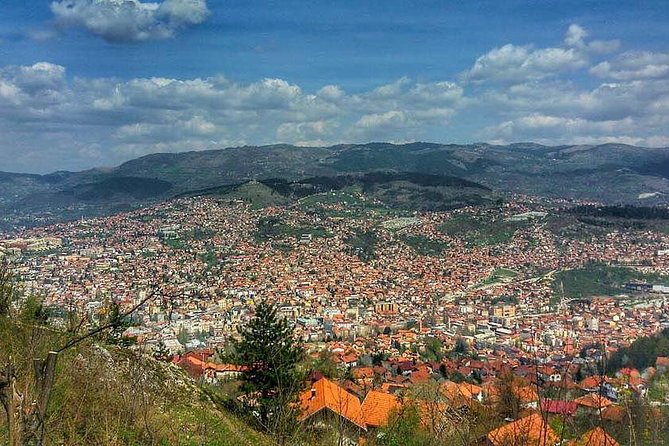
The last major stop is the Jewish Cemetery, one of the largest Jewish cemeteries in Europe. During the Siege of Sarajevo, its position overlooking the city made it part of the front line and a sniper location for the Army of Republika Srpska.
The site carries several layers of Sarajevo’s past. Its Jewish heritage reaches back well before the siege, while its wartime position shows how cemeteries, hills, roads, and neighborhoods were pulled into the conflict.
You spend about 20 minutes here. It is a short stop, but the view and military significance make it a useful final piece of the siege story. It also helps you understand why Sarajevo residents faced such danger on ordinary streets below.
The cemetery is not presented as a cheerful sightseeing stop. Give it the attention it deserves, especially after seeing the tunnel and Trebević positions.
Guides, group size, and the feel of the day
The guide assigned to you may vary. The experience has been led by Hamza, Emir, Ahmed, Salem, Amir, Agnar, and Mustafa. The strongest descriptions of the tour focus on guides who combine dates and political background with personal experiences of Sarajevo.
That matters here. Yugoslavia, the siege, and the breakup of the country can become confusing if you hear only names and timelines. A good guide can connect the bunker’s Cold War purpose to the later war without pretending that the region’s politics are simple.
The group limit of eight is a major practical advantage. You can ask about a detail inside the bunker, request clarification at the War Tunnel, or speak with the guide about what you are seeing. On a very small departure, the day may feel almost private, though the tour still runs on a fixed schedule.
Transport is in an air-conditioned vehicle, and hotel pickup in Sarajevo can save time at the start of an early day. Admission fees and taxes are included, covering the bunker and War Tunnel. Lunch is not included, so confirm how the day handles the meal break and carry water or a snack.
Is $101.85 a fair price?
I consider the price reasonable if you want all these sites in one day. The bunker is outside Sarajevo, the Olympic mountains require transport, and the route includes several locations that would be awkward to connect by local buses.
You are paying for roughly 10 hours, a driver, an English-speaking guide, a small group, hotel pickup, and the two principal entrance fees. The €10 bunker fee and €5 adult War Tunnel fee are already covered, so the advertised price is closer to the final cost than tours that add several charges later.
The value is weaker if you only want one attraction. Someone interested mainly in Tito’s bunker could look for a shorter visit, while someone focused only on the siege might prefer a Sarajevo-based war tour. This day is best for you if you want the connections between Cold War Yugoslavia, the Olympics, and the Siege of Sarajevo.
The tour is recommended by all supplied ratings, with a 5 out of 5 score from 35 reviews. That record supports the tour’s strong points, especially its guides, small groups, and unusual mix of sites, but you should still account for the long hours and serious material.
Who should book this experience?
Book it if you want a serious, fact-filled day and do not mind moving at a steady pace. It suits first-time visitors who want a wider understanding of Sarajevo, history-minded travelers, photographers interested in abandoned Olympic sites, and anyone curious about Tito’s Yugoslavia.
It is also a good choice for solo visitors. The small group makes it easier to meet others, and the company can arrange hotel pickup or an office meeting in the old town.
Think twice if you prefer slow meals, long independent visits, or light historical commentary. The route covers a lot, and several stops involve walking around damaged or uneven sites. The emotional subject matter may also be too heavy for some people.
For the right reader, this is one of the most useful ways to place Sarajevo’s recent past in context. You leave with more than a bunker visit or a war museum. You see how one city’s Olympic ambition, Cold War fears, and wartime survival became tied together.
FAQ
How long does the tour last?
The experience lasts approximately 10 hours. It starts at 8:00 a.m. and ends back at the Funky Tours meeting point in Sarajevo.
Is hotel pickup available in Sarajevo?
Yes. Pickup can be arranged from any hotel in Sarajevo, or you can meet the group at the Funky Tours office at Besarina čikma 5 in the old town.
Are the attraction entrance fees included?
Yes. The entrance fee for Tito’s Bunker is included, as is admission to the Sarajevo War Tunnel. The tour also includes all listed fees and taxes.
Is lunch included?
No. Lunch is not included in the price.
How many people can join the tour?
The tour has a maximum of eight participants, making it a small-group experience.
What language is the tour offered in?
The tour is offered in English and includes a professional English-speaking guide and driver.
Just added around Sarajevo
- Sarajevo Under Siege: A War History Tour★ 5.0 · 10 reviews
- WAR TUNNEL – Sarajevo’s only way of a communication during the WAR – Top secret★ 5.0 · 12 reviews
- Private Full Day Safari Tour★ 5.0 · 8 reviews
- Mysterious Visoko Pyramids Driving and Walking Tour★ 5.0 · 7 reviews
- Ultimate Gastro Experience★ 4.5 · 14 reviews
- Secret Tito’s Bunker/Konjic Tour★ 5.0 · 4 reviews
- The Secret Lifeline: Sarajevo’s War Tunnel Tour★ 5.0 · 6 reviews
- Crossroads of Cultures – Sarajevo Walking Tour★ 5.0 · 8 reviews
Sarajevo Siege Tours, compared.

Fall of Yugoslavia, Sarajevo War Tour with Tunnel of Hope Museum and Frontlines
Read our review →
Bosnian War & Fall of Yugoslavia Tour with Tunnel
Read our review →
Sarajevo War Tour: A Veteran’s Story of the Siege (fees included)
Read our review →
Srebrenica Genocide Study Tour with War Veteran
Read our review →
Break-up of Yugoslavia & The War in Mostar: Life Under Siege
Read our review →
Sarajevo to Srebrenica: Genocide Study Tour with War Veteran
Read our review →
Browse the lists this tour appears in