
Reviewed · FOOD & DRINK
Private Walking Tour, Food Tasting and Bosnian Coffee in Sarajevo
Sarajevo’s story is unusually easy to read on foot. In a few blocks, this private tour moves from an Ottoman bazaar and copper workshop to an Austro-Hungarian cathedral, an Orthodox church, and the bridge linked to the assassination that helped trigger World War I. Bosnian coffee and local food give the history a welcome taste.
I like the personal format, since your guide can explain Sarajevo at your pace and answer questions as you go. I also like the two useful stops that many city walks skip: learning the customs of Bosnian coffee at Kazandziluk and tasting traditional dishes on Bravadziluk Street.
The main consideration is time. Two and a half hours goes quickly, and several stops are brief. You’ll see the city’s key sights and get a good introduction, but you won’t have long inside every building or much time for slow browsing in the bazaar.
Key points to know before booking
- A private route through Sarajevo’s meeting point of cultures: Ottoman, Austro-Hungarian, Islamic, Catholic, and Orthodox landmarks appear within a compact walk.
- Food is part of the tour, not an afterthought: Bravadziluk Street brings traditional Bosnian dishes and sweets to the center of the experience.
- Bosnian coffee comes with local customs: At Kazandziluk and Morica Han, you learn how coffee is prepared and how it is traditionally enjoyed.
- Guides add a personal layer: Emina and Lamija are among the guides who have led the experience, with clear explanations and practical suggestions for the rest of your stay.
- The route links world-changing places: The walk ends near Latin Bridge, the site associated with Franz Ferdinand’s assassination.
- At $66.54 per person, the value depends on your group: A private guide, food, coffee, and a focused history walk make the price more appealing for couples or small groups than for a solo budget visitor.
Why this Sarajevo walk works so well
This is not simply a march from one monument to the next. Sarajevo’s center is compact, but its story is layered. Ottoman buildings sit close to Austro-Hungarian ones, and several religious traditions share the same central streets.
That makes a private guide especially useful. You can ask why a street looks Turkish, why a clock tower tells an unusual time, or how Sarajevo’s coffee custom differs from the coffee you may know elsewhere. Guides such as Emina and Lamija have been praised for making the past easy to follow while also sharing affection for Bosnia.
The food adds another reason to book early in your Sarajevo stay. Instead of guessing what to order later, you get direct advice about popular Bosnian dishes and sweets. The tour can help you get your bearings fast, both on the map and at the table.
More bosnian coffee experiences in Sarajevo:
- Sarajevo Old Town: Bosnian Coffee, Baklava & Panoramic Views
★ 5.0 · 3 reviews
Starting near City Hall and entering the old quarter
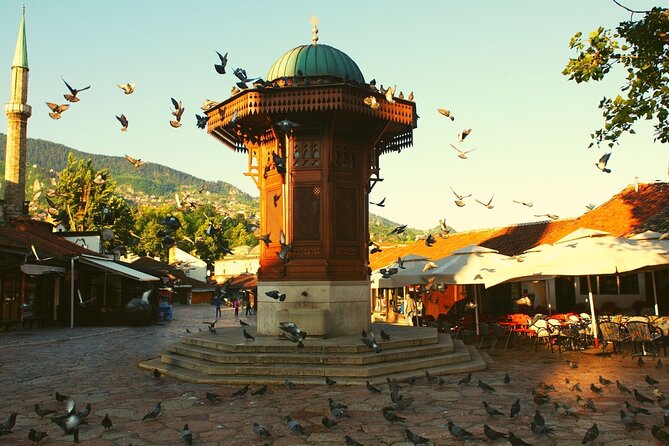
The advertised meeting point is Sarajevo City Hall at Brodac 1. The route then brings you toward Sebilj Fountain, the wooden landmark at the center of Baščaršija, Sarajevo’s old bazaar district.
Sebilj sits on Baščaršija Square, often called Pigeon Square. It is an attractive 18th-century fountain, but the real value of the stop is the introduction to Sarajevo and Bosnia. Your guide uses this busy square to set up the larger story: Ottoman foundations, later Austro-Hungarian rule, and the conflicts that shaped the modern city.
You have about 25 minutes here, the longest single stop at the beginning of the walk. That gives your guide room to explain the setting rather than merely point at the fountain and move on. It also gives you time to look around the square, where the old bazaar begins to feel less like a museum and more like part of daily city life.
The square can be lively, and the pigeon activity is part of its character. If you prefer quiet photography, use the edges of the square and listen for your guide before wandering too far.
Sarajevo City Hall and the Austro-Hungarian chapter
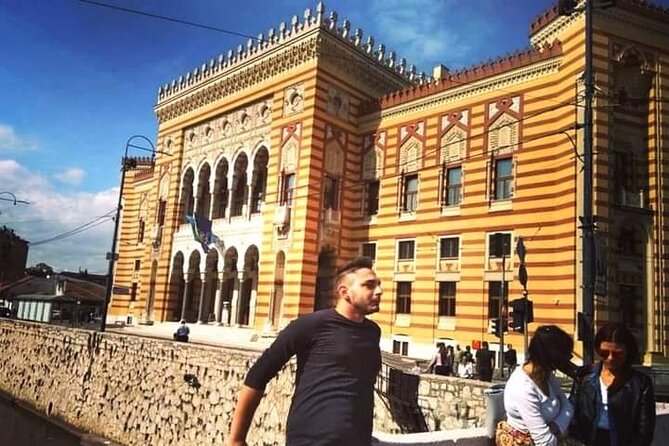
From the Ottoman quarter, the walk turns toward Sarajevo City Hall, one of the city’s most recognizable Austro-Hungarian buildings. Its design makes an immediate contrast with Baščaršija’s smaller Ottoman-era structures.
The building also served as the National and University Library. That detail matters because Sarajevo City Hall is not only a grand administrative building. It also represents the city’s intellectual and civic life, and its history connects architecture with the damage suffered during the war years.
The planned visit here is short, about 10 minutes. Treat it as an exterior and historical explanation rather than a full architectural tour. The meeting point being at City Hall is convenient, especially if you want to arrive early and see the building before the walk begins.
Kazandziluk, where coffee meets copper craft
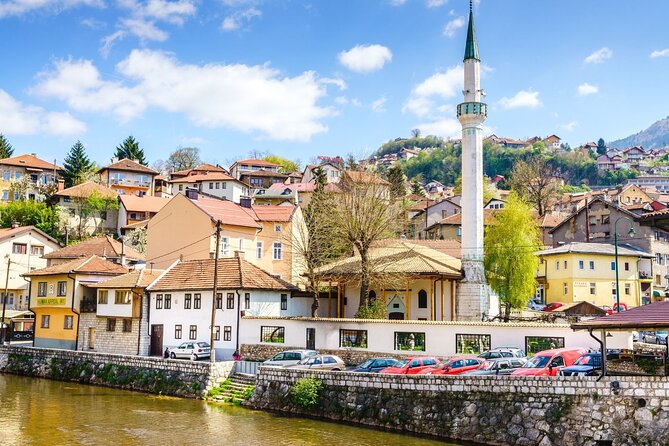
Kazandziluk is Sarajevo’s old copperworkers’ street. The name is tied to the craft of making copperware, and the street remains a good place to see the tradition in practical form.
This is one of the more distinctive parts of the tour. You learn about coffee while looking at the tools and objects connected to Bosnian household customs. The local craft has also taken on a modern, personal meaning: one workshop shown during the walk turns brass and copper mortar shell casings into vases. It is a striking example of changing an object linked to violence into something useful and decorative.
You get around 10 minutes here, so do not expect a long shopping session or a full workshop demonstration. The point is the connection between craft, memory, and coffee culture.
Your guide explains how Bosnian coffee is made and how it is drunk. This is useful preparation for the later tasting, since the drink comes with its own method and manners. I would pay close attention here, then ask questions. Coffee customs are often where a short city tour becomes more personal.
Same country, a completely different kind of day:
- Sarajevo: Mostar, Konjic, Blagaj Tekke, Pocitelj & Waterfall
★ 4.9 · 1,666 reviews - Fall of Yugoslavia, Sarajevo War Tour with Tunnel of Hope Museum and Frontlines
★ 5.0 · 1,314 reviews - Sarajevo: Grand Walking Tour Through Time and Cultures
★ 4.8 · 1,236 reviews - Sarajevo: Mostar, Konjic, Sufi House, Pocitelj & Kravice Falls
★ 5.0 · 1,179 reviews
Morica Han and the proper coffee pause
Morica Han is an old caravanserai, a lodging place for merchants and their animals during the Ottoman period. It remains one of the most atmospheric stops on the route because its architecture helps you picture Sarajevo as a trading city.
The planned visit lasts about 25 minutes, making it another substantial stop. Here, you taste Bosnian coffee in the traditional way rather than simply receiving a cup with no explanation.
That distinction is important. The pleasure is not just caffeine. You are learning when to sip, how the coffee is served, and how it fits into conversation and hospitality. The coffee can be strong, and the grounds remain in the cup, so let it settle before drinking the last mouthful.
This stop also gives the walk a natural pause. The first part has covered history and craft; Morica Han turns those ideas into a lived custom. It is a good place to ask your guide about coffee at home, family habits, and the differences between Bosnian coffee and nearby styles.
Bravadziluk Street and the food tasting
Bravadziluk Street is known for restaurants serving traditional Bosnian food. The stop itself is listed as only a few minutes, but the meal and tasting are clearly one of the tour’s main features.
You receive recommendations for popular Bosnian dishes and sweets, followed by a generous selection of traditional food. The tasting has been described as substantial enough to feel like lunch rather than a token sample, so plan accordingly. If you are booking this as an evening activity, you may not need a large meal beforehand.
The exact portions and dishes can vary, so it is best to ask your guide what is being served that day. The key value is guidance. Bosnian menus can be unfamiliar at first, and it is easier to try something confidently when your guide explains what you are eating.
This is also where the private format helps. If you have dietary concerns or strong preferences, you can discuss them directly with your guide. The supplied tour information does not promise special dietary arrangements, so do not assume every request can be met without checking before booking.
The Old Sarajevo Clock Tower’s strange time
Near one of Sarajevo’s most important mosques, the Old Sarajevo Clock Tower shows a time that can seem completely wrong to a visitor using a standard European clock. Your guide explains the local tradition behind this unusual display.
The stop takes only about two minutes. That sounds brief, but the clock is a quick visual lesson in how religious practice once shaped the city’s daily schedule. It is a small detail with a good story, and you will probably notice it more after the explanation.
Do not expect a long stop or a climb. This is a short roadside look, best enjoyed as part of the walk between larger landmarks.
Sacred Heart Cathedral and Sarajevo’s shared center
The Sacred Heart Cathedral brings the Austro-Hungarian chapter back into view. Built in Neo-Renaissance style, it is an imposing Catholic landmark in the heart of Sarajevo.
The nearby statue of Pope John Paul II recalls his visits to Bosnia. Your guide also talks about Sarajevo roses, markings connected with mortar impacts that have been filled with red resin. These details link architecture and public memory, showing how ordinary streets carry evidence of painful events.
You have about 10 minutes here. That is enough for an introduction and exterior viewing, but not a detailed church visit. If you want to spend time inside the cathedral, ask your guide if the timing allows it, though the listed tour schedule does not promise an extended interior visit.
This stop is valuable because it broadens your view of Sarajevo. The city is not explained by one faith, one empire, or one war. Its central streets hold several identities close together.
Gazi Husrev-beg Mosque and Bezistan
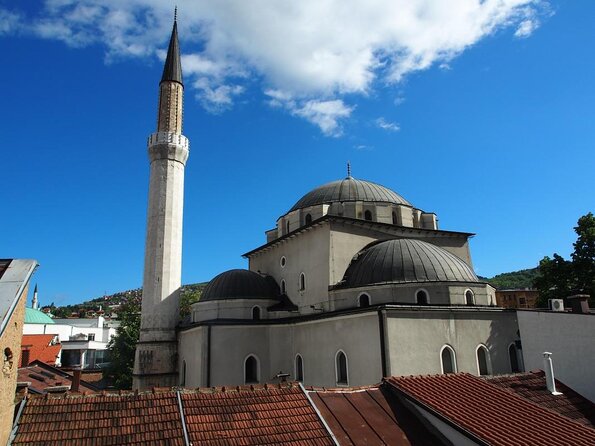
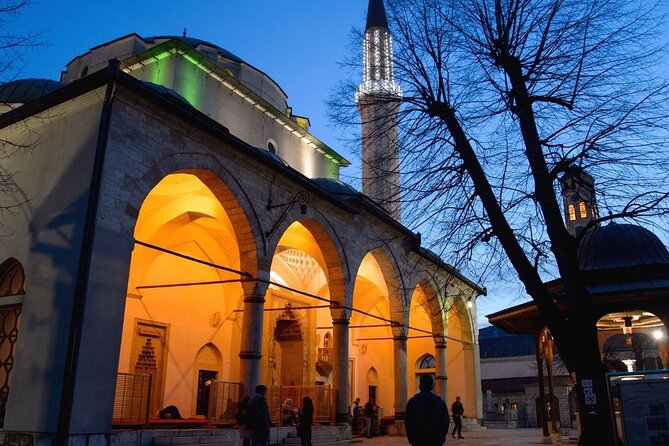
Gazi Husrev-beg Mosque is described as Sarajevo’s largest and one of its most beautiful mosques. It is a major Ottoman landmark and an important stop for understanding the city’s Muslim culture and architecture.
The scheduled visit is about 10 minutes. Dress and conduct should be respectful at any religious site, and access inside can depend on current conditions. The tour information does not guarantee an interior visit, so think of this as a guided look at the mosque and its place in the old city.
Nearby, Gazi Husrev Bey’s Bezistan is an old Ottoman bazaar. Its covered market setting preserves oriental elements in the architecture and gives you another way to understand how commerce shaped Sarajevo.
The mosque and bezistan work well together. One shows religious life, the other trade and everyday business. You may find yourself wanting more time here, especially if you enjoy small shops and traditional objects. The schedule is tight, so return later if you want to browse at leisure.
Latin Bridge and the event that changed Europe
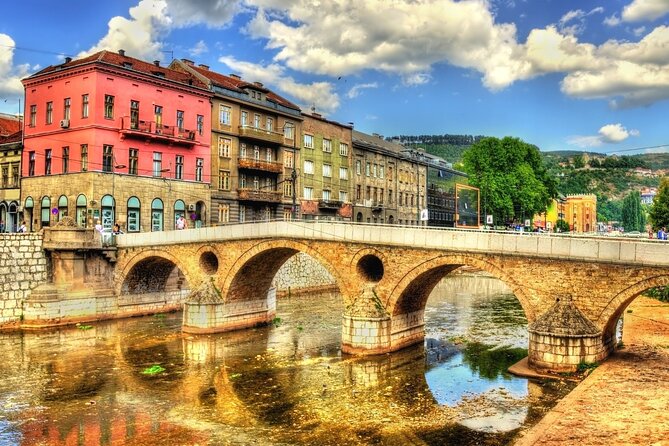
The tour finishes near Latin Bridge, the famous site associated with the assassination of Archduke Franz Ferdinand. That event helped set off the chain of decisions that led to World War I.
The bridge itself is modest. The story is enormous. Your guide explains the location and the political setting, turning a simple crossing into a place where European history suddenly feels close and physical.
The listed time is about 10 minutes. That is enough for the core explanation and some photographs, though anyone fascinated by World War I may wish for a longer specialist visit afterward.
The ending is practical, too. You finish in a central part of Sarajevo rather than returning to the starting point. The information says the activity ends at a different location and identifies Latin Bridge as the finish, so plan your next move from there.
The Serbian Orthodox Cathedral and Sarajevo’s religious mix
The route also includes the Serbian Orthodox Cathedral, formally the Cathedral of the Nativity of the Theotokos. It is described as the largest Orthodox church in Sarajevo and is notable for its architecture and construction story.
The scheduled visit lasts about five minutes. That makes it a concise stop, but its position in the route matters. Alongside the Sacred Heart Cathedral and Gazi Husrev-beg Mosque, it helps you see how several religious communities have long occupied the same urban center.
The walk does not treat these buildings as isolated sights. It puts them into one short route, which is one of the strongest reasons to choose it over a food-only outing.
Is $66.54 per person good value?
At $66.54 per person, this is not the cheapest way to walk around Sarajevo. You could see many of the exteriors independently and eat on your own for less.
The calculation changes if you value a private guide. The price includes roughly two and a half hours of personal explanation, food tasting, and Bosnian coffee. For a couple or small group, that can be fair value, especially on your first day when a good orientation saves time later.
The tour is less compelling for someone who only wants a large meal or a long museum visit. It is also not designed for slow photography, extensive shopping, or detailed interior tours. You are paying for connections: between food and custom, buildings and politics, and Sarajevo’s different cultural traditions.
The experience is offered in English, includes a mobile ticket, and is near public transportation. Most people can take part, and service animals are allowed. Free cancellation is available up to 24 hours before the start time. If the minimum number is not met and the activity is canceled, you are offered another date or experience, or a full refund.
Who should book this private Sarajevo tour?
I would choose it for a first visit, especially if you want history without signing up for a large group. The private setting suits couples, families, and friends who prefer to ask questions freely.
It is also a good fit if food is part of your sightseeing. The generous tasting, local dish suggestions, and coffee lesson give you practical ideas for the rest of your stay.
You should think twice if your main goal is a slow restaurant meal, a long shopping session, or extensive time inside each landmark. The route covers a lot, and some stops last only two to ten minutes.
Book it early in your stay if possible. The tour is often reserved about 28 days ahead, suggesting that popular dates can fill well before arrival. A morning or early afternoon start would also leave you time to revisit Baščaršija, the mosque, or the Latin Bridge afterward, though the available start times should be checked when you reserve.
Final recommendation
I recommend this tour if you want Sarajevo’s essential old-center story paired with real tastes and customs. The strongest parts are the private guide, the generous food tasting, the Morica Han coffee stop, and the way the route places Ottoman, Austro-Hungarian, Catholic, Orthodox, and Islamic landmarks within one walk.
Choose it as an introduction, not as the final word on Sarajevo. It gives you the map, the key stories, and several dishes to try. Then use the rest of your visit to return to the places that caught your attention.
FAQ
How long does the private Sarajevo tour last?
The tour lasts approximately 2 hours and 30 minutes.
Where does the tour start?
The meeting point is Sarajevo City Hall, Brodac 1, Sarajevo 71000, Bosnia and Herzegovina.
Where does the tour finish?
The activity finishes at a different location from the start, near Latin Bridge.
Is food included in the tour?
Yes. The walk includes a tasting of traditional Bosnian food and recommendations for popular Bosnian dishes and sweets on Bravadziluk Street.
Is Bosnian coffee included?
Yes. You learn about traditional coffee preparation at Kazandziluk and taste Bosnian coffee at Morica Han.
Is this a private tour?
Yes. Only your group participates in the activity. It is offered in English and includes a mobile ticket.
More Food in Sarajevo
- Eat, Pray, Love Tour
★ 4.5 · 32 reviews - Sarajevo: Eat, Pray, Love Tour – Local Life Experience
★ 4.9 · 13 reviews - 🍽️ Sarajevo Food Tour: Eat where the locals eat
★ 5.0 · 10 reviews - Half-Day Grbavica Food Tour in a Small Group
★ 5.0 · 6 reviews
More Food & Drink in Sarajevo
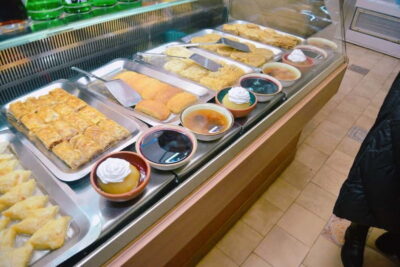
- Sarajevo: 4-Hour Food And Craft Tour
★ 5.0 · 70 reviews - Sarajevo: Sarajevo City Market, Old Town Food Tasting Tour
★ 4.9 · 69 reviews - Sarajevo: Food And Crafts tour
★ 4.9 · 23 reviews - LUKOMIR VILLAGE HIKE & TREK TOUR (nature, hike, food & panorama)
★ 5.0 · 11 reviews
Just added around Sarajevo
- Sarajevo Under Siege: A War History Tour★ 5.0 · 10 reviews
- WAR TUNNEL – Sarajevo’s only way of a communication during the WAR – Top secret★ 5.0 · 12 reviews
- Private Full Day Safari Tour★ 5.0 · 8 reviews
- Ultimate Gastro Experience★ 4.5 · 14 reviews
- Mysterious Visoko Pyramids Driving and Walking Tour★ 5.0 · 7 reviews
- Secret Tito’s Bunker/Konjic Tour★ 5.0 · 4 reviews
- The Secret Lifeline: Sarajevo’s War Tunnel Tour★ 5.0 · 6 reviews
- Crossroads of Cultures – Sarajevo Walking Tour★ 5.0 · 8 reviews
Food & Drink, compared.
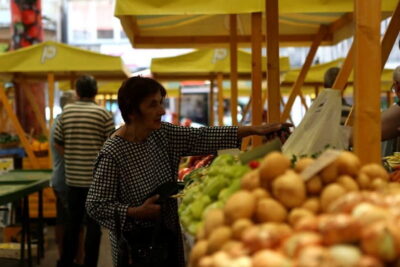
Sarajevo City Market, Old Town Food Tasting Tour
Read our review →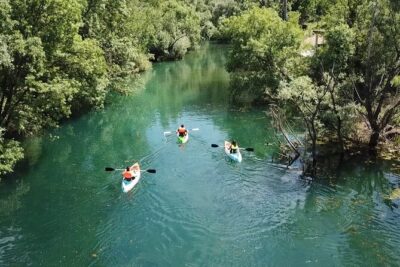
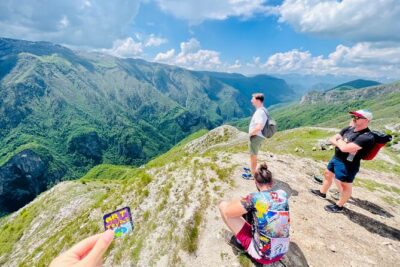
LUKOMIR VILLAGE HIKE & TREK TOUR (nature, hike, food & panorama)
Read our review →
Nature’s Table: River Journey w Wine Tasting & BBQ Dinner Mostar
Read our review →Browse the lists this tour appears in