
Reviewed · SARAJEVO WAR TUNNEL TOURS
Tunnel Museum: Bosnian & Yugoslav Wars Tour with War Veteran
The most affecting part of this Sarajevo tour is the War Tunnel Museum, where a short film and a personal account from a Bosnian war veteran explain how a city under siege stayed connected to the outside world. You also follow the route past Markale, Sniper Alley, Trebević, and other places tied to the conflict.
I like the mix of firsthand testimony and clear historical explanation. I also like the small-group feel, with transport in an air-conditioned car or minivan and guides such as Adis, Ibrahim, Enes, and Mustafa bringing different personal memories to the story. The main drawback is that this is heavy material, and the tunnel visit requires a moderate level of fitness.
Key points to know before booking
- The War Tunnel is the heart of the tour: Allow about an hour for the museum visit, including a short film and a presentation on Yugoslavia’s breakup and the Siege of Sarajevo.
- Your guide may be a war veteran: Guides including Adis and Enes have described their own wartime experiences, giving the tour a personal human scale.
- You see Sarajevo from both sides of the siege: The route includes city streets, former front-line positions on Trebević, and high viewpoints near Yellow Fortress.
- The tour covers more than the 1990s war: You pass the Eternal Flame, the National Museum, the Old Town, and sites connected to Sarajevo’s Ottoman and Jewish heritage.
- The format is practical and compact: The tour lasts about four hours, carries no more than 20 people, and uses an air-conditioned car or minivan.
- The price is reasonable for a half-day: At about $36.28 per person, transport, guiding, and several significant sites are included, but the museum admission and food are extra.
Why this tour helps you understand Sarajevo
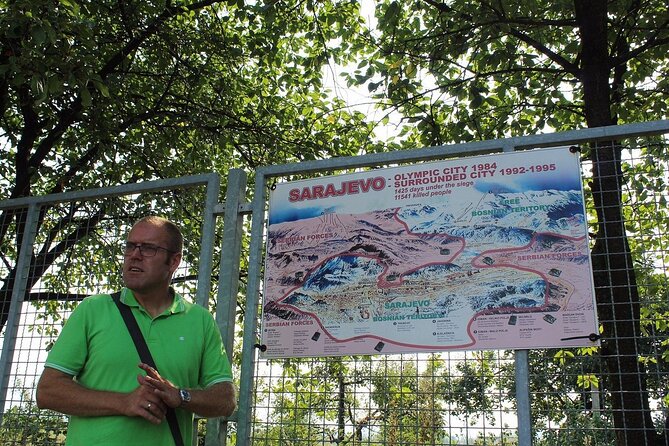
Sarajevo’s wartime story can feel confusing if you only see plaques and buildings. The conflict followed the breakup of Yugoslavia, involved several political and military forces, and left the city surrounded for more than three years. A good guide has to explain the sequence without drowning you in names and dates.
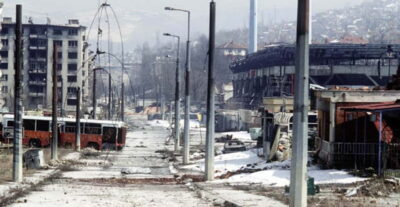
This tour tackles that problem from the road. During the 25 to 30 minute drive toward the museum, your guide introduces the war and points out buildings and streets connected with the siege. You begin to understand Sarajevo as a city shaped by hills, narrow routes, exposed boulevards, and the airport corridor.
The personal element matters. Guides such as Adis have spoken about being in high school when they joined the Bosnian forces. Other guides, including Ibrahim, Enes, Mustafa, Haris, and Asim, have been praised for combining wartime knowledge with humor, patience, and a willingness to answer questions. Your assigned guide will vary, so you should treat the names as examples rather than a guarantee.
The strongest guides do more than recite military facts. They explain how ordinary families found food, moved through dangerous streets, and carried on with school, work, and daily life while artillery and snipers threatened the city. That human scale is what makes this experience more than a drive past historic locations.
More sarajevo war tunnel tours in Sarajevo:
- Fall of Yugoslavia, Sarajevo War Tour with Tunnel of Hope Museum and Frontlines
★ 5.0 · 1,314 reviews - Sarajevo: Tunnel Museum Yugoslavia War Tour with War Veteran
★ 5.0 · 1,111 reviews - Sarajevo: Tunnel of Hope Tour – Survival and Resilience
★ 4.8 · 630 reviews
Starting on Ferhadija and reading the city on the way out
The tour begins in central Sarajevo. The route information places the introduction near the Info Bosnia Tourist Information Center on Ferhadija, beside Sarajevo Meeting of Cultures. The stated meeting point is also given as Velika avlija, Laure Papo Bahorete 2.
Because both central locations appear in the meeting details, check your confirmation carefully before setting out. This is a small but useful precaution, especially if you are unfamiliar with Sarajevo’s pedestrian streets.
Once everyone is together, you board an air-conditioned car or minivan. The vehicle is a real advantage because the tour covers several separated sites, including the airport area and mountain roads. You are not spending the whole afternoon trying to connect these places by public transport.
The route begins with an introduction to the city’s recent past. Your guide points out places that later appear in the museum film, helping you recognize them when the story moves from the vehicle to the exhibition. This early explanation also gives you a better sense of Sarajevo’s shape and the relationship between the center, the airport, and Trebević.
Markale and the civilian cost of the siege
One of the first wartime references is Markale Market. The site is associated with two separate bombardments aimed at civilians during the Siege of Sarajevo. These attacks remain among the clearest examples of how the war reached into normal city life.
Your guide uses places like Markale to move the story away from an abstract account of armies and territory. Markets, roads, apartment blocks, and public buildings were part of the danger zone. You see how a place meant for everyday errands became linked with grief and international attention.
This stop is not presented as a long museum visit. It is part of the moving city tour, so the amount of time spent there can depend on traffic and the guide’s presentation. Still, it gives the later Tunnel Museum visit an important frame: Sarajevo’s problem was not simply that it was cut off. Its civilians were exposed inside the city itself.
Eternal Flame, the National Museum, and Sarajevo’s layered past
The Eternal Flame is another short city stop. It commemorates military and civilian victims of the Second World War and was dedicated on April 6, 1946, the first anniversary of Sarajevo’s liberation from Nazi occupation and the fascist Independent State of Croatia.
Including this memorial widens the tour’s focus. Sarajevo’s painful twentieth-century story did not begin in 1992, and the city’s public spaces carry memories from several periods. The Eternal Flame also sits in the heart of the city, making it easy to connect the memorial with the surrounding streets and daily life.
The route also passes the National Museum of Bosnia and Herzegovina. The museum covers archaeology, art history, ethnology, geography, history, and natural history. Its most famous object is the Sarajevo Haggadah, a decorated Jewish manuscript made in Barcelona around 1350 and regarded as the oldest Sephardic Jewish document of its kind.
You do not have a scheduled museum visit during this tour. That is worth knowing if the Haggadah interests you. You are seeing the institution as part of Sarajevo’s wider cultural story, not taking time to explore its galleries.
More sarajevo siege tours in Sarajevo:
- Sarajevo: Bosnian War & Fall of Yugoslavia Tour with Tunnel
★ 4.9 · 398 reviews - Sarajevo War Tour: A Veteran’s Story of the Siege (fees included)
★ 5.0 · 326 reviews - Sarajevo: Srebrenica Genocide Study Tour with War Veteran
★ 5.0 · 263 reviews - Sarajevo: A Siege Story – The Tunnel of Hope Experience
★ 4.8 · 206 reviews
Sniper Alley and the geography of danger
The tour then explains the boulevard once known as Sniper Alley. This informal name applied mainly to Zmaja od Bosne Street and Meša Selimović Boulevard, the main road linking the industrial part of Sarajevo and the airport with the historic center.
During the war, high-rise buildings along the road gave snipers clear views over civilians trying to cross. The route also connected Sarajevo with the area near the airport and the Tunnel of Hope, so it was both a vital transport corridor and a place of severe danger.
This is where looking at a map before your visit can help. The road may appear ordinary now, but your guide explains why its width, straight lines, buildings, and position in the valley mattered. You begin to see that Sarajevo’s physical setting was part of the military story.
A moving vehicle cannot reproduce the fear of crossing such a street, and that is one limit of this portion of the tour. Its value comes from the guide’s explanation and the chance to connect the road with the other positions you see later from Trebević.
Entering the War Tunnel Museum
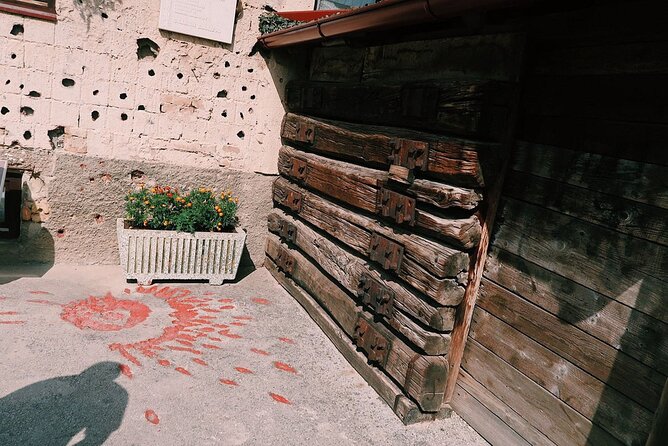
The War Tunnel Museum is the central stop and takes about an hour. The entrance is marked by a Sarajevo Rose, one of the city’s reminders of mortar impacts that were later filled with red resin to mark places where people died.
You first watch a short film. It helps identify the buildings and locations already discussed during the drive. Afterward, the guide gives a presentation covering the breakup of Yugoslavia, the wars in Slovenia and Croatia, the conflict in Bosnia and Herzegovina, and the reason the tunnel became so important.
The tunnel connected besieged Sarajevo with a small area beyond the airport that remained under Bosnian control. It gave the city a narrow route for supplies, weapons, and people while the airport and surrounding hills restricted normal movement.
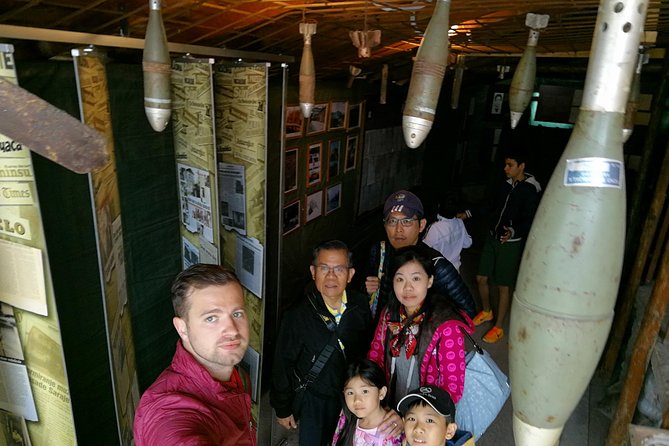
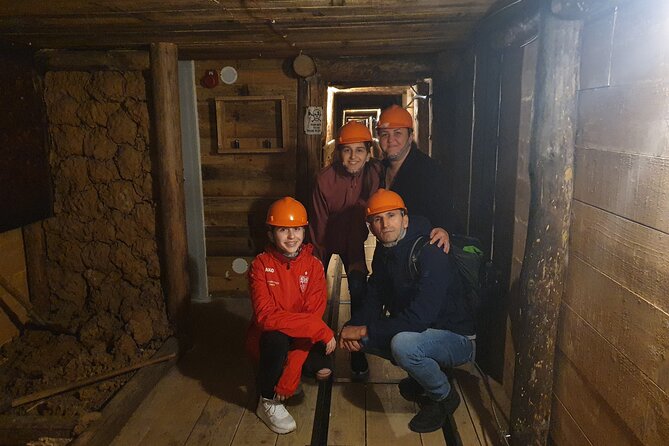
Only a section of the original tunnel is open for visitors. It is not a long underground walk, but the physical space makes the story more immediate. You see the cramped conditions rather than simply hearing that a tunnel existed. The ingenuity behind the project becomes easier to grasp when you consider the city’s need for food, medicine, equipment, and contact with the outside world.
Admission to the museum is not included in the listed tour price. The supplied information does not state the separate fee, so budget for an additional ticket and confirm the current amount when booking. Food is also not included.
Trebević and the view from former front-line positions
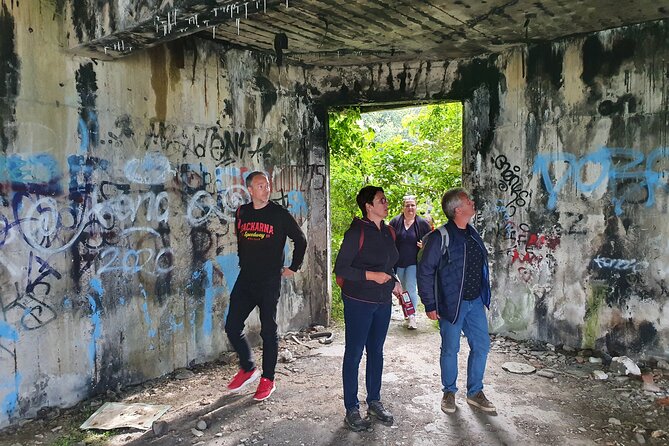
After the museum, the vehicle climbs toward Trebević, the mountain closest to central Sarajevo. The mountain is strongly linked with the 1984 Winter Olympics, but during the siege it also served as a front-line area and offered military positions overlooking the city.
The tour includes time to get out and walk around the area near the former hotel restaurant called 8. The mountain gives you broad views across Sarajevo, including the same general direction from which opposing forces once watched and shelled the city.
The view is one of the tour’s most useful teaching tools. From above, you can see why the city was vulnerable. You also see how close the hills are to the urban center, even though the mood today may feel calm and open.
Some tour descriptions and customer accounts refer to the Olympic bobsled and luge area on Trebević. The exact time available for that part can vary, but the Olympic connection adds another layer to the site. Sarajevo was once known around the world for sport and international cooperation. A few years later, the same mountain was tied to war.
Wear shoes suitable for walking on uneven ground. The tour is not described as strenuous, but it does involve getting out of the vehicle and walking at several locations. The mountain portion may also feel cooler than the city, though no specific weather provision is listed.
The Jewish Cemetery and Yellow Fortress
Below Trebević lies Sarajevo’s Jewish Cemetery, described as the second-largest Jewish cemetery in Europe. Its tombstones have unusual shapes associated with Bosnia and Herzegovina, and some are thought to reflect the form of medieval Bosnian stećak stones.
The cemetery is also connected with the siege. Bullet damage remains visible on some stones, making the location both a cultural site and a physical record of the fighting. Your guide can help you see the cemetery as part of Sarajevo’s long story of different religious and ethnic communities living in the same city.
The next stop is Yellow Fortress, near the old Ottoman part of Sarajevo. From here, you look toward the Soldiers Cemetery and the resting place of Bosnia and Herzegovina’s first president.
This viewpoint brings the tour back toward the historic center. It is a good final stop because you can place many earlier locations within one view: the old city, the valley, the hills, and the routes that made Sarajevo both connected and exposed.
Yellow Fortress is also a reminder that Sarajevo is not only a war destination. The city’s Ottoman past, Jewish heritage, Austro-Hungarian buildings, Olympic identity, and modern civic life all remain part of the same visit.
How the guides shape the experience
The guide is the most important part of this tour. The experience depends less on luxury transport or elaborate museum displays than on how clearly and carefully your guide handles a difficult subject.
The strongest personal accounts come from guides who lived through the war. Adis has described his experience as a young member of the Bosnian forces and later work connected with demining. Other guides have shared memories of growing up in Yugoslavia, living through the siege, or seeing their families affected by the conflict.
Names associated with especially strong tours include Ibrahim, Adnan, Enes, Enis, Mustafa, Haris, Asim, Aid, and Adis. The spelling of some names varies in the supplied information, and the guide is assigned by the operator. You should expect a local guide, but do not book solely to meet one particular person.
The personal approach can make the tour powerful, but it also means the tone may vary. One guide may use more humor and another may focus more closely on military facts or family memories. That variety is normal for a tour built around local experience.
You should also be ready to ask questions. Several guides are described as patient and responsive, and the small groups make it easier to ask about daily life, the city’s ethnic and religious mix, or the transition from Yugoslavia to the present day.
Price, timing, and group size
At approximately $36.28 per person, this is a good-value half-day outing if you want transport between distant sites and an informed guide. The fee includes the driver-guide, air-conditioned vehicle, and hotel pickup for people staying outside Sarajevo’s Old Town.
The price does not include food, hotel drop-off, or admission to the War Tunnel Museum. The tour ends back at the meeting point, so plan your evening from central Sarajevo rather than expecting to be returned to your hotel.
The full experience takes about four hours. That is long enough to cover the main sites without turning the day into a full historical seminar. It is also short enough to fit around a separate Old Town walk, museum visit, or meal.
The maximum group size is 20, though some departures use much smaller vehicles and groups. A reported eight-person van is a comfortable size for this kind of route, while a full minivan could feel less personal. If group size matters to you, ask the operator what vehicle is expected on your date.
Free cancellation is available if you cancel at least 24 hours before the start time. Changes or cancellations inside that window are not accepted for a refund, and the tour requires a minimum number of bookings to operate.
Who should book this Sarajevo tour
I would choose this tour if you want a clear introduction to the Siege of Sarajevo and prefer learning from a local guide rather than piecing the story together alone. It suits first-time visitors, history-minded travelers, and anyone who wants to understand how the city’s hills and roads shaped the war.
It also works well for couples and solo visitors. A solo booking can still operate as a private-feeling experience if no one else has booked that departure, though this cannot be promised. Families can join, but children must be accompanied by an adult, and parents should decide if the subject matter is suitable.
I would not pick it as a light sightseeing excursion. Markale, the Sarajevo Rose, the cemetery, and the tunnel all carry painful associations. The tour can be emotional, especially when a guide describes personal memories.
You should also consider adding a separate Old Town visit. This tour passes through or near historic parts of central Sarajevo, but its focus is the war and the city’s wider historical setting, not a full walking tour of Ottoman streets and major religious buildings.
Should you book the Tunnel Museum tour?
Book it if you want Sarajevo’s recent past explained by someone who understands the city from personal experience. The best reasons are the Tunnel Museum, the mountain viewpoints, the careful route through wartime locations, and the chance to ask questions in a small vehicle.
The main cautions are simple: museum admission costs extra, hotel drop-off is not included, the subject is serious, and you need moderate physical fitness for the walking portions. Confirm the exact central meeting point and expected vehicle before you go.
For about $36.28, the tour gives you four focused hours, transport to places that are awkward to connect on foot, and a human account of one of Europe’s most important recent conflicts. For a first visit to Sarajevo, I consider it a strong choice.
FAQ
How long does the Tunnel Museum tour last?
The tour lasts approximately four hours.
Where does the tour start?
The tour starts in central Sarajevo. The route information identifies the Info Bosnia Tourist Information Center on Ferhadija, beside Sarajevo Meeting of Cultures, while the stated meeting point is Velika avlija, Laure Papo Bahorete 2. Check your booking confirmation for the exact location.
Does the tour include hotel pickup?
Hotel pickup is available for people staying outside Sarajevo’s Old Town.
Does the tour include hotel drop-off?
No. The tour ends back at the meeting point rather than including hotel drop-off.
Is admission to the War Tunnel Museum included?
No. Admission to the War Tunnel Museum is not included in the tour price.
What sites does the tour visit?
The route includes the War Tunnel Museum, Trebević, the Jewish Cemetery, Yellow Fortress, and wartime and historic locations viewed along the drive, including Markale, the Eternal Flame, Sniper Alley, and the National Museum.
Is the tour offered in English?
Yes. The tour is offered in English.
Can children join the tour?
Yes, but children must be accompanied by an adult. The tour also requires a moderate level of physical fitness.
More Museums in Sarajevo
- Cable Car Olympic Tour With Museum
★ 5.0 · 17 reviews - SARAJEVO CONCEPTUAL ART TOUR (galleries, art and arhitecture)
★ 5.0 · 7 reviews - Sarajevo: A City Under Siege – War Tour With Tunnel Museum
★ 5.0 · 4 reviews
Just added around Sarajevo
- Sarajevo Under Siege: A War History Tour★ 5.0 · 10 reviews
- WAR TUNNEL – Sarajevo’s only way of a communication during the WAR – Top secret★ 5.0 · 12 reviews
- Private Full Day Safari Tour★ 5.0 · 8 reviews
- Ultimate Gastro Experience★ 4.5 · 14 reviews
- Mysterious Visoko Pyramids Driving and Walking Tour★ 5.0 · 7 reviews
- Secret Tito’s Bunker/Konjic Tour★ 5.0 · 4 reviews
- The Secret Lifeline: Sarajevo’s War Tunnel Tour★ 5.0 · 6 reviews
- Crossroads of Cultures – Sarajevo Walking Tour★ 5.0 · 8 reviews
Sarajevo War Tunnel Tours, compared.

Fall of Yugoslavia, Sarajevo War Tour with Tunnel of Hope Museum and Frontlines
Read our review →
Sarajevo Grand Tour: Old Town, War Tunnel, Olympic Sites & More
Read our review →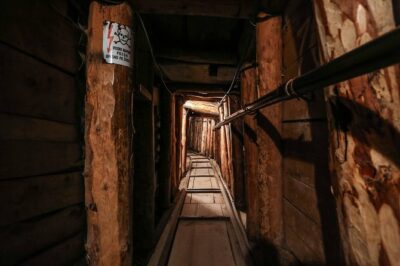
Times of Misfortune – Life Under Siege and the Tunnel of Hope
Read our review →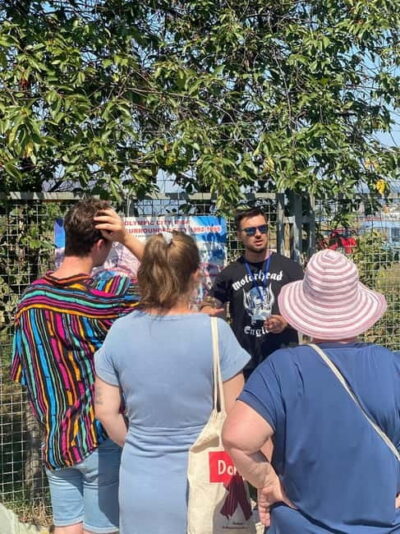
Sarajevo Grand Tour: 5 Hours Old Town, War Tunnel, Olympics
Read our review →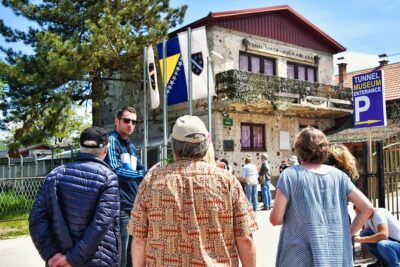
WAR TUNNEL – Sarajevo’s only way of a communication during the WAR – Top secret
Read our review →Browse the lists this tour appears in